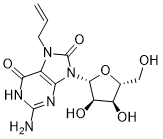
Loxoribine (7-Allyl-8-oxoguanosine; RWJ-21757) is a novel and potent immunostimulant agent acting as an orally bioavailable and selective Toll-like receptor (TLR) 7 agonist. It is a guanosine analog with anti-viral and anti-tumor activities. Loxoribine (7-allyl-7,8-dihydro-8-oxo-guanosine) acts as synthetic adjuvant in anti-tumor responses. Here we first demonstrate that loxoribine activates cells of the innate immune system selectively via the Toll-like receptor (TLR) 7/MyD88-dependent signaling pathway.
Physicochemical Properties
| Molecular Formula | C13H17N5O6 |
| Molecular Weight | 339.3 |
| Exact Mass | 339.118 |
| CAS # | 121288-39-9 |
| PubChem CID | 135410906 |
| Appearance | White to off-white solid powder |
| Density | 1.92g/cm3 |
| Boiling Point | 591.8ºC at 760mmHg |
| Melting Point | 227-230ºC(lit.) |
| Flash Point | 311.7ºC |
| Vapour Pressure | 1.81E-16mmHg at 25°C |
| Index of Refraction | 1.812 |
| LogP | -2.7 |
| Hydrogen Bond Donor Count | 5 |
| Hydrogen Bond Acceptor Count | 7 |
| Rotatable Bond Count | 4 |
| Heavy Atom Count | 24 |
| Complexity | 661 |
| Defined Atom Stereocenter Count | 4 |
| SMILES | C=CCN1C2=C(N=C(NC2=O)N)N(C1=O)[C@H]3[C@@H]([C@@H]([C@H](O3)CO)O)O |
| InChi Key | VDCRFBBZFHHYGT-IOSLPCCCSA-N |
| InChi Code | InChI=1S/C13H17N5O6/c1-2-3-17-6-9(15-12(14)16-10(6)22)18(13(17)23)11-8(21)7(20)5(4-19)24-11/h2,5,7-8,11,19-21H,1,3-4H2,(H3,14,15,16,22)/t5-,7-,8-,11-/m1/s1 |
| Chemical Name | 2-amino-9-[(2R,3R,4S,5R)-3,4-dihydroxy-5-(hydroxymethyl)oxolan-2-yl]-7-prop-2-enyl-1H-purine-6,8-dione |
| Synonyms | Loxoribinum RWJ21757 Loxoribina RWJ-21757 Loxoribine |
| HS Tariff Code | 2934.99.9001 |
| Storage |
Powder-20°C 3 years 4°C 2 years In solvent -80°C 6 months -20°C 1 month |
| Shipping Condition | Room temperature (This product is stable at ambient temperature for a few days during ordinary shipping and time spent in Customs) |
Biological Activity
| ln Vitro | Loxoribine increases the Th-1- and Th-17-polarizing abilities of human monocyte-derived dendritic cells (DCs) and causes them to mature[2]. Up-regulation of CD80, CD83, CD40, CD54, and CCR7 indicates that loxoribine (250 μM; 48 hours) accelerates MoDC maturation[2]. Through the Toll-like receptor (TLR) 7/MyD88-dependent signaling pathway, loxoribine selectively activates innate immune system cells[1]. |
| ln Vivo | In vivo activation of murine natural killer (NK) cells is achieved by loxoribine (2 mg; scor iv)[3]. |
| Animal Protocol |
Animal/Disease Models: 8-12 weeks male CBA/J mice[3] Doses: 2 mg Route of Administration: subcutaneous (sc) or intravenous (iv) injection Experimental Results: activates murine natural killer (NK) cells in vivo. |
| References |
[1]. The Toll-like receptor 7 (TLR7)-specific stimulus loxoribine uncovers a strong relationship within the TLR7, 8 and 9 subfamily. Eur J Immunol. 2003 Nov;33(11):2987-97. [2]. Loxoribine, a selective Toll-like receptor 7 agonist, induces maturation of human monocyte-derived dendritic cells and stimulates their Th-1- and Th-17-polarizing capability. Int Immunopharmacol. 2010 Nov;10(11):1428-33. [3]. In vivo enhancement of murine natural killer cell activity by 7-allyl-8-oxoguanosine (loxoribine). Int J Immunopharmacol. 1992 Nov;14(8):1375-82. |
| Additional Infomation | Loxoribine is a guanine ribonucleotide derivative with immunostimulatory and immunomodulatory activity. Loxoribine undergoes facilitated transport across the plasma membrane into the cytoplasmic compartment of the cell and acts intracellularly, bypassing the biochemical steps involved in the membrane signal transduction pathway used by Ag or anti-IgM Abs to activate B cells. This agent activates the Toll-like receptor 7 (TLR7), a member of the TLR family of pathogen-associated molecular pattern recognition receptors thereby activating the innate immune system. This activation requires endosomal maturation and recognition is restricted to TLR7. As a result, loxoribine induces cycling B cells to proliferate and differentiate non-specifically and recruit antigen-reactive B cells to undergo differentiation to antibody production, markedly amplifying the underlying response in the process. |
Solubility Data
| Solubility (In Vitro) | DMSO : ~100 mg/mL (~294.72 mM) |
| Solubility (In Vivo) |
Solubility in Formulation 1: ≥ 2.5 mg/mL (7.37 mM) (saturation unknown) in 10% DMSO + 40% PEG300 + 5% Tween80 + 45% Saline (add these co-solvents sequentially from left to right, and one by one), clear solution. For example, if 1 mL of working solution is to be prepared, you can add 100 μL of 25.0 mg/mL clear DMSO stock solution to 400 μL PEG300 and mix evenly; then add 50 μL Tween-80 to the above solution and mix evenly; then add 450 μL normal saline to adjust the volume to 1 mL. Preparation of saline: Dissolve 0.9 g of sodium chloride in 100 mL ddH₂ O to obtain a clear solution. Solubility in Formulation 2: ≥ 2.5 mg/mL (7.37 mM) (saturation unknown) in 10% DMSO + 90% (20% SBE-β-CD in Saline) (add these co-solvents sequentially from left to right, and one by one), clear solution. For example, if 1 mL of working solution is to be prepared, you can add 100 μL of 25.0 mg/mL clear DMSO stock solution to 900 μL of 20% SBE-β-CD physiological saline solution and mix evenly. Preparation of 20% SBE-β-CD in Saline (4°C,1 week): Dissolve 2 g SBE-β-CD in 10 mL saline to obtain a clear solution. Solubility in Formulation 3: ≥ 2.5 mg/mL (7.37 mM) (saturation unknown) in 10% DMSO + 90% Corn Oil (add these co-solvents sequentially from left to right, and one by one), clear solution. For example, if 1 mL of working solution is to be prepared, you can add 100 μL of 25.0 mg/mL clear DMSO stock solution to 900 μL of corn oil and mix evenly. (Please use freshly prepared in vivo formulations for optimal results.) |
| Preparing Stock Solutions | 1 mg | 5 mg | 10 mg | |
| 1 mM | 2.9472 mL | 14.7362 mL | 29.4724 mL | |
| 5 mM | 0.5894 mL | 2.9472 mL | 5.8945 mL | |
| 10 mM | 0.2947 mL | 1.4736 mL | 2.9472 mL |