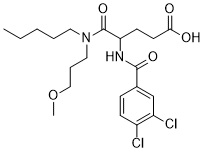
Loxiglumide is a potent, orally bioavailable, and selective CCK-A receptor antagonist which stimulates calorie intake and hunger feelings in humans. Loxiglumide blocks CCK-induced gastric secretions and emptying in addition to inhibiting pancreatic secretion of digestive enzymes. Administering loxiglumide intravenously counteracted the effects of CCK on various physiological processes, including decreased gastric emptying in rats, accelerated intestinal transport in mice, increased ileal motility in rabbits, gallbladder contraction in guinea pigs, and accelerated gallbladder emptying in mice.
Physicochemical Properties
| Molecular Formula | C21H30CL2N2O5 |
| Molecular Weight | 461.38 |
| Exact Mass | 460.153 |
| Elemental Analysis | C, 54.67; H, 6.55; Cl, 15.37; N, 6.07; O, 17.34 |
| CAS # | 107097-80-3 |
| Related CAS # | 107097-80-3 |
| PubChem CID | 60182 |
| Appearance | White to off-white solid powder |
| Density | 1.233g/cm3 |
| Boiling Point | 632.2ºC at 760mmHg |
| Flash Point | 336.1ºC |
| Vapour Pressure | 7.51E-17mmHg at 25°C |
| Index of Refraction | 1.537 |
| LogP | 4.402 |
| Hydrogen Bond Donor Count | 2 |
| Hydrogen Bond Acceptor Count | 5 |
| Rotatable Bond Count | 14 |
| Heavy Atom Count | 30 |
| Complexity | 550 |
| Defined Atom Stereocenter Count | 0 |
| SMILES | O=C(O)CCC(NC(C1=CC=C(Cl)C(Cl)=C1)=O)C(N(CCCOC)CCCCC)=O |
| InChi Key | QNQZBKQEIFTHFZ-UHFFFAOYSA-N |
| InChi Code | InChI=1S/C21H30Cl2N2O5/c1-3-4-5-11-25(12-6-13-30-2)21(29)18(9-10-19(26)27)24-20(28)15-7-8-16(22)17(23)14-15/h7-8,14,18H,3-6,9-13H2,1-2H3,(H,24,28)(H,26,27) |
| Chemical Name | 4-[(3,4-dichlorobenzoyl)amino]-5-[3-methoxypropyl(pentyl)amino]-5-oxopentanoic acid |
| Synonyms | CR-1505; CR 1505; CR1505; Loxiglumide; Loxizin |
| HS Tariff Code | 2934.99.9001 |
| Storage |
Powder-20°C 3 years 4°C 2 years In solvent -80°C 6 months -20°C 1 month |
| Shipping Condition | Room temperature (This product is stable at ambient temperature for a few days during ordinary shipping and time spent in Customs) |
Biological Activity
| Targets | CCK-1 receptor |
| ln Vivo | The effects of oral CCK-1 receptor antagonist Loxiglumide administration on pancreatic rest and pancreas stimulation are examined using endogenous CCK release induced by po protease inhibitor capostat on the recovery of pancreatic secretory function and on the biochemical and histological alterations in the pancreas following acute hemorrhagic pancreatitis. Loxiglumide, a CCK-1 receptor antagonist, when taken orally at a dose of 50 mg/kg body weight, inhibits pancreatic exocrine secretion for a duration exceeding 12 hours. As a result, every 12-hour dose of loxiglumide may totally prevent the pancreas from being affected by endogenously released CCK (pancreatic rest)[1]. |
| Animal Protocol | Rats: Rats receiving standard rat chow (AP-C), standard rat chow with pancreatic rest (AP-R), standard rat chow with pancreatic stimulation (AP-S), and standard rat chow with pancreatic rest followed by pancreatic stimulation (AP-R/S) are split into four treatment groups 24 hours after the induction of acute hemorrhagic pancreatitis. The rats in the AP-C group are given 2 mL/kg body weight saline orally (po) via an orogastric tube twice a day (09:00 and 21:00 h) for ten days; the rats in the AP-R group are given 50 mg/kg body weight of CCK-1 receptor antagonist Loxiglumide dissolved in 2 mL distilled water po twice a day for ten days; the rats in the AP-S group are given 25 mg/kg body weight of protease inhibitor Camostat, which is known to stimulate endogenous CCK release, dissolved in 2 mL distilled water po twice a day for 10 days; and the rats in the AP-R/S group are given 50 mg/kg body weight Loxiglumide twice a day for the first five days, followed by 25 mg/kg body weight camostat twice a day for the remaining five days. Rats are given unlimited food. Histological analysis and pancreatic exocrine function tests are carried out on day 12, 24 hours following the final treatment and overnight fast. |
| References |
[1]. Effect of endogenous cholecystokinin on the course of acute pancreatitis in rats. World J Gastroenterol. 2015 Jul 7;21(25):7742-53. |
| Additional Infomation | Loxiglumide is an organic molecular entity. |
Solubility Data
| Solubility (In Vitro) | DMSO: ≥ 100 mg/mL (~216.7 mM) |
| Solubility (In Vivo) |
Solubility in Formulation 1: ≥ 2.5 mg/mL (5.42 mM) (saturation unknown) in 10% DMSO + 40% PEG300 + 5% Tween80 + 45% Saline (add these co-solvents sequentially from left to right, and one by one), clear solution. For example, if 1 mL of working solution is to be prepared, you can add 100 μL of 25.0 mg/mL clear DMSO stock solution to 400 μL PEG300 and mix evenly; then add 50 μL Tween-80 to the above solution and mix evenly; then add 450 μL normal saline to adjust the volume to 1 mL. Preparation of saline: Dissolve 0.9 g of sodium chloride in 100 mL ddH₂ O to obtain a clear solution. Solubility in Formulation 2: ≥ 2.5 mg/mL (5.42 mM) (saturation unknown) in 10% DMSO + 90% Corn Oil (add these co-solvents sequentially from left to right, and one by one), clear solution. For example, if 1 mL of working solution is to be prepared, you can add 100 μL of 25.0 mg/mL clear DMSO stock solution to 900 μL of corn oil and mix evenly. (Please use freshly prepared in vivo formulations for optimal results.) |
| Preparing Stock Solutions | 1 mg | 5 mg | 10 mg | |
| 1 mM | 2.1674 mL | 10.8371 mL | 21.6741 mL | |
| 5 mM | 0.4335 mL | 2.1674 mL | 4.3348 mL | |
| 10 mM | 0.2167 mL | 1.0837 mL | 2.1674 mL |