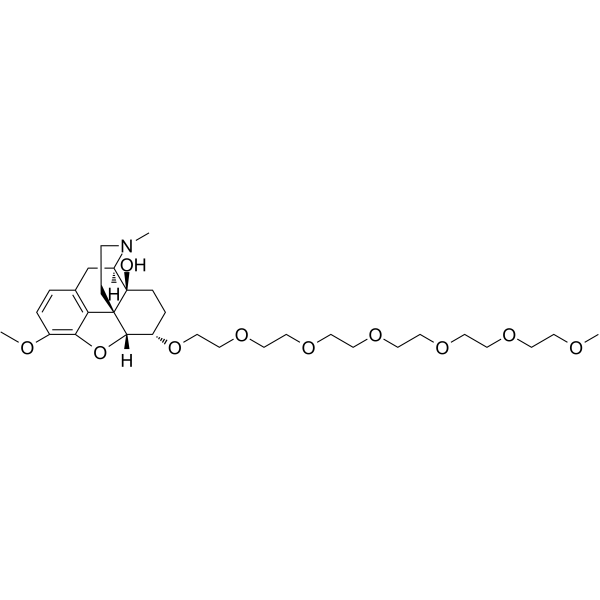
Physicochemical Properties
| Molecular Formula | C31H49NO10 |
| Molecular Weight | 595.721470594406 |
| Exact Mass | 595.335 |
| CAS # | 1211231-76-3 |
| Related CAS # | 1415126-69-0 (phosphate); 1211231-85-4 (trifluoroacetate); 1211231-53-6 (HCl); 1211231-76-3; |
| PubChem CID | 73673720 |
| Appearance | Typically exists as solid at room temperature |
| Density | 1.2±0.1 g/cm3 |
| Boiling Point | 679.2±55.0 °C at 760 mmHg |
| Flash Point | 364.6±31.5 °C |
| Vapour Pressure | 0.0±2.2 mmHg at 25°C |
| Index of Refraction | 1.560 |
| LogP | -0.49 |
| Hydrogen Bond Donor Count | 1 |
| Hydrogen Bond Acceptor Count | 11 |
| Rotatable Bond Count | 20 |
| Heavy Atom Count | 42 |
| Complexity | 808 |
| Defined Atom Stereocenter Count | 5 |
| SMILES | O1C2=C(C=CC3C[C@@H]4[C@@]5(CC[C@@H]([C@H]1[C@@]5(C=32)CCN4C)OCCOCCOCCOCCOCCOCCOC)O)OC |
| InChi Key | RQHILGKAOIGUHU-XPLSERNMSA-N |
| InChi Code | InChI=1S/C31H49NO10/c1-32-9-8-30-27-23-4-5-24(35-3)28(27)42-29(30)25(6-7-31(30,33)26(32)22-23)41-21-20-40-19-18-39-17-16-38-15-14-37-13-12-36-11-10-34-2/h4-5,25-26,29,33H,6-22H2,1-3H3/t25-,26+,29-,30-,31+/m0/s1 |
| Chemical Name | (4R,4aS,7S,7aR,12bS)-9-methoxy-7-[2-[2-[2-[2-[2-(2-methoxyethoxy)ethoxy]ethoxy]ethoxy]ethoxy]ethoxy]-3-methyl-1,2,4,5,6,7,7a,13-octahydro-4,12-methanobenzofuro[3,2-e]isoquinolin-4a-ol |
| HS Tariff Code | 2934.99.9001 |
| Storage |
Powder-20°C 3 years 4°C 2 years In solvent -80°C 6 months -20°C 1 month |
| Shipping Condition | Room temperature (This product is stable at ambient temperature for a few days during ordinary shipping and time spent in Customs) |
Biological Activity
| ADME/Pharmacokinetics |
Absorption, Distribution and Excretion Loxicodegol has a Tmax of 1.8h and a bioavailability of 34% with oral administration. It enters the brain about 17-70 times more slowly than oxycodone. Loxicodegol is also a p-glycoprotein substrate further reducing its transport into the brain. Loxicodegol has a steady-state Vd of 4.19 L/kg. Loxicodegol has a clearance rate of 59.3 mL/min/kg. Biological Half-Life Loxicodegol has a half-life of 4.53 h allowing for a longer duration of action. |
| References |
[1]. NKTR-181: A Novel Mu-Opioid Analgesic with Inherently Low Abuse Potential. J Pharmacol Exp Ther. 2017;363(1):104-113. [2]. Long-term Safety and Tolerability of NKTR-181 in Patients with Moderate to Severe Chronic Low Back Pain or Chronic Noncancer Pain: A Phase 3 Multicenter, Open-Label, 52-Week Study (SUMMIT-08 LTS). Pain Med. 2020;21(7):1347-1356. |
| Additional Infomation |
Loxicodegol was developed by Nektar Therapeutics as an opioid analgesic with low abuse potential for the treatment of chronic pain. The lack of abuse potential is believed to be due to the drug's slow rate of entry into brain, a unique characteristic compared to others in the opioid class. This is also thought to be the reason behind the reduced frequency of CNS-mediated adverse effects, like sedation, seen with Loxicodegol. Nektar Therapeutics has filed an application for FDA approval of Loxicodegol for use in the treatment of chronic lower back pain Drug Indication Loxicodegol was developed as an opioid analgesic with low abuse potential for use in treating chronic pain. An application has been filed for FDA approval of Loxicodegol for use in treating chronic lower back pain. Mechanism of Action Loxicodegol is a full agonist at the μ-opioid receptor. It also displays selectivity towards this subtype with an affinity of 237 nM compared to 4150 nM and >100000 nM for the δ- and κ-opioid receptors. The μ-opioid receptor is activated with an EC₅₀ of 12.5 μM. Activation of this receptor produces an inhibitory effect on neurotransmission through Gi/Go coupling. Opioid medications like Loxicodegol inhibit voltage gated Ca²⁺ channel opening presynaptically on C fibres and activate inward-rectifying K⁺ channels post-synaptically on 2nd order neurons, leading to hyperpolarization. Together, these prevent the nociceptive signal from traveling up the spinal cord to the brain. In the brain, opioids work through a mechanism of inhibition of inhibition to allow regulatory neurons to suppress nociception. Pharmacodynamics Loxicodegol displays full analgesic activity comparable to that of oxycodone, producing similar acetone-writhing test responses in mice and hot-plate test maximal latencies in rats. The safety profile of Loxicodegol is much improved from that of other opioid analgesics. The incidence of respiratory depression and sedation is reduced compared to oxycodone and morphine. Generalized pruritus occurred in 7.3% and 4.9% of subjects at 200mg and 400mg of Loxicodegol compared to 41.5% with 40mg oxycodone. Nausea occurred in 2.5%, 2.4%, and 7.3% with 100mg, 200mg, and 400mg of Loxecodegol compared to 29.3% with 40mg oxycodone. Lastly, vomiting occurred in 2.4% with both 200mg and 400mg Loxicodegol compared to 24.4% with 40mg oxycodone. Loxicodegol is much less addictive than other opioid analgesics. It produces a only a slight high at dosages of 400mg, peaking at scores only 25% that of oxycodone, with no difference compared to placebo at lower dosages. No differences have been noted between Loxicodegol and saline in self-administration or behavior reinforcement in monkeys or rats |
Solubility Data
| Solubility (In Vitro) | May dissolve in DMSO (in most cases), if not, try other solvents such as H2O, Ethanol, or DMF with a minute amount of products to avoid loss of samples |
| Solubility (In Vivo) |
Note: Listed below are some common formulations that may be used to formulate products with low water solubility (e.g. < 1 mg/mL), you may test these formulations using a minute amount of products to avoid loss of samples. Injection Formulations (e.g. IP/IV/IM/SC) Injection Formulation 1: DMSO : Tween 80: Saline = 10 : 5 : 85 (i.e. 100 μL DMSO stock solution → 50 μL Tween 80 → 850 μL Saline) *Preparation of saline: Dissolve 0.9 g of sodium chloride in 100 mL ddH ₂ O to obtain a clear solution. Injection Formulation 2: DMSO : PEG300 :Tween 80 : Saline = 10 : 40 : 5 : 45 (i.e. 100 μL DMSO → 400 μLPEG300 → 50 μL Tween 80 → 450 μL Saline) Injection Formulation 3: DMSO : Corn oil = 10 : 90 (i.e. 100 μL DMSO → 900 μL Corn oil) Example: Take the Injection Formulation 3 (DMSO : Corn oil = 10 : 90) as an example, if 1 mL of 2.5 mg/mL working solution is to be prepared, you can take 100 μL 25 mg/mL DMSO stock solution and add to 900 μL corn oil, mix well to obtain a clear or suspension solution (2.5 mg/mL, ready for use in animals). Injection Formulation 4: DMSO : 20% SBE-β-CD in saline = 10 : 90 [i.e. 100 μL DMSO → 900 μL (20% SBE-β-CD in saline)] *Preparation of 20% SBE-β-CD in Saline (4°C,1 week): Dissolve 2 g SBE-β-CD in 10 mL saline to obtain a clear solution. Injection Formulation 5: 2-Hydroxypropyl-β-cyclodextrin : Saline = 50 : 50 (i.e. 500 μL 2-Hydroxypropyl-β-cyclodextrin → 500 μL Saline) Injection Formulation 6: DMSO : PEG300 : castor oil : Saline = 5 : 10 : 20 : 65 (i.e. 50 μL DMSO → 100 μLPEG300 → 200 μL castor oil → 650 μL Saline) Injection Formulation 7: Ethanol : Cremophor : Saline = 10: 10 : 80 (i.e. 100 μL Ethanol → 100 μL Cremophor → 800 μL Saline) Injection Formulation 8: Dissolve in Cremophor/Ethanol (50 : 50), then diluted by Saline Injection Formulation 9: EtOH : Corn oil = 10 : 90 (i.e. 100 μL EtOH → 900 μL Corn oil) Injection Formulation 10: EtOH : PEG300:Tween 80 : Saline = 10 : 40 : 5 : 45 (i.e. 100 μL EtOH → 400 μLPEG300 → 50 μL Tween 80 → 450 μL Saline) Oral Formulations Oral Formulation 1: Suspend in 0.5% CMC Na (carboxymethylcellulose sodium) Oral Formulation 2: Suspend in 0.5% Carboxymethyl cellulose Example: Take the Oral Formulation 1 (Suspend in 0.5% CMC Na) as an example, if 100 mL of 2.5 mg/mL working solution is to be prepared, you can first prepare 0.5% CMC Na solution by measuring 0.5 g CMC Na and dissolve it in 100 mL ddH2O to obtain a clear solution; then add 250 mg of the product to 100 mL 0.5% CMC Na solution, to make the suspension solution (2.5 mg/mL, ready for use in animals). Oral Formulation 3: Dissolved in PEG400 Oral Formulation 4: Suspend in 0.2% Carboxymethyl cellulose Oral Formulation 5: Dissolve in 0.25% Tween 80 and 0.5% Carboxymethyl cellulose Oral Formulation 6: Mixing with food powders Note: Please be aware that the above formulations are for reference only. InvivoChem strongly recommends customers to read literature methods/protocols carefully before determining which formulation you should use for in vivo studies, as different compounds have different solubility properties and have to be formulated differently. (Please use freshly prepared in vivo formulations for optimal results.) |
| Preparing Stock Solutions | 1 mg | 5 mg | 10 mg | |
| 1 mM | 1.6786 mL | 8.3932 mL | 16.7864 mL | |
| 5 mM | 0.3357 mL | 1.6786 mL | 3.3573 mL | |
| 10 mM | 0.1679 mL | 0.8393 mL | 1.6786 mL |