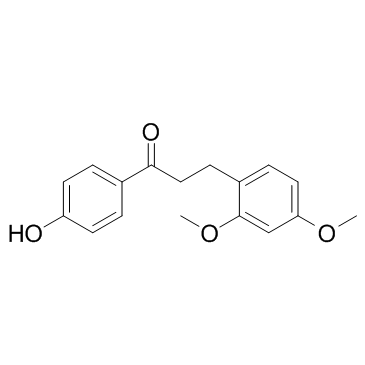
Loureirin A, a naturally occurring di-hydrochalcone/flavonoid isolated from Dragon's Blood, can inhibit Akt phosphorylation and has antiplatelet activity. It has been used to promote blood circulation and remove stasis in Chinese traditional medicine.
Physicochemical Properties
| Molecular Formula | C17H18O4 |
| Molecular Weight | 286.3224 |
| Exact Mass | 286.12 |
| CAS # | 119425-89-7 |
| PubChem CID | 5319081 |
| Appearance | White to off-white solid powder |
| Density | 1.2±0.1 g/cm3 |
| Boiling Point | 479.1±40.0 °C at 760 mmHg |
| Flash Point | 175.8±20.8 °C |
| Vapour Pressure | 0.0±1.2 mmHg at 25°C |
| Index of Refraction | 1.573 |
| LogP | 3.3 |
| Hydrogen Bond Donor Count | 1 |
| Hydrogen Bond Acceptor Count | 4 |
| Rotatable Bond Count | 6 |
| Heavy Atom Count | 21 |
| Complexity | 323 |
| Defined Atom Stereocenter Count | 0 |
| InChi Key | RSAIVLRELNGZEY-UHFFFAOYSA-N |
| InChi Code | InChI=1S/C17H18O4/c1-20-15-9-5-13(17(11-15)21-2)6-10-16(19)12-3-7-14(18)8-4-12/h3-5,7-9,11,18H,6,10H2,1-2H3 |
| Chemical Name | 3-(2,4-dimethoxyphenyl)-1-(4-hydroxyphenyl)propan-1-one |
| HS Tariff Code | 2934.99.9001 |
| Storage |
Powder-20°C 3 years 4°C 2 years In solvent -80°C 6 months -20°C 1 month |
| Shipping Condition | Room temperature (This product is stable at ambient temperature for a few days during ordinary shipping and time spent in Customs) |
Biological Activity
| Targets | Akt (protein kinase B) phosphorylation at Ser473, downstream of the PI3K signaling pathway [1] |
| ln Vitro |
In a dose-dependent manner, loureirin A (50 μM, 100 μM) suppresses the release of platelet ATP produced by collagen and the expression of P-selectin activated by thrombin. Additionally, with immobilized fibrinogen, loureirin A dramatically reduces platelet spreading. At a dosage of 100 μM, luminirin A nearly entirely removes collagen-induced Akt phosphorylation at Ser473, and at 50 μM, it exhibits an additive inhibitory effect when combined with the phosphoinositide 3-kinase (PI3K) inhibitor Ly294002 on collage-induced Akt phosphorylation in platelets[1]. Loureirin A dose-dependently inhibited platelet aggregation induced by collagen (50 μM: 77.9±2.3%; 100 μM: 15.2±6.2% of control), collagen-related peptide (CRP), ADP, and thrombin [1] It inhibited collagen-induced ATP secretion from platelet dense granules (50 μM: 29.7±4.0%; 100 μM: 11.6±3.1% of control) [1] Loureirin A inhibited thrombin-stimulated P-selectin expression on the platelet surface, a marker of α-granule release (100 μM: 59.0±3.3%; 300 μM: 15.0±2.3% of control) [1] It significantly impaired human platelet spreading on immobilized fibrinogen, reducing platelet surface area (50 μM: 28.4±6.5 μm²; 100 μM: 20.1±7.3 μm² vs. control) and altering morphology (more filopodia, less lamellipodia) [1] Western blot analysis showed that 100 μM Loureirin A almost completely eliminated collagen-induced Akt phosphorylation at Ser473, but did not affect JNK phosphorylation [1] A submaximal dose (50 μM) of Loureirin A had an additive inhibitory effect with the PI3K inhibitor LY294002 on collagen-induced Akt phosphorylation in platelets [1] |
| Cell Assay |
Platelet Aggregation and Secretion Assay: Washed mouse platelets (3×10⁸/ml) in Tyrode's buffer containing 1 mM CaCl₂ were preincubated with Loureirin A or vehicle (0.33% DMSO) for 5 minutes at room temperature. Agonists (collagen, CRP, ADP, or thrombin) were then added to stimulate aggregation, which was measured using a lumi-aggregometer. For ATP secretion measurement, luciferin-luciferase reagent was added prior to agonist stimulation to record ATP release [1] P-selectin Expression Assay (Flow Cytometry): Washed mouse platelets were preincubated with Loureirin A or vehicle and then stimulated with thrombin. Fluorescein isothiocyanate (FITC)-labeled anti-mouse CD62P antibody was added, and platelet surface P-selectin expression was analyzed using flow cytometry [1] Platelet Spreading Assay: Washed human platelets (2×10⁷/ml) in Tyrode's buffer containing 1 mM CaCl₂ and 5 mM MnCl₂ were preincubated with Loureirin A or vehicle for 5 minutes. The platelets were then allowed to adhere and spread on cover glasses coated with fibrinogen (25 μg/ml) for 45 minutes at room temperature. Non-adherent platelets were removed by washing. Adherent platelets were fixed with 4% paraformaldehyde, permeabilized with 0.1% Triton X-100, and stained with TRITC-conjugated phalloidin (1 μg/ml) to visualize F-actin. Platelet spreading was observed using a fluorescence microscope, and platelet surface areas were quantified using image analysis software [1] Western Blot Analysis: Washed mouse platelets were preincubated with Loureirin A or vehicle for 5 minutes and then stimulated with collagen for 3 minutes. The reaction was stopped by adding an equal volume of lysis buffer containing protease and phosphatase inhibitors. Proteins were separated by SDS-PAGE, transferred to PVDF membranes, and probed with specific antibodies against phospho-Akt (Ser473), total Akt, phospho-JNK (Thr183/Tyr185), and total JNK. Protein bands were detected using a chemiluminescence imaging system [1] |
| References |
[1]. Antiplatelet activity of loureirin A by attenuating Akt phosphorylation: In vitro studies. Eur J Pharmacol. 2015 Jan 5;746:63-9. |
| Additional Infomation |
Loureirin A has been reported in Dracaena cochinchinensis, Soymida febrifuga, and Garcinia dulcis with data available. Loureirin A is a flavonoid extracted from Dragon's Blood (a traditional Chinese medicinal resin), used historically to promote blood circulation and remove stasis [1] The study suggests that the antiplatelet mechanism of Loureirin A involves impairment of the PI3K/Akt signaling pathway, which is crucial for platelet activation, aggregation, and integrin αIIbβ3 outside-in signaling [1] The study used relatively high concentrations of Loureirin A (50-300 μM) in in vitro experiments, and the authors note that the effective dose may differ across species and that in vivo efficacy requires further investigation [1] |
Solubility Data
| Solubility (In Vitro) | DMSO : ≥ 86.6 mg/mL (~302.46 mM) |
| Solubility (In Vivo) |
Solubility in Formulation 1: ≥ 2.08 mg/mL (7.26 mM) (saturation unknown) in 10% DMSO + 40% PEG300 + 5% Tween80 + 45% Saline (add these co-solvents sequentially from left to right, and one by one), clear solution. For example, if 1 mL of working solution is to be prepared, you can add 100 μL of 20.8 mg/mL clear DMSO stock solution to 400 μL PEG300 and mix evenly; then add 50 μL Tween-80 to the above solution and mix evenly; then add 450 μL normal saline to adjust the volume to 1 mL. Preparation of saline: Dissolve 0.9 g of sodium chloride in 100 mL ddH₂ O to obtain a clear solution. Solubility in Formulation 2: ≥ 2.08 mg/mL (7.26 mM) (saturation unknown) in 10% DMSO + 90% (20% SBE-β-CD in Saline) (add these co-solvents sequentially from left to right, and one by one), clear solution. For example, if 1 mL of working solution is to be prepared, you can add 100 μL of 20.8 mg/mL clear DMSO stock solution to 900 μL of 20% SBE-β-CD physiological saline solution and mix evenly. Preparation of 20% SBE-β-CD in Saline (4°C,1 week): Dissolve 2 g SBE-β-CD in 10 mL saline to obtain a clear solution. Solubility in Formulation 3: ≥ 2.08 mg/mL (7.26 mM) (saturation unknown) in 10% DMSO + 90% Corn Oil (add these co-solvents sequentially from left to right, and one by one), clear solution. For example, if 1 mL of working solution is to be prepared, you can add 100 μL of 20.8 mg/mL clear DMSO stock solution to 900 μL of corn oil and mix evenly. (Please use freshly prepared in vivo formulations for optimal results.) |
| Preparing Stock Solutions | 1 mg | 5 mg | 10 mg | |
| 1 mM | 3.4926 mL | 17.4630 mL | 34.9260 mL | |
| 5 mM | 0.6985 mL | 3.4926 mL | 6.9852 mL | |
| 10 mM | 0.3493 mL | 1.7463 mL | 3.4926 mL |