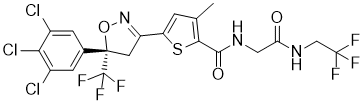
Lotilaner (Credelio; Xdemvy)) is a potent insecticide agent (veterinary drug) acting as a non-competitive antagonist of insect GABA receptors. Lotilaner (Xdemvy) was approved in 2023 by FDA for treating Demodex blepharitis.
Physicochemical Properties
| Molecular Formula | C20H14CL3F6N3O3S |
| Molecular Weight | 596.757881641388 |
| Exact Mass | 594.973 |
| Elemental Analysis | C, 40.25; H, 2.36; Cl, 17.82; F, 19.10; N, 7.04; O, 8.04; S, 5.37 |
| CAS # | 1369852-71-0 |
| PubChem CID | 76959255 |
| Appearance | White to off-white solid powder |
| LogP | 6.224 |
| Hydrogen Bond Donor Count | 2 |
| Hydrogen Bond Acceptor Count | 11 |
| Rotatable Bond Count | 6 |
| Heavy Atom Count | 36 |
| Complexity | 868 |
| Defined Atom Stereocenter Count | 1 |
| SMILES | CC1=C(SC(=C1)C2=NO[C@@](C2)(C3=CC(=C(C(=C3)Cl)Cl)Cl)C(F)(F)F)C(=O)NCC(=O)NCC(F)(F)F |
| InChi Key | HDKWFBCPLKNOCK-SFHVURJKSA-N |
| InChi Code | InChI=1S/C20H14Cl3F6N3O3S/c1-8-2-13(36-16(8)17(34)30-6-14(33)31-7-19(24,25)26)12-5-18(35-32-12,20(27,28)29)9-3-10(21)15(23)11(22)4-9/h2-4H,5-7H2,1H3,(H,30,34)(H,31,33)/t18-/m0/s1 |
| Chemical Name | 3-methyl-N-[2-oxo-2-(2,2,2-trifluoroethylamino)ethyl]-5-[(5S)-5-(3,4,5-trichlorophenyl)-5-(trifluoromethyl)-4H-1,2-oxazol-3-yl]thiophene-2-carboxamide |
| Synonyms | Lotilaner; 1369852-71-0; Credelio; XDEMVY; lotilanerum; Xdemvy |
| HS Tariff Code | 2934.99.9001 |
| Storage |
Powder-20°C 3 years 4°C 2 years In solvent -80°C 6 months -20°C 1 month |
| Shipping Condition | Room temperature (This product is stable at ambient temperature for a few days during ordinary shipping and time spent in Customs) |
Biological Activity
| Targets | GABA receptors |
| ln Vitro | The IC50 values of lotilaner for the GABACl receptors of Drosophila dieldrin/flupron formaldehyde-resistant form (DmR2), Lepeophtheirus Salmonis (Ls), and Rhipicephalus microplus (Rm) are 38.25 ± 3.75, 52.40 ± 4.54, and 36.79 ± 4.39 nM, respectively [1 ‑. |
| ln Vivo |
For the treatment of flea and tick infestations. Fleas and ticks must attach to the host and commence feeding in order to be exposed to the active substance. The veterinary medicinal product can be used as part of a treatment strategy for the control of flea allergy dermatitis (FAD). DogsThis veterinary medicinal product provides immediate and persistent killing activity for 1 month for fleas (Ctenocephalides felis and C. canis) and ticks (Rhipicephalus sanguineus, Ixodes ricinus, I. hexagonus and Dermacentor reticulatus). CatsThis veterinary medicinal product provides immediate and persistent killing activity for 1 month against fleas (Ctenocephalides felis and C. canis) and ticks (Ixodes ricinus).
Lotilaner is an ectoparasiticide that is a member of the isoxazoline family of compounds. Lotilaner has largely been used for veterinary uses as an antiparasitic agent to treat flea and tick infestations in animals. Lotilaner consists of two enantiomers: the S-enantiomer is active in vivo, while the R-enantiomer is reported to exhibit low biological activity. The active ingredient found in drug products of lotilaner is the S-enantiomer. On July 25, 2023, lotilaner was approved by the FDA for the treatment of Demodex blepharitis, making it the first and only approved therapeutic for this condition. Lotilaner is an Ectoparasiticide. LOTILANER is a small molecule drug with a maximum clinical trial phase of IV (across all indications) that was first approved in 2017 and is indicated for eye infection and has 2 investigational indications. |
| ADME/Pharmacokinetics |
Absorption, Distribution and Excretion Tmax is about two hours after a single ocular administration on Day 1 and one hour after the last drug administration on Day 42. In healthy subjects, the peak concentration (Cmax) in whole blood increased after 42 days of repeated ocular administration, from 0.596 to 17.8 ng/mL. The total exposure (AUC0-12) also increased from 5.75 to 149 hr x ng/mL. In patients with Demodex blepharitis who received lotilaner twice daily for 42 days, the mean systemic exposure at the end of treatment was 12.0 ng/mL, with a range of 0.4-46.1 ng/mL. No information is available. No information is available. No information is available. Metabolism / Metabolites In cats, mininal metabolism of lotilaner was observed. Lotilaner is not metabolized by CYP enzymes. Biological Half-Life The effective half-life in healthy subjects, which is based on the accumulation ratio over the dosing interval of 12 hours, is 264 hours (11 days). |
| Toxicity/Toxicokinetics |
Protein Binding Lotilaner plasma protein binding is high (> 99.9%) in human plasma. The partitioning of lotilaner to human blood cells is approximately 10% (range 0-20%). |
| References |
[1]. The novel isoxazoline ectoparasiticide lotilaner (Credelio™): a non-competitive antagonist specific to invertebrates γ-aminobutyric acid-gated chloride channels (GABACls). Parasit Vectors. 2017 Nov 1;10(1):530. |
| Additional Infomation |
Lotilaner is a member of the class of isoxazoles that is 4,5-dihydro-1,2-oxazole substituted by 4-methyl-5-({2-oxo-2-[(2,2,2-trifluoroethyl)amino]ethyl}carbamoyl)thiophen-2-yl, trifluoromethyl, and 3,4,5-trichlorophenyl groups at positions 3, 5 and 5, respectively (the 5S-stereoisomer). It is a gamma-aminobutyric acid (GABA)-gated chloride channel inhibitor selective for mites, approved for the treatment of Demodex blepharitis. It has a role as a GABA-gated chloride channel antagonist, an ophthalmology drug and an ectoparasiticide. It is a trichlorobenzene, a member of isoxazoles, an organofluorine compound, a member of thiophenes and a secondary carboxamide. Lotilaner is an ectoparasiticide that is a member of the isoxazoline family of compounds. Lotilaner has largely been used for veterinary uses as an antiparasitic agent to treat flea and tick infestations in animals. Lotilaner consists of two enantiomers: the S-enantiomer is active in vivo, while the R-enantiomer is reported to exhibit low biological activity. The active ingredient found in drug products of lotilaner is the S-enantiomer. On July 25, 2023, lotilaner was approved by the FDA for the treatment of Demodex blepharitis, making it the first and only approved therapeutic for this condition. Lotilaner is an Ectoparasiticide. Drug Indication Lotilaner is indicated for the treatment of Demodex blepharitis. For the treatment of flea and tick infestations. Fleas and ticks must attach to the host and commence feeding in order to be exposed to the active substance. The veterinary medicinal product can be used as part of a treatment strategy for the control of flea allergy dermatitis (FAD). DogsThis veterinary medicinal product provides immediate and persistent killing activity for 1 month for fleas (Ctenocephalides felis and C. canis) and ticks (Rhipicephalus sanguineus, Ixodes ricinus, I. hexagonus and Dermacentor reticulatus). CatsThis veterinary medicinal product provides immediate and persistent killing activity for 1 month against fleas (Ctenocephalides felis and C. canis) and ticks (Ixodes ricinus). Mechanism of Action Lotilaner is a non-competitive antagonist of the gamma-aminobutyric acid (GABA)-gated chloride channel (GABACl) selective for mites. Inhibition of GABACl causes a paralytic action in the target organism, leading to death. Lotilaner is not an inhibitor of mammalian GABA-mediated chloride channels when tested at up to 30 µM (18 µg/mL) _in vitro_, which is approximately 1100 times the recommended human ophthalmic dose. The target site in GABACl is hypothesized to be localized in a pore between the T9’ to S15’ region, an interstitial subunit region. A study suggested that lotilaner may migrate within the pore of the GABACl to its final location to stabilize the channel in a closed state; however, this hypothesis requires further investigation. Pharmacodynamics Lotilaner is a parasiticide that works against Demodex mites that cause Demodex blepharitis. It is also active against insects, ticks, and lice. Its activity is arthropod-specific, as it does not bind to the same therapeutic target in mammals. |
Solubility Data
| Solubility (In Vitro) | DMSO : ≥ 100 mg/mL (~167.57 mM) |
| Solubility (In Vivo) |
Solubility in Formulation 1: ≥ 2.5 mg/mL (4.19 mM) (saturation unknown) in 10% DMSO + 40% PEG300 + 5% Tween80 + 45% Saline (add these co-solvents sequentially from left to right, and one by one), clear solution. For example, if 1 mL of working solution is to be prepared, you can add 100 μL of 25.0 mg/mL clear DMSO stock solution to 400 μL PEG300 and mix evenly; then add 50 μL Tween-80 to the above solution and mix evenly; then add 450 μL normal saline to adjust the volume to 1 mL. Preparation of saline: Dissolve 0.9 g of sodium chloride in 100 mL ddH₂ O to obtain a clear solution. Solubility in Formulation 2: ≥ 2.08 mg/mL (3.49 mM) (saturation unknown) in 10% DMSO + 90% Corn Oil (add these co-solvents sequentially from left to right, and one by one), clear solution. For example, if 1 mL of working solution is to be prepared, you can add 100 μL of 20.8 mg/mL clear DMSO stock solution to 900 μL of corn oil and mix evenly. (Please use freshly prepared in vivo formulations for optimal results.) |
| Preparing Stock Solutions | 1 mg | 5 mg | 10 mg | |
| 1 mM | 1.6757 mL | 8.3786 mL | 16.7572 mL | |
| 5 mM | 0.3351 mL | 1.6757 mL | 3.3514 mL | |
| 10 mM | 0.1676 mL | 0.8379 mL | 1.6757 mL |