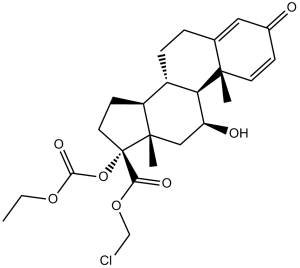
Loteprednol etabonate (Lotemax; Alrex; HGP-1; Loterox; Locort; P-5604; HGP1; Lenoxin, CDDD-5604), the esther form of Loteprednol, is a potent glucocorticoid receptor agonist approved as a medication used in treatment of inflammation of the eye due to allergies. Loteprednol possesses a metabolically labile function, the 17beta-ester, that is designed to be rapidly deactivated in the systemic circulation. Loteprednol etabonate exhibits a binding affinity which is 4.3 times that of dexamethasone.
Physicochemical Properties
| Molecular Formula | C24H31CLO7 | |
| Molecular Weight | 466.95 | |
| Exact Mass | 466.175 | |
| CAS # | 82034-46-6 | |
| Related CAS # | Loteprednol Etabonate-d5;2026643-11-6;Loteprednol Etabonate-d3 | |
| PubChem CID | 444025 | |
| Appearance | White to off-white solid powder | |
| Density | 1.3±0.1 g/cm3 | |
| Boiling Point | 600.1±55.0 °C at 760 mmHg | |
| Melting Point | 220.5-223.5ºC | |
| Flash Point | 316.7±31.5 °C | |
| Vapour Pressure | 0.0±3.9 mmHg at 25°C | |
| Index of Refraction | 1.571 | |
| LogP | 3.17 | |
| Hydrogen Bond Donor Count | 1 | |
| Hydrogen Bond Acceptor Count | 7 | |
| Rotatable Bond Count | 7 | |
| Heavy Atom Count | 32 | |
| Complexity | 882 | |
| Defined Atom Stereocenter Count | 7 | |
| SMILES | CCOC(=O)O[C@@]1(CC[C@@H]2[C@@]1(C[C@@H]([C@H]3[C@H]2CCC4=CC(=O)C=C[C@]34C)O)C)C(=O)OCCl |
|
| InChi Key | DMKSVUSAATWOCU-HROMYWEYSA-N | |
| InChi Code | InChI=1S/C24H31ClO7/c1-4-30-21(29)32-24(20(28)31-13-25)10-8-17-16-6-5-14-11-15(26)7-9-22(14,2)19(16)18(27)12-23(17,24)3/h7,9,11,16-19,27H,4-6,8,10,12-13H2,1-3H3/t16-,17-,18-,19+,22-,23-,24-/m0/s1 | |
| Chemical Name | chloromethyl (8S,9S,10R,11S,13S,14S,17R)-17-ethoxycarbonyloxy-11-hydroxy-10,13-dimethyl-3-oxo-7,8,9,11,12,14,15,16-octahydro-6H-cyclopenta[a]phenanthrene-17-carboxylate | |
| Synonyms |
|
|
| HS Tariff Code | 2934.99.9001 | |
| Storage |
Powder-20°C 3 years 4°C 2 years In solvent -80°C 6 months -20°C 1 month |
|
| Shipping Condition | Room temperature (This product is stable at ambient temperature for a few days during ordinary shipping and time spent in Customs) |
Biological Activity
| Targets |
Glucocorticoid Receptor (GR)[1][2][5] |
| ln Vitro |
In vitro activity: Loteprednol possesses a metabolically labile function, the 17beta-ester, that is designed to be rapidly deactivated in the systemic circulation. Loteprednol etabonate exhibits a binding affinity which is 4.3 times that of dexamethasone, both compounds having a Hill factor close to 1 whereas PJ90 and PJ91 does not show any affinity to the receptor. Kinase Assay: Cell Assay: In human mast cells and eosinophils (key inflammatory cells in allergic responses), Loteprednol etabonate (10-1000 nM) dose-dependently inhibited IgE-mediated degranulation. At 100 nM, it reduced histamine release by 55% and leukotriene C4 secretion by 48% (ELISA detection). It also suppressed the expression of pro-inflammatory cytokines (IL-4, IL-5, TNF-α) by 35-42% (RT-PCR)[2] - In rabbit corneal epithelial cells and conjunctival fibroblasts, Loteprednol etabonate (0.1-10 μM) inhibited LPS-induced inflammation. At 1 μM, it downregulated cyclooxygenase-2 (COX-2) and inducible nitric oxide synthase (iNOS) protein expression by 40-45% (Western blot), reducing nitric oxide (NO) and prostaglandin E2 (PGE2) production[1][3] - In human bronchial epithelial cells, Loteprednol etabonate (50-500 nM) suppressed TNF-α-induced ICAM-1 expression by 50% at 200 nM (immunofluorescence), inhibiting leukocyte adhesion to epithelial cells[2] |
| ln Vivo |
Dogs receiving 5 mg/kg of loteprednol etabonate intravenously show a 2.8 h terminal half-life, 3.7 L/kg volume of distribution, and 0.9 L/h/kg total body clearance. not found in the urine. Dogs received the medication orally (5 mg/kg), and the plasma solely contained metabolites—no intact drug—which suggests a substantial first-pass impact. In a rabbit model of allergic conjunctivitis (induced by ovalbumin), topical administration of Loteprednol etabonate eye drops (0.5%, 4 times daily for 7 days) reduced conjunctival redness, edema, and itching scores by 60-70% compared to vehicle. It also decreased eosinophil infiltration in conjunctival tissues by 58% (histopathological analysis)[1][3] - In a mouse model of allergic asthma (sensitized with ovalbumin), inhaled Loteprednol etabonate (0.1-1 mg/kg, once daily for 14 days) dose-dependently reduced airway hyperresponsiveness to methacholine (by 45% at 1 mg/kg) and decreased inflammatory cell counts (eosinophils, neutrophils) in bronchoalveolar lavage fluid (BALF) by 50-65%[2] - In patients with endogenous anterior uveitis, topical Loteprednol etabonate (0.5% eye drops, 4 times daily for 2 weeks) improved anterior chamber inflammation (cell and flare scores reduced by 75%) and relieved eye pain and photophobia in 80% of patients[4][5] |
| Enzyme Assay |
Glucocorticoid Receptor (GR) binding assay: Recombinant human GR ligand-binding domain was incubated with [3H]-dexamethasone (a reference GR agonist) and gradient concentrations of Loteprednol etabonate (1-100 nM) at 25°C for 2 hours. Bound ligands were separated by gel filtration, and radioactivity was quantified to assess competitive binding to GR[1][5] |
| Cell Assay |
Mast cell degranulation assay: Human mast cells were sensitized with IgE and pre-treated with Loteprednol etabonate (10 nM, 100 nM, 1000 nM) for 1 hour, then stimulated with specific antigen. Histamine and leukotriene C4 levels in the supernatant were measured by ELISA. Pro-inflammatory cytokine mRNA expression was detected by RT-PCR[2] - Corneal epithelial cell inflammation assay: Rabbit corneal epithelial cells were seeded in 6-well plates and pre-treated with Loteprednol etabonate (0.1 μM, 1 μM, 10 μM) for 2 hours, then stimulated with LPS (1 μg/mL) for 24 hours. COX-2 and iNOS protein levels were analyzed by Western blot; NO and PGE2 production was quantified by colorimetric assay and ELISA, respectively[1][3] - Bronchial epithelial cell ICAM-1 expression assay: Human bronchial epithelial cells were cultured in 96-well plates and treated with Loteprednol etabonate (50 nM, 200 nM, 500 nM) for 1 hour, then stimulated with TNF-α (10 ng/mL) for 18 hours. ICAM-1 expression was detected by immunofluorescence, and leukocyte adhesion was assessed by co-culturing with labeled neutrophils[2] |
| Animal Protocol |
Allergic conjunctivitis rabbit model: New Zealand white rabbits were sensitized with ovalbumin via intraperitoneal injection. After 2 weeks, Loteprednol etabonate eye drops (0.2%, 0.5%) were administered topically 4 times daily for 7 days, starting 1 day before ovalbumin ocular challenge. Conjunctival symptoms (redness, edema, itching) were scored daily; conjunctival tissues were collected for histopathological analysis of eosinophil infiltration[1][3] - Allergic asthma mouse model: BALB/c mice were sensitized with ovalbumin and aluminum hydroxide, then challenged with ovalbumin aerosol. Loteprednol etabonate (0.1 mg/kg, 0.5 mg/kg, 1 mg/kg) was administered via inhalation once daily for 14 days during the challenge phase. Airway hyperresponsiveness was measured by methacholine provocation; BALF was collected to count inflammatory cells[2] |
| ADME/Pharmacokinetics |
Absorption, Distribution and Excretion Loteprednol etabonate (LE) demonstrates good ocular permeation properties as it is lipid soluble, allowing the agent to penetrate into cells with relative ease. Results from the ocular administration of loteprednol in normal, healthy volunteers have shown that there are low or undetectable concentrations of either unchanged material or its metabolite. Following twice-daily unilateral topical ocular dosing of LE for 14 days in healthy subjects, the plasma concentrations of loteprednol etabonate were below the limit of quantitation (1 ng/mL) at all time points. These finds suggest that limited, if any, systemic absorption of LE occurs. Following systemic administration to rats, loteprednol etabonate is eliminated primarily via the biliary/faecal route, with most of the dose eliminated in the form of the metabolite, PJ-90. The only data available regarding the volume of distribution of loteprednol etabonate (LE) is the volume of distribution the agent demonstrated when administered to dogs - a value of 3.7 L/kg. It has been shown, however, that the topical ocular administration of LE distributes preferentially into the cellular components of blood. Loteprednol etabonate was slowly hydrolyzed in liver at clearance rates of 0.21 +/- 0.04 and 2.41 +/- 0.13 ml/h/kg in the liver and plasma, respectively. Metabolism / Metabolites Loteprednol etabonate (LE) is readily and extensively metabolized to two inactive metabolites, PJ-90 (Δ1-cortienic acid) and PJ-91 (Δ1-cortienic acid etabonate). Metabolism occurs locally in ocular tissues, and to the extent that loteprednol etabonate reaches the systemic circulation, likely the liver and other tissues into which it distributes. In particular, studies have demonstrated that LE (chloromethyl 17alpha-ethoxycarbonyloxy-11beta-hydroxy-3-oxoandrosta-1,4-diene) is rapidly hydrolyzed at the location of its 17beta-chloromethyl ester function by paraoxonase 1 in human plasma at the site of administration at the level of the affected eye tissue to the 17beta-carboxylate PJ-91 metabolite and PJ-90 metabolite. Both metabolites are considered inactive. Biological Half-Life The terminal half-life of loteprednol etabonate as determined when administered intravenously at a dose of 5 mg/kg in the dog animal model is 2.8 hours. Absorption: Topical ocular administration (0.5% eye drops) results in minimal systemic absorption (<0.1% of dose detected in plasma). Inhaled administration shows low systemic bioavailability (~2%)[1][2] - Distribution: After topical ocular application, it primarily distributes in ocular tissues (cornea, conjunctiva, anterior chamber) with minimal penetration into the posterior segment of the eye[3][5] - Metabolism: Rapidly metabolized in the liver and target tissues via esterase hydrolysis to inactive carboxylic acid metabolites. The elimination half-life in plasma is ~1 hour[1][5] - Excretion: Metabolites are primarily excreted in urine (~70%) and feces (~25%), with no accumulation of parent drug[1] |
| Toxicity/Toxicokinetics |
Protein Binding Strong protein binding of approximately 98% for loteprednol etabonate facilitates little pharmacodynamic action and/or adverse effects on the part of the agent in the systemic circulation. Local toxicity: Ocular administration shows low risk of (IOP) elevation (incidence <5%, vs. 15-20% with prednisolone). No significant corneal epithelial toxicity or conjunctival irritation in long-term use (up to 6 weeks)[3][4] - Systemic toxicity: No significant (liver/renal function markers within normal ranges) even at 10-fold therapeutic doses[1][5] - Plasma protein binding rate: ~80% bound to human plasma proteins[1] - Drug-drug interactions: No significant interactions with other ocular or systemic drugs; does not inhibit or induce cytochrome P450 enzymes[5] |
| References |
[1]. Noble S, Goa KL. Loteprednol etabonate: clinical potential in the management of ocular inflammation. BioDrugs. 1998 Oct;10(4):329-39. [2]. Loteprednol etabonate: a soft steroid for the treatment of allergic diseases of the airways. Drugs Today (Barc). 2000 May;36(5):313-20. [3]. Howes JF. Loteprednol etabonate: a review of ophthalmic clinical studies. Pharmazie. 2000 Mar;55(3):178-83. [4]. Pavesio CE, Decory HH. Treatment of ocular inflammatory conditions with loteprednol etabonate. Br J Ophthalmol. 2008 Apr;92(4):455-9. [5]. Comstock TL, Decory HH. Advances in corticosteroid therapy for ocular inflammation: loteprednol etabonate. Int J Inflam. 2012;2012:789623. |
| Additional Infomation |
Pharmacodynamics Loteprednol etabonate (LE) belongs to a unique class of corticosteroids with potent anti-inflammatory effects designed to be active at the site of action. Animal studies have shown that LE has a binding affinity to steroid receptors that is 4.3 times greater than dexamethasone. This particular class of steroids consists of bioactive molecules whose in-vivo transformation to non-toxic substances can be predicted from their chemistry and knowledge of enzymatic pathways in the body. Cortienic acid is an inactive metabolite of hydrocortisone and analogs of cortienic acid are also devoid of corticosteroid activity. Specifically, LE is an ester derivative of one of these analogs, cortienic acid etabonate. In particular, LE possesses a metabolically labile 17 beta-chloromethyl ester function which was designed in order to be hydrolyzed to an inactive carboxylic acid moiety. This inactive metabolite is more hydrophilic and is thus readily eliminated from the body. LE also exhibits good ocular permeation properties and good skin permeation properties. Loteprednol etabonate is a "soft steroid" (prodrug-like) developed for topical anti-inflammatory therapy, with high potency and low systemic toxicity[1][2][5] - Its core mechanism involves binding to GR, inhibiting the transcription of pro-inflammatory genes (cytokines, chemokines, COX-2) and activating anti-inflammatory gene expression[1][5] - Clinical indications include ocular inflammatory conditions (allergic conjunctivitis, anterior uveitis, blepharitis) and airway allergic diseases (allergic rhinitis, mild-to-moderate asthma)[2][4] - It is FDA-approved for ocular use and has a favorable safety profile compared to conventional corticosteroids, due to rapid metabolism to inactive metabolites[3][5] - The ester linkage in its structure is critical for local activity and rapid inactivation, minimizing systemic side effects[1][2] |
Solubility Data
| Solubility (In Vitro) |
|
|||
| Solubility (In Vivo) |
Solubility in Formulation 1: ≥ 2.5 mg/mL (5.35 mM) (saturation unknown) in 10% DMSO + 90% Corn Oil (add these co-solvents sequentially from left to right, and one by one), clear solution. For example, if 1 mL of working solution is to be prepared, you can add 100 μL of 25.0 mg/mL clear DMSO stock solution to 900 μL of corn oil and mix evenly. (Please use freshly prepared in vivo formulations for optimal results.) |
| Preparing Stock Solutions | 1 mg | 5 mg | 10 mg | |
| 1 mM | 2.1416 mL | 10.7078 mL | 21.4156 mL | |
| 5 mM | 0.4283 mL | 2.1416 mL | 4.2831 mL | |
| 10 mM | 0.2142 mL | 1.0708 mL | 2.1416 mL |