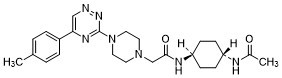
Physicochemical Properties
| Molecular Formula | C24H33N7O2 |
| Molecular Weight | 451.564524412155 |
| Exact Mass | 451.269 |
| Elemental Analysis | C, 63.84; H, 7.37; N, 21.71; O, 7.09 |
| CAS # | 1820940-17-7 |
| PubChem CID | 126567187 |
| Appearance | Light yellow to yellow solid powder |
| LogP | 1.5 |
| Hydrogen Bond Donor Count | 2 |
| Hydrogen Bond Acceptor Count | 7 |
| Rotatable Bond Count | 6 |
| Heavy Atom Count | 33 |
| Complexity | 639 |
| Defined Atom Stereocenter Count | 0 |
| SMILES | N1(CC(N[C@@H]2CC[C@@H](NC(C)=O)CC2)=O)CCN(C2=NC(C3=CC=C(C)C=C3)=CN=N2)CC1 |
| InChi Key | YHGVDZULVMINCJ-UHFFFAOYSA-N |
| InChi Code | InChI=1S/C24H33N7O2/c1-17-3-5-19(6-4-17)22-15-25-29-24(28-22)31-13-11-30(12-14-31)16-23(33)27-21-9-7-20(8-10-21)26-18(2)32/h3-6,15,20-21H,7-14,16H2,1-2H3,(H,26,32)(H,27,33) |
| Chemical Name | N-(4-acetamidocyclohexyl)-2-[4-[5-(4-methylphenyl)-1,2,4-triazin-3-yl]piperazin-1-yl]acetamide |
| Synonyms | Lorundrostat; 1820940-17-7; Lorundrostat [INN]; KA8W5LDS6Z; UNII-KA8W5LDS6Z; 1-Piperazineacetamide, N-(trans-4-(acetylamino)cyclohexyl)-4-(5-(4-methylphenyl)-1,2,4-triazin-3-yl)-; N-(trans-4-(Acetylamino)cyclohexyl)-4-(5-(4-methylphenyl)-1,2,4-triazin-3-yl)-1-piperazineacetamide; N-(trans-4-Acetamidocyclohexyl)-2-(4-(5-(4- methylphenyl)-1,2,4-triazin-3-yl)piperazin-1- yl)acetamide; |
| HS Tariff Code | 2934.99.9001 |
| Storage |
Powder-20°C 3 years 4°C 2 years In solvent -80°C 6 months -20°C 1 month |
| Shipping Condition | Room temperature (This product is stable at ambient temperature for a few days during ordinary shipping and time spent in Customs) |
Biological Activity
| Targets | Aldosterone synthase |
| ln Vitro | Lorundrostat selectively inhibits human CYP11B2 (IC50 = 9 nM), reduces plasma aldosterone and systolic blood pressure, and can be used for research on obesity- or renin-induced hypertension. |
| ln Vivo | Between July 2021 and June 2022, 200 participants were randomized, with final follow-up in September 2022. Following 8 weeks of treatment in participants with suppressed PRA, changes in office systolic blood pressure of -14.1, -13.2, -6.9, and -4.1 mm Hg were observed with 100 mg, 50 mg, and 12.5 mg once daily of lorundrostat and placebo, respectively. Observed reductions in systolic blood pressure in individuals receiving twice-daily doses of 25 mg and 12.5 mg of lorundrostat were -10.1 and -13.8 mm Hg, respectively. The least-squares mean difference between placebo and treatment in systolic blood pressure was -9.6 mm Hg (90% CI, -15.8 to -3.4 mm Hg; P = .01) for the 50-mg once-daily dose and -7.8 mm Hg (90% CI, -14.1 to -1.5 mm Hg; P = .04) for 100 mg daily. Among participants without suppressed PRA, 100 mg once daily of lorundrostat decreased systolic blood pressure by 11.4 mm Hg (SD, 2.5 mm Hg), which was similar to blood pressure reduction among participants with suppressed PRA receiving the same dose. Six participants had increases in serum potassium above 6.0 mmol/L that corrected with dose reduction or drug discontinuation. No instances of cortisol insufficiency occurred. Conclusions and relevance: Among individuals with uncontrolled hypertension, use of lorundrostat was effective at lowering blood pressure compared with placebo, which will require further confirmatory studies [2]. |
| Animal Protocol |
Study Procedures [2] Participants underwent 2 to 4 weeks of prescreening, a 2-week placebo run-in period to ensure eligibility, and then randomization and treatment for 8 weeks. A final visit was conducted 2 to 4 weeks following completion of the double-blind treatment (eFigure 1 in Supplement 2). Cohort 1 participants were randomly assigned in a 1:1:1:1:1:1 ratio to placebo or 1 of 5 lorundrostat doses (12.5 mg, 50 mg, or 100 mg once daily or 12.5 mg or 25 mg twice daily). An independent data and safety monitoring board performed an interim analysis in January 2022, and randomization to the 2 lowest doses of lorundrostat (12.5 mg once daily and 12.5 mg twice daily) was discontinued due to lack of consistent meaningful reduction of BP. A second cohort randomized participants to placebo or 100 mg once daily of lorundrostat in a 1:6 ratio. An additional interim analysis was performed following the last participant visit from cohort 1 and full enrollment of cohort 2 to guide dose selection in future studies. Following randomization, all participants’ study visits were conducted at weeks 1 through 8. Efficacy assessment with AOBP (average of the last 2 of 5 unattended measurements using an automated oscillometric sphygmomanometer device after approximately 5 minutes of rest in a seated position) was measured weekly throughout the study. Twenty-four-hour ambulatory BP monitoring was measured at baseline and once again prior to the 8-week visit. Sample Size Calculation and Power [2] The study was designed to provide information regarding a safe and effective dose of lorundrostat for subsequent efficacy trials. The sample size was based on the point and interval estimation of the difference in means between each dose group and placebo in change from baseline at week 8 in systolic AOBP. A sample size of 30 participants per group was estimated to provide the half-width of the 2-sided 90% CI of 3.8 mm Hg with a common standard deviation assumed to be 9 mm Hg. This was considered to have adequate precision to guide the evaluation of systolic BP changes across different dose levels for selection of doses and regimens to be investigated in future studies. All analyses of cohort 2 of the study were exploratory in nature, and no formal sample size considerations were undertaken for this cohort. |
| Toxicity/Toxicokinetics |
Safety End Points [2] No participant deaths occurred during the trial. Three serious adverse events occurred; only 1 was deemed treatment related. A participant randomized to 100 mg once daily of lorundrostat in cohort 2 had worsening of hyponatremia necessitating stopping the drug. A total of 110 participants (55%) experienced any adverse event during the trial (Table 3). Most adverse events were classified as mild by investigators. No adrenocortical insufficiency occurred during the trial. Cosyntropin stimulation testing in participants randomized to 100 mg once daily in both cohort 1 and cohort 2 was normal, with stimulated values of cortisol greater than 18 µg/dL in all individuals receiving cosyntropin (eFigure 4 in Supplement 2). Prespecified adverse events of special interest included 3 participants (2%) with hypotension. Mean serum potassium increases were similar across all lorundrostat doses, including increases of 0.25 mmol/L in the 50-mg and 100-mg once-daily groups. Six participants (3.6%) had serum potassium levels above 6.0 mmol/L during the trial (Table 3). No instances of hyperkalemia required intervention beyond discontinuation or reduction in the dose of lorundrostat. |
| References |
[1]. International Nonproprietary Names for Pharmaceutical Substances (INN). WHO Drug Information, Vol. 36, No. 2, 2022. [2]. Aldosterone Synthase Inhibition With Lorundrostat for Uncontrolled Hypertension: The Target-HTN Randomized Clinical Trial. JAMA. 2023 Sep 26;330(12):1140-1150. |
| Additional Infomation |
Importance: Excess aldosterone production contributes to hypertension in both classical hyperaldosteronism and obesity-associated hypertension. Therapies that reduce aldosterone synthesis may lower blood pressure.
Objective: To compare the safety and efficacy of lorundrostat, an aldosterone synthase inhibitor, with placebo, and characterize dose-dependent safety and efficacy to inform dose selection in future trials.
Design, setting, and participants: Randomized, placebo-controlled, dose-ranging trial among adults with uncontrolled hypertension taking 2 or more antihypertensive medications. An initial cohort of 163 participants with suppressed plasma renin (plasma renin activity [PRA] ≤1.0 ng/mL/h) and elevated plasma aldosterone (≥1.0 ng/dL) were enrolled, with subsequent enrollment of 37 participants with PRA greater than 1.0 ng/mL/h.
Interventions: Participants were randomized to placebo or 1 of 5 dosages of lorundrostat in the initial cohort (12.5 mg, 50 mg, or 100 mg once daily or 12.5 mg or 25 mg twice daily). In the second cohort, participants were randomized in a 1:6 ratio to placebo or lorundrostat, 100 mg once daily.
Main outcomes and measures: The primary end point was change in automated office systolic blood pressure from baseline to study week 8.[2] Lorundrostat at doses of 50 mg and 100 mg once daily decreased AOBP significantly more than placebo. Blood pressure reduction was particularly evident among participants with hypertension and concomitant obesity. Lorundrostat was well tolerated, and small expected increases in serum potassium and declines in eGFR suggest a favorable safety profile, particularly with a 50-mg once-daily dose. The trial results support further study of lorundrostat as a treatment for uncontrolled hypertension.[1] |
Solubility Data
| Solubility (In Vitro) | DMSO : ~33.33 mg/mL (~73.81 mM) |
| Solubility (In Vivo) |
Solubility in Formulation 1: ≥ 2.5 mg/mL (5.54 mM) (saturation unknown) in 10% DMSO + 40% PEG300 + 5% Tween80 + 45% Saline (add these co-solvents sequentially from left to right, and one by one), clear solution. For example, if 1 mL of working solution is to be prepared, you can add 100 μL of 25.0 mg/mL clear DMSO stock solution to 400 μL PEG300 and mix evenly; then add 50 μL Tween-80 to the above solution and mix evenly; then add 450 μL normal saline to adjust the volume to 1 mL. Preparation of saline: Dissolve 0.9 g of sodium chloride in 100 mL ddH₂ O to obtain a clear solution. Solubility in Formulation 2: ≥ 2.5 mg/mL (5.54 mM) (saturation unknown) in 10% DMSO + 90% (20% SBE-β-CD in Saline) (add these co-solvents sequentially from left to right, and one by one), clear solution. For example, if 1 mL of working solution is to be prepared, you can add 100 μL of 25.0 mg/mL clear DMSO stock solution to 900 μL of 20% SBE-β-CD physiological saline solution and mix evenly. Preparation of 20% SBE-β-CD in Saline (4°C,1 week): Dissolve 2 g SBE-β-CD in 10 mL saline to obtain a clear solution. (Please use freshly prepared in vivo formulations for optimal results.) |
| Preparing Stock Solutions | 1 mg | 5 mg | 10 mg | |
| 1 mM | 2.2145 mL | 11.0727 mL | 22.1455 mL | |
| 5 mM | 0.4429 mL | 2.2145 mL | 4.4291 mL | |
| 10 mM | 0.2215 mL | 1.1073 mL | 2.2145 mL |