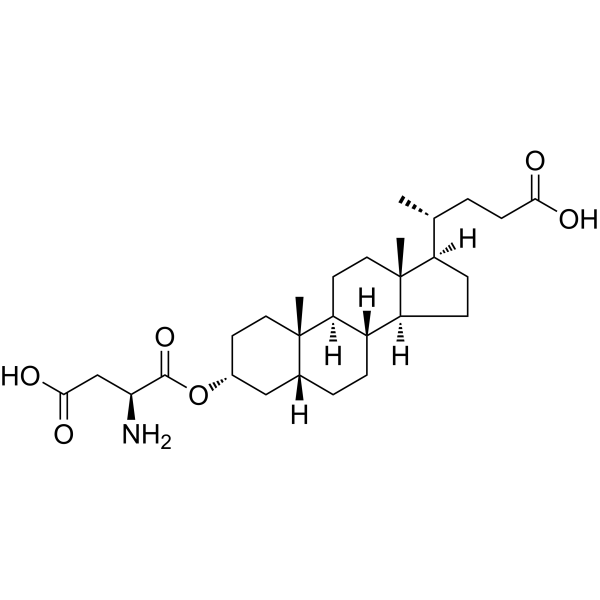
Physicochemical Properties
| Molecular Formula | C28H45NO6 |
| Molecular Weight | 491.660009145737 |
| Exact Mass | 491.324 |
| CAS # | 881179-02-8 |
| PubChem CID | 11698848 |
| Appearance | White to off-white solid powder |
| LogP | 3.2 |
| Hydrogen Bond Donor Count | 3 |
| Hydrogen Bond Acceptor Count | 7 |
| Rotatable Bond Count | 9 |
| Heavy Atom Count | 35 |
| Complexity | 830 |
| Defined Atom Stereocenter Count | 10 |
| SMILES | C[C@@]12[C@@H]([C@H](C)CCC(=O)O)CC[C@H]1[C@@H]1CC[C@@H]3C[C@@H](CC[C@]3(C)[C@H]1CC2)OC(=O)[C@@H](N)CC(=O)O |
| InChi Key | NUUCRVJEHQBAKP-CNZWOIIDSA-N |
| InChi Code | InChI=1S/C28H45NO6/c1-16(4-9-24(30)31)20-7-8-21-19-6-5-17-14-18(35-26(34)23(29)15-25(32)33)10-12-27(17,2)22(19)11-13-28(20,21)3/h16-23H,4-15,29H2,1-3H3,(H,30,31)(H,32,33)/t16-,17-,18-,19+,20-,21+,22+,23+,27+,28-/m1/s1 |
| Chemical Name | (4R)-4-[(3R,5R,8R,9S,10S,13R,14S,17R)-3-[(2S)-2-amino-3-carboxypropanoyl]oxy-10,13-dimethyl-2,3,4,5,6,7,8,9,11,12,14,15,16,17-tetradecahydro-1H-cyclopenta[a]phenanthren-17-yl]pentanoic acid |
| HS Tariff Code | 2934.99.9001 |
| Storage |
Powder-20°C 3 years 4°C 2 years In solvent -80°C 6 months -20°C 1 month |
| Shipping Condition | Room temperature (This product is stable at ambient temperature for a few days during ordinary shipping and time spent in Customs) |
Biological Activity
| ln Vitro | The findings demonstrated that at test levels of 10, 30, and 60 μM, Lith-O-Asp did not clearly suppress the proliferation of various cancer cell lines. An in vitro activity study demonstrated Lith-O-Asp's capacity to suppress ST3Gal I, ST3Gal III, and ST6Gal I activities. The range of IC50 values is 12–37 μM. The expression of a-2,3- and a-2,6-sialylated antigens on the cell surface was dramatically downregulated, according to flow cytometry. The findings demonstrated that a-2,3- and a-2,3- and a-2,6-sialylated antigens' activity was decreased by Lith-O-Asp. sialic acid transport to target glycoproteins is consequently inhibited by -2,6-sialyltransferase [1]. |
| ln Vivo | Using the IVIS in vivo imaging technology, a significant number of secondary metastatic cancer cells were found in the lung tissue of DMSO control animals 26 days after fat pad inoculation. On the other hand, mice given Lith-O-Asp had fewer lung metastases. All of the DMSO-treated mice had secondary lung metastases confirmed, whereas only three of the eight Lith-O-Asp-treated mice had lung metastases. The average tumor nodules per mouse in the DMSO-treated group was 11±9 nodules, whereas the average tumor nodules per mouse in the Lith-O-Asp-treated group was 2±4 nodules. Moreover, the 4T1-Luc illumination signal on days 7 and 9 was substantially stronger in control mice than in mice injected with cancer cells treated with Lith-O-Asp [1]. |
| References |
[1]. A novel sialyltransferase inhibitor suppresses FAK/paxillin signaling and cancer angiogenesis and metastasis pathways. Cancer Res. 2011 Jan 15;71(2):473-83. |
Solubility Data
| Solubility (In Vitro) | DMSO : ~100 mg/mL (~203.39 mM) |
| Solubility (In Vivo) |
Solubility in Formulation 1: 2.5 mg/mL (5.08 mM) in 10% DMSO + 40% PEG300 + 5% Tween80 + 45% Saline (add these co-solvents sequentially from left to right, and one by one), suspension solution; with sonication. For example, if 1 mL of working solution is to be prepared, you can add 100 μL of 25.0 mg/mL clear DMSO stock solution to 400 μL PEG300 and mix evenly; then add 50 μL Tween-80 to the above solution and mix evenly; then add 450 μL normal saline to adjust the volume to 1 mL. Preparation of saline: Dissolve 0.9 g of sodium chloride in 100 mL ddH₂ O to obtain a clear solution. Solubility in Formulation 2: ≥ 2.5 mg/mL (5.08 mM) (saturation unknown) in 10% DMSO + 90% (20% SBE-β-CD in Saline) (add these co-solvents sequentially from left to right, and one by one), clear solution. For example, if 1 mL of working solution is to be prepared, you can add 100 μL of 25.0 mg/mL clear DMSO stock solution to 900 μL of 20% SBE-β-CD physiological saline solution and mix evenly. Preparation of 20% SBE-β-CD in Saline (4°C,1 week): Dissolve 2 g SBE-β-CD in 10 mL saline to obtain a clear solution. Solubility in Formulation 3: ≥ 2.5 mg/mL (5.08 mM) (saturation unknown) in 10% DMSO + 90% Corn Oil (add these co-solvents sequentially from left to right, and one by one), clear solution. For example, if 1 mL of working solution is to be prepared, you can add 100 μL of 25.0 mg/mL clear DMSO stock solution to 900 μL of corn oil and mix evenly. (Please use freshly prepared in vivo formulations for optimal results.) |
| Preparing Stock Solutions | 1 mg | 5 mg | 10 mg | |
| 1 mM | 2.0339 mL | 10.1696 mL | 20.3393 mL | |
| 5 mM | 0.4068 mL | 2.0339 mL | 4.0679 mL | |
| 10 mM | 0.2034 mL | 1.0170 mL | 2.0339 mL |