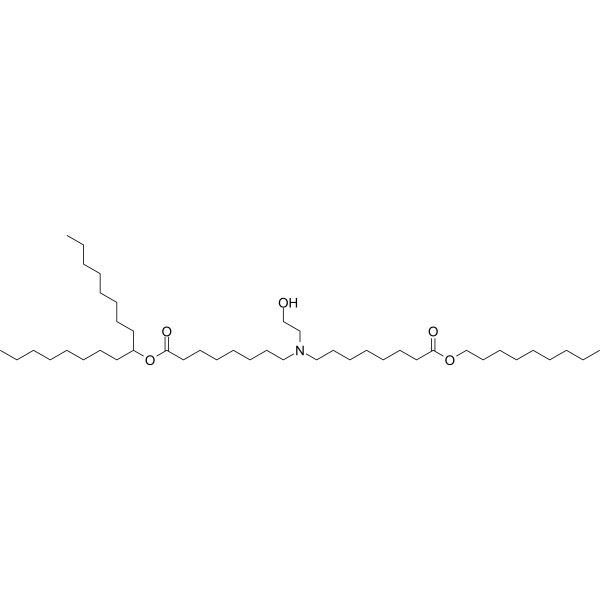
Physicochemical Properties
| Molecular Formula | C44H87NO5 |
| Molecular Weight | 710.165294885635 |
| Exact Mass | 709.658 |
| CAS # | 2089251-33-0 |
| PubChem CID | 126697428 |
| Appearance | Colorless to light yellow liquid |
| LogP | 15.5 |
| Hydrogen Bond Donor Count | 1 |
| Hydrogen Bond Acceptor Count | 6 |
| Rotatable Bond Count | 43 |
| Heavy Atom Count | 50 |
| Complexity | 686 |
| Defined Atom Stereocenter Count | 0 |
| InChi Key | ABCVHPIKBGRCJA-UHFFFAOYSA-N |
| InChi Code | InChI=1S/C44H87NO5/c1-4-7-10-13-16-25-32-41-49-43(47)35-28-21-17-23-30-37-45(39-40-46)38-31-24-18-22-29-36-44(48)50-42(33-26-19-14-11-8-5-2)34-27-20-15-12-9-6-3/h42,46H,4-41H2,1-3H3 |
| Chemical Name | nonyl 8-[(8-heptadecan-9-yloxy-8-oxooctyl)-(2-hydroxyethyl)amino]octanoate |
| HS Tariff Code | 2934.99.9001 |
| Storage |
Powder-20°C 3 years 4°C 2 years In solvent -80°C 6 months -20°C 1 month |
| Shipping Condition | Room temperature (This product is stable at ambient temperature for a few days during ordinary shipping and time spent in Customs) |
Biological Activity
| ln Vitro | Increased expression and ideal tissue clearance are obtained by substituting the main ester-containing lipid tail (Lipid 5) for the linoleic tail. The main ester's hydrolysis is the initial stage of the lipid's metabolism, according to metabolite identification research using Lipid 5[1]. |
| ln Vivo | Following 0.05 mg/kg mRNA dosage on days 1, 8, and 15, the clearance of Lipid 5 and MC3 from various mouse tissues is assessed in CD-1 female mice. The largest concentrations of Lipid 5 are found in the liver and spleen, however they are much lower than in MC3. Plasma, the lung, and the kidney all contain lipid 5, but the heart does not[1]. |
| References |
[1]. A Novel Amino Lipid Series for mRNA Delivery: Improved Endosomal Escape and Sustained Pharmacology and Safety in Non-human Primates. Mol Ther. 2018 Jun 6;26(6):1509-1519. |
Solubility Data
| Solubility (In Vitro) | DMSO: 100 mg/mL (140.81 mM) |
| Solubility (In Vivo) |
Solubility in Formulation 1: 2.5 mg/mL (3.52 mM) in 10% DMSO + 40% PEG300 + 5% Tween80 + 45% Saline (add these co-solvents sequentially from left to right, and one by one), suspension solution; with sonication. For example, if 1 mL of working solution is to be prepared, you can add 100 μL of 25.0 mg/mL clear DMSO stock solution to 400 μL PEG300 and mix evenly; then add 50 μL Tween-80 to the above solution and mix evenly; then add 450 μL normal saline to adjust the volume to 1 mL. Preparation of saline: Dissolve 0.9 g of sodium chloride in 100 mL ddH₂ O to obtain a clear solution. Solubility in Formulation 2: 2.5 mg/mL (3.52 mM) in 10% DMSO + 90% (20% SBE-β-CD in Saline) (add these co-solvents sequentially from left to right, and one by one), suspension solution; with ultrasonication. For example, if 1 mL of working solution is to be prepared, you can add 100 μL of 25.0 mg/mL clear DMSO stock solution to 900 μL of 20% SBE-β-CD physiological saline solution and mix evenly. Preparation of 20% SBE-β-CD in Saline (4°C,1 week): Dissolve 2 g SBE-β-CD in 10 mL saline to obtain a clear solution. Solubility in Formulation 3: ≥ 2.5 mg/mL (3.52 mM) (saturation unknown) in 10% DMSO + 90% Corn Oil (add these co-solvents sequentially from left to right, and one by one), clear solution. For example, if 1 mL of working solution is to be prepared, you can add 100 μL of 25.0 mg/mL clear DMSO stock solution to 900 μL of corn oil and mix evenly. (Please use freshly prepared in vivo formulations for optimal results.) |
| Preparing Stock Solutions | 1 mg | 5 mg | 10 mg | |
| 1 mM | 1.4081 mL | 7.0406 mL | 14.0811 mL | |
| 5 mM | 0.2816 mL | 1.4081 mL | 2.8162 mL | |
| 10 mM | 0.1408 mL | 0.7041 mL | 1.4081 mL |