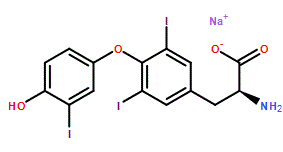
Physicochemical Properties
| Molecular Formula | C15H11I3NNAO4 |
| Molecular Weight | 672.9553 |
| Exact Mass | 672.771 |
| Elemental Analysis | C, 26.77; H, 1.65; I, 56.57; N, 2.08; Na, 3.42; O, 9.51 |
| CAS # | 55-06-1 |
| Related CAS # | Liothyronine;6893-02-3;Liothyronine sodium hydrate;345957-19-9;Liothyronine hydrochloride;6138-47-2 |
| PubChem CID | 23666110 |
| Appearance | White to off-white solid powder |
| Boiling Point | 563.5ºC at 760 mmHg |
| Melting Point | 205 °C (dec.)(lit.) |
| Flash Point | 294.6ºC |
| LogP | 3.318 |
| Hydrogen Bond Donor Count | 2 |
| Hydrogen Bond Acceptor Count | 5 |
| Rotatable Bond Count | 5 |
| Heavy Atom Count | 24 |
| Complexity | 408 |
| Defined Atom Stereocenter Count | 1 |
| SMILES | IC1C(=C(C([H])=C(C=1[H])C([H])([H])[C@@]([H])(C(=O)[O-])N([H])[H])I)OC1C([H])=C([H])C(=C(C=1[H])I)O[H].[Na+] |
| InChi Key | SBXXSUDPJJJJLC-YDALLXLXSA-M |
| InChi Code | InChI=1S/C15H12I3NO4.Na/c16-9-6-8(1-2-13(9)20)23-14-10(17)3-7(4-11(14)18)5-12(19)15(21)22;/h1-4,6,12,20H,5,19H2,(H,21,22);/q;+1/p-1/t12-;/m0./s1 |
| Chemical Name | sodium;(2S)-2-amino-3-[4-(4-hydroxy-3-iodophenoxy)-3,5-diiodophenyl]propanoate |
| Synonyms | Liothyronine; Cytomel; Tertroxin; Triiodothyronine; 3,5,3'-triiodothyronine; 3,3',5-Triiodo-L-thyronine; Tresitope; LIOTHYRONINE SODIUM; 55-06-1; Cytomel; Triostat; 3,3',5-Triiodo-L-thyronine sodium salt; Tertroxin; Basoprocin; Ibiothyron; Liothyronin |
| HS Tariff Code | 2934.99.9001 |
| Storage |
Powder-20°C 3 years 4°C 2 years In solvent -80°C 6 months -20°C 1 month Note: Please store this product in a sealed and protected environment, avoid exposure to moisture. |
| Shipping Condition | Room temperature (This product is stable at ambient temperature for a few days during ordinary shipping and time spent in Customs) |
Biological Activity
| Targets |
thyroid hormone receptorα; thyroid hormone receptor β-1 Liothyronine sodium (active component: T3) acts on beta 1 thyroid hormone receptor (TRβ1)[1] Liothyronine sodium (active component: T3) binds to human beta 1 thyroid hormone receptor (hTRβ1)[2] |
| ln Vitro |
Liothyronine (T3, 100 nM) sodium encourages hepatocarcinoma cells with overexpressed TRβ1 to proliferate[1]. When ligothyronine sodium binds to the human β1 thyroid hormone receptor (hTRβ1), it modifies the receptor's structure. Growth, differentiation, and metabolic effects are all regulated by lithyronine sodium [2]. In poorly differentiated human hepatocarcinoma cells overexpressing TRβ1, treatment with Liothyronine sodium (active component: T3) stimulated cell proliferation[1] Binding of Liothyronine sodium (active component: T3) to hTRβ1 induced conformational changes in hTRβ1[2] |
| ln Vivo |
The experiment for detecting conformational changes of hTRβ1 induced by Liothyronine sodium (active component: T3) involved purification of recombinant hTRβ1 protein, incubation of T3 with hTRβ1 at a specific temperature and time, and detection of conformational changes using a specific method[2] |
| Enzyme Assay | To understand the structural basis in the hormone-dependent transcriptional regulation of human beta 1 thyroid hormone receptor (h-TR beta 1), we studied the conformational changes of h-TR beta 1 induced by binding of 3,3',5-triiodo-L-thyronine (T3). h-TR beta 1 was treated with trypsin alone or in the presence of T3, thyroid hormone response element (TRE) or T3 together with TREs. Without T3, h-TR beta 1 was completely digested by trypsin. Binding of TREs had no effect on the tryptic digestion pattern. However, T3-bound h-TR beta 1 became resistant to tryptic digestion and yielded trypsin-resistant peptide fragments with molecular weight of 28,000 and 24,000. Chymotryptic digestion also yielded a T3-protected 24 Kd peptide fragment. Using anti-h-TR beta 1 antibodies and amino acid sequencing, the 28 Kd fragment was identified to be Ser202-Asp456. The 24 Kd tryptic fragments were found to be Lys239-Asp456 and Phe240-Asp456. The 24 Kd chymotryptic fragment was identified to be Lys235-Asp456. The structural changes as a result of T3 binding could serve as a transducing signal to modulate the gene regulating activity of h-TR beta 1[2]. |
| Cell Assay |
Thyroid hormone depleted (Td) serum is prepared. Hepatocarcinoma cell growth in methylcellulose is carried out. Cells are plated at a density of 3 × 10⁴ cells/60 mm dish on day 0 and incubated in medium containing 5% regular serum, 5% Td or 5% Td and 100 nM T3. This is done to ascertain the impact of Liothyronine (T3) on the growth of cells. Three weeks after the initial plating, the methylcellulose colony formation is scored[1]. The cell experiment for Liothyronine sodium (active component: T3) included transfection of TRβ1 expression vector into poorly differentiated human hepatocarcinoma cells to establish TRβ1-overexpressing cell lines, culture of cells in medium containing T3 for a specific duration, and detection of cell proliferation using a specific method[1] |
| References |
[1]. Stimulation of proliferation by 3,3',5-triiodo-L-thyronine in poorly differentiated human hepatocarcinoma cells overexpressing beta 1 thyroid hormone receptor. Cancer Lett. 1994 Oct 14;85(2):189-94. [2]. Conformational changes of human beta 1 thyroid hormone receptor induced by binding of 3,3',5-triiodo-L-thyronine. Biochem Biophys Res Commun. 1993 Aug 31;195(1):385-92. [3]. Discovery of novel indane derivatives as liver-selective thyroid hormone receptor β (TRβ) agonists for the treatment of dyslipidemia. Bioorg Med Chem. 2012 Jun 1;20(11):3622-34. |
| Additional Infomation |
Liothyronine sodium is the sodium salt of liothyronine. Thought to be more active than levothyroxine and with a rapid (few hours) onset and short duration of action, liothyronine sodium is used in the treatment of hypothyroidism, particularly in cases of hypothyroid coma. It contains a 3,3',5-triiodo-L-thyroninate. Liothyronine Sodium is the sodium salt form of liothyronine, a synthetic form of the levorotatory isomer of the naturally occurring thyroid hormone triiodothyronine (T3). Liothyronine sodium binds to nuclear thyroid receptors which then bind to thyroid hormone response elements of target genes. As a result, liothyronine sodium induces gene expression that is required for normal growth and development. Liothyronine sodium is more potent and has a more rapid action than thyroxine (T4). A T3 thyroid hormone normally synthesized and secreted by the thyroid gland in much smaller quantities than thyroxine (T4). Most T3 is derived from peripheral monodeiodination of T4 at the 5' position of the outer ring of the iodothyronine nucleus. The hormone finally delivered and used by the tissues is mainly T3. See also: Liothyronine (has active moiety). Liothyronine sodium is a synthetic form of thyroid hormone, and its active component T3 exerts biological effects by binding to thyroid hormone receptors; the literature suggests that T3 can promote proliferation of TRβ1-overexpressing human hepatocarcinoma cells, which may be related to the regulatory role of TRβ1 in cell cycle progression[1] Conformational changes of hTRβ1 induced by Liothyronine sodium (active component: T3) are the basis for the receptor to recruit coactivators or corepressors, thereby regulating downstream gene expression[2] |
Solubility Data
| Solubility (In Vitro) |
0.1 M NaOH: ~12.5 mg/mL (~18.6 mM) DMSO: ~5.6 mg/mL (~8.3 mM) H2O: < 0.1 mg/mL) |
| Solubility (In Vivo) |
Solubility in Formulation 1: ≥ 2.5 mg/mL (3.71 mM) (saturation unknown) in 10% DMSO + 40% PEG300 + 5% Tween80 + 45% Saline (add these co-solvents sequentially from left to right, and one by one), clear solution. For example, if 1 mL of working solution is to be prepared, you can add 100 μL of 25.0 mg/mL clear DMSO stock solution to 400 μL PEG300 and mix evenly; then add 50 μL Tween-80 to the above solution and mix evenly; then add 450 μL normal saline to adjust the volume to 1 mL. Preparation of saline: Dissolve 0.9 g of sodium chloride in 100 mL ddH₂ O to obtain a clear solution. Solubility in Formulation 2: ≥ 2.5 mg/mL (3.71 mM) (saturation unknown) in 10% DMSO + 90% (20% SBE-β-CD in Saline) (add these co-solvents sequentially from left to right, and one by one), clear solution. For example, if 1 mL of working solution is to be prepared, you can add 100 μL of 25.0 mg/mL clear DMSO stock solution to 900 μL of 20% SBE-β-CD physiological saline solution and mix evenly. Preparation of 20% SBE-β-CD in Saline (4°C,1 week): Dissolve 2 g SBE-β-CD in 10 mL saline to obtain a clear solution. Solubility in Formulation 3: ≥ 2.5 mg/mL (3.71 mM) (saturation unknown) in 10% DMSO + 90% Corn Oil (add these co-solvents sequentially from left to right, and one by one), clear solution. For example, if 1 mL of working solution is to be prepared, you can add 100 μL of 25.0 mg/mL clear DMSO stock solution to 900 μL of corn oil and mix evenly. (Please use freshly prepared in vivo formulations for optimal results.) |
| Preparing Stock Solutions | 1 mg | 5 mg | 10 mg | |
| 1 mM | 1.4860 mL | 7.4299 mL | 14.8597 mL | |
| 5 mM | 0.2972 mL | 1.4860 mL | 2.9719 mL | |
| 10 mM | 0.1486 mL | 0.7430 mL | 1.4860 mL |