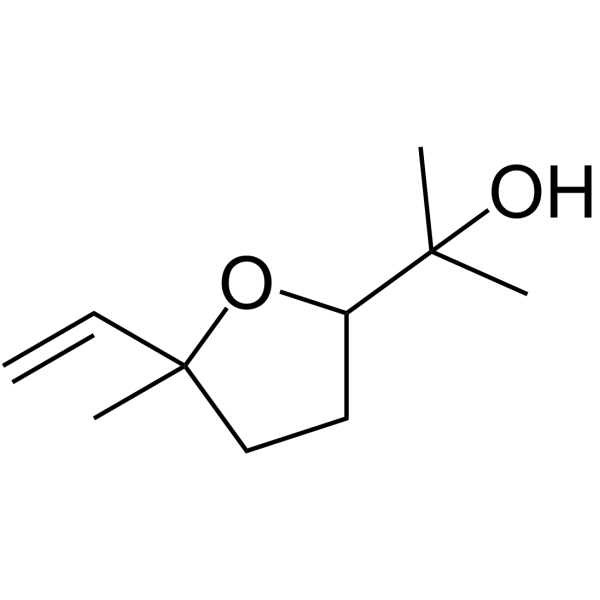
Physicochemical Properties
| Molecular Formula | C10H18O2 |
| Molecular Weight | 170.24872 |
| Exact Mass | 170.131 |
| CAS # | 60047-17-8 |
| PubChem CID | 22310 |
| Appearance | Colorless to light yellow liquid |
| Density | 0.945 g/mL at 20 °C(lit.) |
| Boiling Point | 188°C |
| Melting Point | 128.30 °C. @ 0.00 mm Hg |
| Flash Point | 63°C |
| Index of Refraction | n20/D 1.452 |
| LogP | 1.881 |
| Hydrogen Bond Donor Count | 1 |
| Hydrogen Bond Acceptor Count | 2 |
| Rotatable Bond Count | 2 |
| Heavy Atom Count | 12 |
| Complexity | 186 |
| Defined Atom Stereocenter Count | 0 |
| SMILES | C=CC1(C)CCC(C(C)(C)O)O1 |
| InChi Key | BRHDDEIRQPDPMG-UHFFFAOYSA-N |
| InChi Code | InChI=1S/C10H18O2/c1-5-10(4)7-6-8(12-10)9(2,3)11/h5,8,11H,1,6-7H2,2-4H3 |
| Chemical Name | 2-(5-ethenyl-5-methyloxolan-2-yl)propan-2-ol |
| HS Tariff Code | 2934.99.9001 |
| Storage |
Powder-20°C 3 years 4°C 2 years In solvent -80°C 6 months -20°C 1 month |
| Shipping Condition | Room temperature (This product is stable at ambient temperature for a few days during ordinary shipping and time spent in Customs) |
Biological Activity
| References |
[1]. Antinociceptive and anticonvulsant effects of the monoterpene linalool oxide. Pharm Biol. 2017 Dec;55(1):63-67. [2]. Anxiolytic-like effects of inhaled linalool oxide in experimental mouse anxiety models. Pharmacol Biochem Behav. 2011 Dec;100(2):259-63. [3]. Mechanically-injured wheat plants release greater amounts of the secondary metabolites linalool and linalool oxide. Journal of Plant Protection Research, 2006: 29-39-29-39. |
| Additional Infomation |
Linalyl oxide is a member of oxolanes. Linalyl oxide has been reported in Camellia sinensis, Pulicaria arabica, and Carica papaya with data available. |
Solubility Data
| Solubility (In Vitro) | DMSO : ~100 mg/mL (~587.37 mM) |
| Solubility (In Vivo) |
Solubility in Formulation 1: ≥ 2.5 mg/mL (14.68 mM) (saturation unknown) in 10% DMSO + 40% PEG300 + 5% Tween80 + 45% Saline (add these co-solvents sequentially from left to right, and one by one), clear solution. For example, if 1 mL of working solution is to be prepared, you can add 100 μL of 25.0 mg/mL clear DMSO stock solution to 400 μL PEG300 and mix evenly; then add 50 μL Tween-80 to the above solution and mix evenly; then add 450 μL normal saline to adjust the volume to 1 mL. Preparation of saline: Dissolve 0.9 g of sodium chloride in 100 mL ddH₂ O to obtain a clear solution. Solubility in Formulation 2: ≥ 2.5 mg/mL (14.68 mM) (saturation unknown) in 10% DMSO + 90% (20% SBE-β-CD in Saline) (add these co-solvents sequentially from left to right, and one by one), clear solution. For example, if 1 mL of working solution is to be prepared, you can add 100 μL of 25.0 mg/mL clear DMSO stock solution to 900 μL of 20% SBE-β-CD physiological saline solution and mix evenly. Preparation of 20% SBE-β-CD in Saline (4°C,1 week): Dissolve 2 g SBE-β-CD in 10 mL saline to obtain a clear solution. Solubility in Formulation 3: ≥ 2.5 mg/mL (14.68 mM) (saturation unknown) in 10% DMSO + 90% Corn Oil (add these co-solvents sequentially from left to right, and one by one), clear solution. For example, if 1 mL of working solution is to be prepared, you can add 100 μL of 25.0 mg/mL clear DMSO stock solution to 900 μL of corn oil and mix evenly. (Please use freshly prepared in vivo formulations for optimal results.) |
| Preparing Stock Solutions | 1 mg | 5 mg | 10 mg | |
| 1 mM | 5.8737 mL | 29.3686 mL | 58.7372 mL | |
| 5 mM | 1.1747 mL | 5.8737 mL | 11.7474 mL | |
| 10 mM | 0.5874 mL | 2.9369 mL | 5.8737 mL |