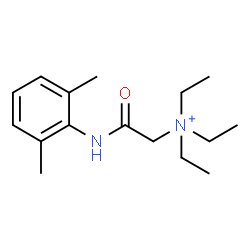
Lidocaine N-ethyl bromide is a novel and potent blocker of fast Na+-dependent action potentials and voltage-dependent
Physicochemical Properties
| Molecular Formula | C16H27N2O |
| Molecular Weight | 343.30200 |
| Exact Mass | 342.131 |
| Elemental Analysis | C, 55.98; H, 7.93; Br, 23.27; N, 8.16; O, 4.66 |
| CAS # | 21306-56-9 |
| PubChem CID | 9884487 |
| Appearance | Typically exists as solid at room temperature |
| LogP | 0.195 |
| Hydrogen Bond Donor Count | 1 |
| Hydrogen Bond Acceptor Count | 2 |
| Rotatable Bond Count | 6 |
| Heavy Atom Count | 20 |
| Complexity | 268 |
| Defined Atom Stereocenter Count | 0 |
| SMILES | [Br-].CC[N+](CC(NC1=C(C)C=CC=C1C)=O)(CC)CC |
| InChi Key | DLHMKHREUTXMCH-UHFFFAOYSA-N |
| InChi Code | InChI=1S/C16H26N2O.BrH/c1-6-18(7-2,8-3)12-15(19)17-16-13(4)10-9-11-14(16)5;/h9-11H,6-8,12H2,1-5H3;1H |
| Chemical Name | [2-(2,6-dimethylanilino)-2-oxoethyl]-triethylazanium;bromide |
| Synonyms | 24003-58-5; N-(2,6-Dimethylphenylcarbamoylmethyl)triethylammonium bromide; QX-314 BROMIDE; 3OYF1S84EN; UNII-3OYF1S84EN; DTXSID001018052; Ethanaminium, 2-((2,6-dimethylphenyl)amino)-N,N,N-triethyl-2-oxo-, bromide (1:1); ...; 21306-56-9; |
| HS Tariff Code | 2934.99.9001 |
| Storage |
Powder-20°C 3 years 4°C 2 years In solvent -80°C 6 months -20°C 1 month |
| Shipping Condition | Room temperature (This product is stable at ambient temperature for a few days during ordinary shipping and time spent in Customs) |
Biological Activity
| Targets | Na+/Sodium channel |
| ln Vivo | N-methyl bromide of lidocaine (QX-314) is a potential local anaesthetic with compromised penetration through cell membranes due to its obligated positive charge. Liposomes have been widely used for drug delivery with promising efficacy and safety. Therefore we investigated the local anaesthetic effects and tissue reactions of QX-314 in combination with anionic, cationic or neutral liposomes in rat sciatic nerve block model, and explored the effects of these liposomes on cellular entry of QX-314 in human embryonic kidney 293 cells. The results demonstrated that anionic liposomes substantially prolonged the duration of sensory (25.7 ± 8.3 h) and motor (41.4 ± 6.1 h) blocks of QX-314, while cationic and neutral ones had little effects. Tissue reactions from QX-314 with anionic liposomes were similar to those with commonly used local anaesthetic bupivacaine. Consistent with in vivo results, the anionic liposomes produced the greatest promotion of cellular entry of QX-314 in a time-dependent manner. In conclusion, ultra-long lasting nerve blocks were achieved by a mixture of QX-314 and anionic liposomes with a satisfactory safety profile, indicating a potential approach to improve postoperative pain management. The liposome-induced enhancement in cellular uptake of QX-314 may underlie the in vivo effects [1]. |
| Animal Protocol | Sprague-Dowley rats weighted 200~300 g were housed in a 12 h light/12 h dark cycle with free access to food and water. Animals were acclimated for one week before formal test, and randomized into nine groups with 8 rats each. Baselines of sensory and motor function were measured for three consecutive days prior to experiments (see below). Rats with normal sensation and muscle strength received 0.2 mL of peri-sciatic nerve injection of the following test solutions: 25 mmol/L QX-314 (Q), 25 mmol/L QX-314 in 40 mmol/L anionic liposomes (AL40), 25 mmol/L QX-314 in 80 mmol/L anionic liposomes (AL80), 25 mmol/L QX-314 in 40 mmol/L neutral liposomes (NL40), 25 mmol/L QX-314 in 80 mmol/L neutral liposomes (NL80), 25 mmol/L QX-314 in 40 mmol/L cationic liposomes (CL40), or 25 mmol/L QX-314 in 80 mmol/L cationic liposomes (CL80). 0.5% bupivacaine hydrochloride and saline served as positive and negative control, respectively. [1] |
| References | [1]. Effects of Liposomes Charge on Extending Sciatic Nerve Blockade of N-ethyl Bromide of Lidocaine in Rats. Sci Rep. 2016 Dec 7;6:38582 |
| Additional Infomation | In conclusion, mixing of QX-314 with anionic liposomes produced ultra-long lasting sciatic nerve blocks in rats without systemic toxicity and local tissue injury, indicating a potential approach to improve postoperative pain management. The substantial increase in cellular accumulation of QX-314 by anionic liposomes may attribute to the prolongation effects in vivo. [1] |
Solubility Data
| Solubility (In Vitro) | May dissolve in DMSO (in most cases), if not, try other solvents such as H2O, Ethanol, or DMF with a minute amount of products to avoid loss of samples |
| Solubility (In Vivo) |
Note: Listed below are some common formulations that may be used to formulate products with low water solubility (e.g. < 1 mg/mL), you may test these formulations using a minute amount of products to avoid loss of samples. Injection Formulations (e.g. IP/IV/IM/SC) Injection Formulation 1: DMSO : Tween 80: Saline = 10 : 5 : 85 (i.e. 100 μL DMSO stock solution → 50 μL Tween 80 → 850 μL Saline) *Preparation of saline: Dissolve 0.9 g of sodium chloride in 100 mL ddH ₂ O to obtain a clear solution. Injection Formulation 2: DMSO : PEG300 :Tween 80 : Saline = 10 : 40 : 5 : 45 (i.e. 100 μL DMSO → 400 μLPEG300 → 50 μL Tween 80 → 450 μL Saline) Injection Formulation 3: DMSO : Corn oil = 10 : 90 (i.e. 100 μL DMSO → 900 μL Corn oil) Example: Take the Injection Formulation 3 (DMSO : Corn oil = 10 : 90) as an example, if 1 mL of 2.5 mg/mL working solution is to be prepared, you can take 100 μL 25 mg/mL DMSO stock solution and add to 900 μL corn oil, mix well to obtain a clear or suspension solution (2.5 mg/mL, ready for use in animals). Injection Formulation 4: DMSO : 20% SBE-β-CD in saline = 10 : 90 [i.e. 100 μL DMSO → 900 μL (20% SBE-β-CD in saline)] *Preparation of 20% SBE-β-CD in Saline (4°C,1 week): Dissolve 2 g SBE-β-CD in 10 mL saline to obtain a clear solution. Injection Formulation 5: 2-Hydroxypropyl-β-cyclodextrin : Saline = 50 : 50 (i.e. 500 μL 2-Hydroxypropyl-β-cyclodextrin → 500 μL Saline) Injection Formulation 6: DMSO : PEG300 : castor oil : Saline = 5 : 10 : 20 : 65 (i.e. 50 μL DMSO → 100 μLPEG300 → 200 μL castor oil → 650 μL Saline) Injection Formulation 7: Ethanol : Cremophor : Saline = 10: 10 : 80 (i.e. 100 μL Ethanol → 100 μL Cremophor → 800 μL Saline) Injection Formulation 8: Dissolve in Cremophor/Ethanol (50 : 50), then diluted by Saline Injection Formulation 9: EtOH : Corn oil = 10 : 90 (i.e. 100 μL EtOH → 900 μL Corn oil) Injection Formulation 10: EtOH : PEG300:Tween 80 : Saline = 10 : 40 : 5 : 45 (i.e. 100 μL EtOH → 400 μLPEG300 → 50 μL Tween 80 → 450 μL Saline) Oral Formulations Oral Formulation 1: Suspend in 0.5% CMC Na (carboxymethylcellulose sodium) Oral Formulation 2: Suspend in 0.5% Carboxymethyl cellulose Example: Take the Oral Formulation 1 (Suspend in 0.5% CMC Na) as an example, if 100 mL of 2.5 mg/mL working solution is to be prepared, you can first prepare 0.5% CMC Na solution by measuring 0.5 g CMC Na and dissolve it in 100 mL ddH2O to obtain a clear solution; then add 250 mg of the product to 100 mL 0.5% CMC Na solution, to make the suspension solution (2.5 mg/mL, ready for use in animals). Oral Formulation 3: Dissolved in PEG400 Oral Formulation 4: Suspend in 0.2% Carboxymethyl cellulose Oral Formulation 5: Dissolve in 0.25% Tween 80 and 0.5% Carboxymethyl cellulose Oral Formulation 6: Mixing with food powders Note: Please be aware that the above formulations are for reference only. InvivoChem strongly recommends customers to read literature methods/protocols carefully before determining which formulation you should use for in vivo studies, as different compounds have different solubility properties and have to be formulated differently. (Please use freshly prepared in vivo formulations for optimal results.) |
| Preparing Stock Solutions | 1 mg | 5 mg | 10 mg | |
| 1 mM | 2.9129 mL | 14.5645 mL | 29.1290 mL | |
| 5 mM | 0.5826 mL | 2.9129 mL | 5.8258 mL | |
| 10 mM | 0.2913 mL | 1.4565 mL | 2.9129 mL |