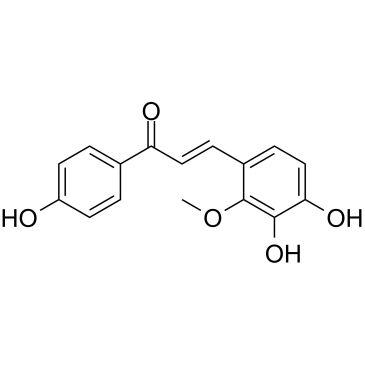
Licochalcone B, a naturally occuring chalcone compound isolated from the root of Glycyrrhiza inflate, is an inhibitor of phosphorylation of NF-kappaB p65 in LPS signaling pathway. It also inhibits amyloid β (Aβ42) self-aggregation (IC50=2.16 μM) and disaggregate pre-formed Aβ42 fibrils, reduce metal-induced Aβ42 aggregation through chelating metal ions.
Physicochemical Properties
| Molecular Formula | C16H14O5 |
| Molecular Weight | 286.28 |
| Exact Mass | 286.084 |
| CAS # | 58749-23-8 |
| Related CAS # | 58749-23-8; |
| PubChem CID | 5318999 |
| Appearance | Light yellow to yellow solid powder |
| Density | 1.4±0.1 g/cm3 |
| Boiling Point | 550.5±50.0 °C at 760 mmHg |
| Melting Point | 196-197ºC |
| Flash Point | 208.5±23.6 °C |
| Vapour Pressure | 0.0±1.5 mmHg at 25°C |
| Index of Refraction | 1.684 |
| LogP | 2.57 |
| Hydrogen Bond Donor Count | 3 |
| Hydrogen Bond Acceptor Count | 5 |
| Rotatable Bond Count | 4 |
| Heavy Atom Count | 21 |
| Complexity | 373 |
| Defined Atom Stereocenter Count | 0 |
| SMILES | COC1=C(C=CC(=C1O)O)/C=C/C(=O)C2=CC=C(C=C2)O |
| InChi Key | IOBDWJXFMVMVKI-XBXARRHUSA-N |
| InChi Code | InChI=1S/C16H14O5/c1-21-16-12(7-9-14(19)15(16)20)13(18)8-4-10-2-5-11(17)6-3-10/h2-9,17,19-20H,1H3/b8-4+ |
| Chemical Name | (E)-1-(3,4-dihydroxy-2-methoxyphenyl)-3-(4-hydroxyphenyl)prop-2-en-1-one |
| Synonyms | LicoB Lico-B Lico BLicochalcone-B |
| HS Tariff Code | 2934.99.9001 |
| Storage |
Powder-20°C 3 years 4°C 2 years In solvent -80°C 6 months -20°C 1 month Note: This product requires protection from light (avoid light exposure) during transportation and storage. |
| Shipping Condition | Room temperature (This product is stable at ambient temperature for a few days during ordinary shipping and time spent in Customs) |
Biological Activity
| ln Vitro | Aβ42 aggregation is inhibited and Aβ42 pre-fibril formation is fragmented by licochalcone B (IC50: 2.16 μM) [1]. In SH-SY5Y cells, licochalcone B (0–12 μM, 48 h) decreases ROS generation and safeguards the cell culture medium H2O2. causes cellular apoptosis. In RAW264.7 cells, licochalcone B (10 μM, 1 h) suppresses the activation of NF-κB triggered by LPS [2]. Licochalcone B (0–20 μM, 24 or 48 h) suppresses the development of human NSCLC cells, while licochalcone B (10 μM, 1 h) inhibits LPS-induced NF-κB p65 serine 276 phosphorylation [3]. |
| ln Vivo | Licochalcone B (1–25 mg/kg, gavage) reduces the oxidative stress and hepatotoxicity that CCl4[5] causes in mice. |
| Cell Assay |
Western Blot Analysis[2] Cell Types: RAW264.7 Cell Tested Concentrations: 10. µM Incubation Duration: 1 hour Experimental Results: Inhibits phosphorylation of NF-κB at serine 276 but not at serine 536. |
| Animal Protocol |
Animal/Disease Models: CCl4[5] induced mice Doses: 1, 5, 25 mg/kg Route of Administration: po (oral gavage). Experimental Results: SOD and GSH levels increased, and GSSG levels diminished. |
| References |
[1]. Licochalcone B, a chalcone derivative from Glycyrrhiza inflata, as a multifunctional agent for the treatment of Alzheimer's disease. Nat Prod Res. 2018 Oct 22:1-4. [2]. Glycyrrhiza inflata-derived chalcones, Licochalcone A, Licochalcone B and Licochalcone D, inhibit phosphorylation of NF-kappaB p65 in LPS signaling pathway. Int Immunopharmacol. 2009 Apr;9(4):499-507. [3]. Licochalcone B inhibits growth and induces apoptosis of human non-small-cell lung cancer cells by dual targeting of EGFR and MET. Phytomedicine. 2019 Oct;63:153014. [4]. Licochalcone B specifically inhibits the NLRP3 inflammasome by disrupting NEK7-NLRP3 interaction. EMBO Rep. 2022 Feb 3;23(2):e53499. [5]. Hepatoprotective effects of licochalcone B on carbon tetrachloride-induced liver toxicity in mice. Iran J Basic Med Sci. 2016 Aug;19(8):910-915. |
| Additional Infomation |
Licochalcone B is a member of chalcones. Licochalcone B has been reported in Glycyrrhiza uralensis, Euphorbia helioscopia, and other organisms with data available. See also: Glycyrrhiza inflata root (part of). |
Solubility Data
| Solubility (In Vitro) |
DMSO : ~83.33 mg/mL (~291.08 mM) H2O : < 0.1 mg/mL |
| Solubility (In Vivo) |
Solubility in Formulation 1: ≥ 2.08 mg/mL (7.27 mM) (saturation unknown) in 10% DMSO + 90% (20% SBE-β-CD in Saline) (add these co-solvents sequentially from left to right, and one by one), clear solution. For example, if 1 mL of working solution is to be prepared, you can add 100 μL of 20.8 mg/mL clear DMSO stock solution to 900 μL of 20% SBE-β-CD physiological saline solution and mix evenly. Preparation of 20% SBE-β-CD in Saline (4°C,1 week): Dissolve 2 g SBE-β-CD in 10 mL saline to obtain a clear solution. (Please use freshly prepared in vivo formulations for optimal results.) |
| Preparing Stock Solutions | 1 mg | 5 mg | 10 mg | |
| 1 mM | 3.4931 mL | 17.4654 mL | 34.9308 mL | |
| 5 mM | 0.6986 mL | 3.4931 mL | 6.9862 mL | |
| 10 mM | 0.3493 mL | 1.7465 mL | 3.4931 mL |