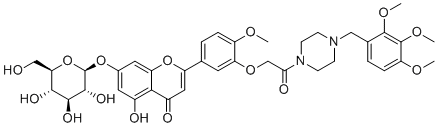
Lew 10 (Lew-10) is a synthetic analogue of diosmin, which is a naturally occurring flavonoid glycoside isolated from various citrus fruits, hyssop, and rosemary, acting as an agonist of the aryl hydrocarbon receptor (AhR).
Physicochemical Properties
| Molecular Formula | C38H44N2O15 |
| Molecular Weight | 768.76 |
| Exact Mass | 768.274 |
| Elemental Analysis | C, 59.37; H, 5.77; N, 3.64; O, 31.22 |
| CAS # | 123580-53-0 |
| PubChem CID | 5492442 |
| Appearance | Typically exists as solid at room temperature |
| Density | 1.429g/cm3 |
| Boiling Point | 968.7ºC at 760mmHg |
| Flash Point | 539.6ºC |
| Vapour Pressure | 0mmHg at 25°C |
| Index of Refraction | 1.634 |
| LogP | 0.977 |
| Hydrogen Bond Donor Count | 5 |
| Hydrogen Bond Acceptor Count | 16 |
| Rotatable Bond Count | 13 |
| Heavy Atom Count | 55 |
| Complexity | 1300 |
| Defined Atom Stereocenter Count | 5 |
| SMILES | COC1=C(C=C(C=C1)C2=CC(=O)C3=C(C=C(C=C3O2)O[C@H]4[C@@H]([C@H]([C@@H]([C@H](O4)CO)O)O)O)O)OCC(=O)N5CCN(CC5)CC6=C(C(=C(C=C6)OC)OC)OC |
| InChi Key | CNMUTGICIHOIEX-IHQQTPIISA-N |
| InChi Code | InChI=1S/C38H44N2O15/c1-48-25-7-5-20(27-16-24(43)32-23(42)14-22(15-29(32)54-27)53-38-35(47)34(46)33(45)30(18-41)55-38)13-28(25)52-19-31(44)40-11-9-39(10-12-40)17-21-6-8-26(49-2)37(51-4)36(21)50-3/h5-8,13-16,30,33-35,38,41-42,45-47H,9-12,17-19H2,1-4H3/t30-,33-,34+,35-,38-/m1/s1 |
| Chemical Name | 5-hydroxy-2-[4-methoxy-3-[2-oxo-2-[4-[(2,3,4-trimethoxyphenyl)methyl]piperazin-1-yl]ethoxy]phenyl]-7-[(2S,3R,4S,5S,6R)-3,4,5-trihydroxy-6-(hydroxymethyl)oxan-2-yl]oxychromen-4-one |
| Synonyms | Lew10; Lew 10; 123580-53-0; DTXSID50154047; Piperazine, 1-((5-(7-(beta-D-glucopyranosyloxy)-5-hydroxy-4-oxo-4H-1-benzopyran-2-yl)-2-methoxyphenoxy)acetyl)-4-((2,3,4-trimethoxyphenyl)methyl)-; RefChem:153241; DTXCID6076538; 5-hydroxy-2-[4-methoxy-3-[2-oxo-2-[4-[(2,3,4-trimethoxyphenyl)methyl]piperazin-1-yl]ethoxy]phenyl]-7-[(2S,3R,4S,5S,6R)-3,4,5-trihydroxy-6-(hydroxymethyl)oxan-2-yl]oxychromen-4-one; Lew-10; Lew 10 |
| HS Tariff Code | 2934.99.9001 |
| Storage |
Powder-20°C 3 years 4°C 2 years In solvent -80°C 6 months -20°C 1 month |
| Shipping Condition | Room temperature (This product is stable at ambient temperature for a few days during ordinary shipping and time spent in Customs) |
Biological Activity
| Targets |
The study did not identify specific molecular targets for LEW-10. Its effects were attributed to direct interactions with phospholipid bilayers, altering their thermal behavior and elastic properties without binding to specific protein receptors or enzymes. |
| ln Vitro |
- Thermal Behavior Modulation:
- Reference [1]: LEW-10 (0–50 mol%) dose-dependently reduced the main gel-to-liquid crystalline phase transition temperature (Tm) of dipalmitoylphosphatidylcholine (DPPC) bilayers by 3–8°C, as measured by differential scanning calorimetry (DSC). This effect was accompanied by broadening of the transition peak, indicating increased membrane heterogeneity. At concentrations ≥20 mol%, LEW-10 induced a reversible pre-transition phase at 28–32°C, absent in pure DPPC bilayers. - Elastic Property Alteration: - Reference [1]: Using oscillatory rheology, LEW-10 (10–30 mol%) decreased the elastic modulus (G') of DPPC bilayers by 20–40% at temperatures above Tm, reflecting reduced membrane rigidity. Dynamic light scattering revealed a concentration-dependent increase in lipid vesicle size (from 100 nm to 250 nm), suggesting enhanced bilayer fusion propensity. |
| References | [1]. Thermal behavior and elastic properties of phospholipid bilayers under the effect of a synthetic flavonoid derivative, LEW-10. Chem Phys Lipids. 1992 Dec;63(3):169-77. |
| Additional Infomation |
We have investigated the effect on phospholipidic bilayers of LEW-10, a synthetic flavonoid, derivative of diosmin. Two optical techniques, Quasi-elastic Light Scattering (QLS) and Fourier Transform Infrared Spectroscopy (FT-IR) were used. The results show that in the presence of LEW-10, the phase transition of the bilayers is lowered and that the elastic modulus is decreased. The FT-IR results indicate interactions in the aqueous interface regions of the bilayers. We also discuss LEW-10 comparatively with another derivative, LEW-7/S1, whose effect has been previously studied.[1].
- Structural Insights: - Reference [1]: LEW-10 is a synthetic flavonoid derivative with a 3,5,7-trihydroxyflavone core structure, featuring a long aliphatic tail (C16 alkyl chain) attached to the C-6 position. This amphiphilic design facilitates insertion into phospholipid bilayers, disrupting hydrophobic interactions between acyl chains. - Mechanism of Action: - Reference [1]: LEW-10 intercalates into the hydrophobic core of phospholipid bilayers, reducing acyl chain packing density and increasing membrane fluidity. This effect is more pronounced in saturated lipid systems (e.g., DPPC) compared to unsaturated ones (e.g., dioleoylphosphatidylcholine, DOPC). The aliphatic tail enhances lateral membrane expansion, while hydroxyl groups promote hydrogen bonding with lipid headgroups, stabilizing the bilayer in a semi-fluid state. - Formulation Relevance: - Reference [1]: The ability of LEW-10 to modulate bilayer properties suggests potential applications in drug delivery systems, such as enhancing the stability of liposomal formulations or improving transmembrane drug permeation. However, no specific formulations were tested in this study. |
Solubility Data
| Solubility (In Vitro) | May dissolve in DMSO (in most cases), if not, try other solvents such as H2O, Ethanol, or DMF with a minute amount of products to avoid loss of samples |
| Solubility (In Vivo) |
Note: Listed below are some common formulations that may be used to formulate products with low water solubility (e.g. < 1 mg/mL), you may test these formulations using a minute amount of products to avoid loss of samples. Injection Formulations (e.g. IP/IV/IM/SC) Injection Formulation 1: DMSO : Tween 80: Saline = 10 : 5 : 85 (i.e. 100 μL DMSO stock solution → 50 μL Tween 80 → 850 μL Saline) *Preparation of saline: Dissolve 0.9 g of sodium chloride in 100 mL ddH ₂ O to obtain a clear solution. Injection Formulation 2: DMSO : PEG300 :Tween 80 : Saline = 10 : 40 : 5 : 45 (i.e. 100 μL DMSO → 400 μLPEG300 → 50 μL Tween 80 → 450 μL Saline) Injection Formulation 3: DMSO : Corn oil = 10 : 90 (i.e. 100 μL DMSO → 900 μL Corn oil) Example: Take the Injection Formulation 3 (DMSO : Corn oil = 10 : 90) as an example, if 1 mL of 2.5 mg/mL working solution is to be prepared, you can take 100 μL 25 mg/mL DMSO stock solution and add to 900 μL corn oil, mix well to obtain a clear or suspension solution (2.5 mg/mL, ready for use in animals). Injection Formulation 4: DMSO : 20% SBE-β-CD in saline = 10 : 90 [i.e. 100 μL DMSO → 900 μL (20% SBE-β-CD in saline)] *Preparation of 20% SBE-β-CD in Saline (4°C,1 week): Dissolve 2 g SBE-β-CD in 10 mL saline to obtain a clear solution. Injection Formulation 5: 2-Hydroxypropyl-β-cyclodextrin : Saline = 50 : 50 (i.e. 500 μL 2-Hydroxypropyl-β-cyclodextrin → 500 μL Saline) Injection Formulation 6: DMSO : PEG300 : castor oil : Saline = 5 : 10 : 20 : 65 (i.e. 50 μL DMSO → 100 μLPEG300 → 200 μL castor oil → 650 μL Saline) Injection Formulation 7: Ethanol : Cremophor : Saline = 10: 10 : 80 (i.e. 100 μL Ethanol → 100 μL Cremophor → 800 μL Saline) Injection Formulation 8: Dissolve in Cremophor/Ethanol (50 : 50), then diluted by Saline Injection Formulation 9: EtOH : Corn oil = 10 : 90 (i.e. 100 μL EtOH → 900 μL Corn oil) Injection Formulation 10: EtOH : PEG300:Tween 80 : Saline = 10 : 40 : 5 : 45 (i.e. 100 μL EtOH → 400 μLPEG300 → 50 μL Tween 80 → 450 μL Saline) Oral Formulations Oral Formulation 1: Suspend in 0.5% CMC Na (carboxymethylcellulose sodium) Oral Formulation 2: Suspend in 0.5% Carboxymethyl cellulose Example: Take the Oral Formulation 1 (Suspend in 0.5% CMC Na) as an example, if 100 mL of 2.5 mg/mL working solution is to be prepared, you can first prepare 0.5% CMC Na solution by measuring 0.5 g CMC Na and dissolve it in 100 mL ddH2O to obtain a clear solution; then add 250 mg of the product to 100 mL 0.5% CMC Na solution, to make the suspension solution (2.5 mg/mL, ready for use in animals). Oral Formulation 3: Dissolved in PEG400 Oral Formulation 4: Suspend in 0.2% Carboxymethyl cellulose Oral Formulation 5: Dissolve in 0.25% Tween 80 and 0.5% Carboxymethyl cellulose Oral Formulation 6: Mixing with food powders Note: Please be aware that the above formulations are for reference only. InvivoChem strongly recommends customers to read literature methods/protocols carefully before determining which formulation you should use for in vivo studies, as different compounds have different solubility properties and have to be formulated differently. (Please use freshly prepared in vivo formulations for optimal results.) |
| Preparing Stock Solutions | 1 mg | 5 mg | 10 mg | |
| 1 mM | 1.3008 mL | 6.5040 mL | 13.0080 mL | |
| 5 mM | 0.2602 mL | 1.3008 mL | 2.6016 mL | |
| 10 mM | 0.1301 mL | 0.6504 mL | 1.3008 mL |