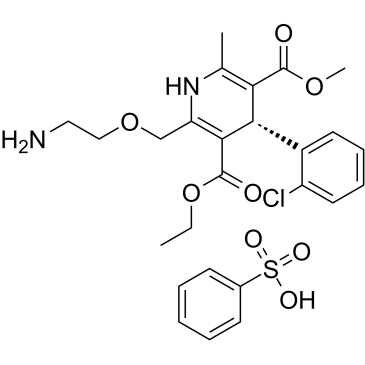
Levamlodipine besylate, the besylate salt of Levamlodipine which is the S-isomer and impurity of Amlodipine (Amlodis; Amlor, Coroval; Lipinox; Norvasc; Amvaz), is an anti-hypertensive agent of the dihydropyridine (DHP) class and can be used for lowering blood pressure. It acts as a long-acting L-type calcium channel blocker (CCB).
Physicochemical Properties
| Molecular Formula | C₂₆H₃₁CLN₂O₈S |
| Molecular Weight | 567.05 |
| Exact Mass | 566.149 |
| CAS # | 150566-71-5 |
| Related CAS # | Levamlodipine;103129-82-4 |
| PubChem CID | 11365087 |
| Appearance | White to light yellow solid powder |
| Density | 1.228 g/cm3 |
| Boiling Point | 527.161ºC at 760 mmHg |
| Flash Point | 272.617ºC |
| LogP | 5.309 |
| Hydrogen Bond Donor Count | 3 |
| Hydrogen Bond Acceptor Count | 10 |
| Rotatable Bond Count | 11 |
| Heavy Atom Count | 38 |
| Complexity | 830 |
| Defined Atom Stereocenter Count | 1 |
| SMILES | CCOC(=O)C1=C(NC(=C([C@@H]1C2=CC=CC=C2Cl)C(=O)OC)C)COCCN.C1=CC=C(C=C1)S(=O)(=O)O |
| InChi Key | ZPBWCRDSRKPIDG-LMOVPXPDSA-N |
| InChi Code | InChI=1S/C20H25ClN2O5.C6H6O3S/c1-4-28-20(25)18-15(11-27-10-9-22)23-12(2)16(19(24)26-3)17(18)13-7-5-6-8-14(13)21;7-10(8,9)6-4-2-1-3-5-6/h5-8,17,23H,4,9-11,22H2,1-3H3;1-5H,(H,7,8,9)/t17-;/m0./s1 |
| Chemical Name | benzenesulfonic acid;3-O-ethyl 5-O-methyl (4S)-2-(2-aminoethoxymethyl)-4-(2-chlorophenyl)-6-methyl-1,4-dihydropyridine-3,5-dicarboxylate |
| Synonyms | Amlodis Amlor, Coroval Lipinox NorvascAmvaz (S)-Amlodipine besylate |
| HS Tariff Code | 2934.99.9001 |
| Storage |
Powder-20°C 3 years 4°C 2 years In solvent -80°C 6 months -20°C 1 month Note: Please store this product in a sealed and protected environment (e.g. under nitrogen), avoid exposure to moisture and light. |
| Shipping Condition | Room temperature (This product is stable at ambient temperature for a few days during ordinary shipping and time spent in Customs) |
Biological Activity
| ln Vivo |
In a murine model of vascular dementia (VaD) induced by right unilateral common carotid arteries occlusion (rUCCAO), oral administration of Levamlodipine besylate at a dose of 0.1 mg/kg for eight weeks significantly reduced the escape latency to find the hidden platform during training trials in the Morris Water Maze test compared to the vehicle-treated group, indicating improved spatial learning. [1] In the probe trial of the Morris Water Maze, no significant improvement in platform crossing times was observed in the Levamlodipine besylate-treated groups compared to the vehicle group. [1] In the Novel Object Recognition test, treatment with Levamlodipine besylate (0.1 or 0.5 mg/kg) significantly improved recognition memory in rUCCAO mice, as evidenced by increased exploring time and exploring frequency on the novel object compared to the vehicle-treated group. [1] Immunofluorescence staining revealed a significant decrease in phospho-CaMKII (Thr286) levels in the hippocampal CA1 region of vehicle-treated rUCCAO mice. Treatment with Levamlodipine besylate (0.1 mg/kg and 0.5 mg/kg) partially restored these decreased phospho-CaMKII levels. [1] Treatment with Levamlodipine besylate (0.1 mg/kg and 0.5 mg/kg) did not show significant effects on brain vascular structure, blood pressure, or the activation of astrocytes (GFAP, S100β expression) and microglia (Iba-1 expression) in the hippocampus of rUCCAO mice. [1] |
| Animal Protocol |
Vascular dementia was induced in mice using the right unilateral common carotid arteries occlusion (rUCCAO) model. Mice were anesthetized, the right common carotid artery was isolated and double-ligated. Sham-operated mice underwent the same surgery without ligation. [1] Eight weeks after the rUCCAO surgery, drug treatment began. Levamlodipine besylate was administered orally (p.o.) once daily at doses of 0.1 mg/kg or 0.5 mg/kg for a duration of eight weeks. The drug was dissolved in saline. The vehicle control group received oral saline. [1] Behavioral tests (Morris Water Maze and Novel Object Recognition Test) were conducted after the eight-week treatment period. [1] Following behavioral tests, mice were perfused, and brain tissues were collected for immunohistochemical analysis. [1] |
| References |
[1]. Effect of low-dose Levamlodipine Besylate in the treatment of vascular dementia. Sci Rep. 2019 Dec 3;9(1):18248. [2]. Effects of antihypertensive drugs losartan and levamlodipine besylate on insulin resistance in patients with essential hypertension combined with isolated impaired fasting glucose. Hypertens Res. 2016 May;39(5):321-6. [3]. [Effect of probucol on serum malondialdehyde and superoxide dismutase in patients with primary hypertension]. Zhong Nan Da Xue Xue Bao Yi Xue Ban. 2012 May;37(5):458-62. [4]. Synergic effects of levamlodipine and bisoprolol on blood pressure reduction and organ protection in spontaneously hypertensive rats. CNS Neurosci Ther. 2012 Jun;18(6):471-4. |
| Additional Infomation |
Levamlodipine besylate is proposed as a prospective pharmacological treatment for vascular dementia (VaD) due to its L-type calcium channel blocking activity, which may lead to cerebral vasodilation and improved perfusion. [1] The study suggests that the cognitive-enhancing effects of low-dose Levamlodipine besylate in the VaD mouse model are mediated through the restoration of hippocampal CaMKII phosphorylation at Thr286, a key mediator of synaptic plasticity and memory, rather than through effects on blood pressure or neuroinflammation (astrocyte/microglia activation). [1] The study used memantine (20 mg/kg, p.o.) as a positive control, which also showed restorative effects on phospho-CaMKII levels and cognitive function in the VaD model. [1] |
Solubility Data
| Solubility (In Vitro) |
DMSO : ≥ 150 mg/mL (~264.53 mM) H2O : ≥ 3.33 mg/mL (~5.87 mM) |
| Solubility (In Vivo) |
Solubility in Formulation 1: ≥ 2.5 mg/mL (4.41 mM) (saturation unknown) in 10% DMSO + 40% PEG300 + 5% Tween80 + 45% Saline (add these co-solvents sequentially from left to right, and one by one), clear solution. For example, if 1 mL of working solution is to be prepared, you can add 100 μL of 25.0 mg/mL clear DMSO stock solution to 400 μL PEG300 and mix evenly; then add 50 μL Tween-80 to the above solution and mix evenly; then add 450 μL normal saline to adjust the volume to 1 mL. Preparation of saline: Dissolve 0.9 g of sodium chloride in 100 mL ddH₂ O to obtain a clear solution. Solubility in Formulation 2: ≥ 2.5 mg/mL (4.41 mM) (saturation unknown) in 10% DMSO + 90% (20% SBE-β-CD in Saline) (add these co-solvents sequentially from left to right, and one by one), clear solution. For example, if 1 mL of working solution is to be prepared, you can add 100 μL of 25.0 mg/mL clear DMSO stock solution to 900 μL of 20% SBE-β-CD physiological saline solution and mix evenly. Preparation of 20% SBE-β-CD in Saline (4°C,1 week): Dissolve 2 g SBE-β-CD in 10 mL saline to obtain a clear solution. Solubility in Formulation 3: ≥ 2.5 mg/mL (4.41 mM) (saturation unknown) in 10% DMSO + 90% Corn Oil (add these co-solvents sequentially from left to right, and one by one), clear solution. For example, if 1 mL of working solution is to be prepared, you can add 100 μL of 25.0 mg/mL clear DMSO stock solution to 900 μL of corn oil and mix evenly. (Please use freshly prepared in vivo formulations for optimal results.) |
| Preparing Stock Solutions | 1 mg | 5 mg | 10 mg | |
| 1 mM | 1.7635 mL | 8.8176 mL | 17.6351 mL | |
| 5 mM | 0.3527 mL | 1.7635 mL | 3.5270 mL | |
| 10 mM | 0.1764 mL | 0.8818 mL | 1.7635 mL |