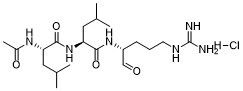
Leupeptin HCl, the hydrochloride salt of Leupeptin ,is a potent protease inhibitor and lysosome inhibitor.
Physicochemical Properties
| Exact Mass | 426.29545 |
| Elemental Analysis | C, 51.88; H, 8.49; Cl, 7.66; N, 18.15; O, 13.82 |
| CAS # | 9740-82-4 |
| Related CAS # |
39740-82-4 (HCl); 24365-47-7; 55123-66-5(free base); 1082207-96-2 (hemisulfate hydrate); 103476-89-7 (hemisulfate) |
| Appearance | Typically exists as solid at room temperature |
| LogP | 1.1 |
| InChi Key | OQQYPQNFLLAILR-LPZNKSAJSA-N |
| InChi Code | InChI=1S/C20H38N6O4.ClH/c1-12(2)9-16(24-14(5)28)19(30)26-17(10-13(3)4)18(29)25-15(11-27)7-6-8-23-20(21)22;/h11-13,15-17H,6-10H2,1-5H3,(H,24,28)(H,25,29)(H,26,30)(H4,21,22,23);1H/t15-,16+,17+;/m1./s1 |
| Chemical Name | (S)-2-acetamido-N-((S)-1-(((R)-5-guanidino-1-oxopentan-2-yl)amino)-4-methyl-1-oxopentan-2-yl)-4-methylpentanamide hydrochloride InChi Key: OQQYPQNFLLAILR-LPZNKSAJSA-N |
| Synonyms | N-Acetyl-L-leucyl-L-leucyl-L-argininal Leupeptin Ac-LL Leupeptin |
| HS Tariff Code | 2934.99.9001 |
| Storage |
Powder-20°C 3 years 4°C 2 years In solvent -80°C 6 months -20°C 1 month |
| Shipping Condition | Room temperature (This product is stable at ambient temperature for a few days during ordinary shipping and time spent in Customs) |
Biological Activity
| Targets | protease: Cathepsin B; Cathepsin L; Cathepsin H; Ser/Thr Protease; Mpro |
| ln Vitro | Leupeptin, produced by a variety of actinomycetes, which effectively prevent proteolysis.[1] Tubulin purity is raised when leupeptin hemisulfate shields it from endogenous proteolytic activities during the isolation process.[2] Leupeptin hemisulfate has the potential to restore up to 50% of the expression of the hepatitis B surface antigen (HBsAg) in cell suspension cultures. [3] |
| ln Vivo | Leupeptin was well accepted by the animals and resulted in a significant dose-dependent rise in LC3b-II in the lysosome enriched fraction (LE fraction) as well as total tissue extracts. Leupeptin caused electron-dense vesicular structures to accumulate at the electron microscopy (EM) level. In hepatocytes, these structures became visible 60 minutes after treatment (40 mg/kg). The findings indicated that leupeptin prevented LC3b-II from being broken down inside lysosomes, increasing its levels in vivo. As a result, the leupeptin-based assay has the potential to be used to investigate the dynamics of macroautophagy in mice. |
| Enzyme Assay | Mpro enzyme activity inhibition test. [5] A total of 20 mM leupeptin hemisulfate in deionized water was diluted to 2 mM to 31.25 μM with 25 mM Tris buffer (pH 8.0). A 30-μl inhibitor solution with a series of concentrations in 25 mM Tris buffer (pH 8.0) was first mixed with 10 μl 100 μM peptide substrate (Dabcyl-TSAVLQ↓SGFRKMK-Edans; GenScript). Next, 10 μl of a final concentration of 200 nM Mpro was added to the plate. The relative fluorescence unit (RFU) value was measured with an excitation wavelength of 360 nm and an emission wavelength of 490 nm at 37°C for 1 h by using a SpectraMax Paradigm multimode detection platform (Molecular Devices, USA). Experiments were performed in triplicate. The enzyme activity reaction rate and inhibition rate were calculated by using MS Excel. The inhibition curve was plotted by using GraphPad Prism 8.0. |
| Cell Assay | Leupeptin inhibited human coronavirus strain 229E multiplication in MRC-C cell cultures. Leupeptin's IC50 value in plaque tests was 0.4 μg/mL, and at 50 μg/mL, it had no effect on the host cells' ability to grow. Leupeptin (100 μg/mL) only inhibited virus yield in single-cycle growth experiments when added within two hours of infection, suggesting that it acts on the early stages of virus replication.[5] |
| Animal Protocol | C57BL/6NCrl male mice 20 mg/kg i.p. |
| References |
[1]. J Antibiot (Tokyo). 1969 Nov;22(11):558-68. [2]. Cell Biol Int Rep. 1985 Sep;9(9):849-57. [3]. Inhibition of human prostate cancer growth, osteolysis and angiogenesis in a bone metaPlant Cell Rep. 2007 Sep;26(9):1575-84. [4]. Autophagy. 2011 Jun;7(6):629-42. [5]. mBio. 2021 Oct 26;12(5):e0222021. |
Solubility Data
| Solubility (In Vitro) | May dissolve in DMSO (in most cases), if not, try other solvents such as H2O, Ethanol, or DMF with a minute amount of products to avoid loss of samples |
| Solubility (In Vivo) |
Note: Listed below are some common formulations that may be used to formulate products with low water solubility (e.g. < 1 mg/mL), you may test these formulations using a minute amount of products to avoid loss of samples. Injection Formulations (e.g. IP/IV/IM/SC) Injection Formulation 1: DMSO : Tween 80: Saline = 10 : 5 : 85 (i.e. 100 μL DMSO stock solution → 50 μL Tween 80 → 850 μL Saline) *Preparation of saline: Dissolve 0.9 g of sodium chloride in 100 mL ddH ₂ O to obtain a clear solution. Injection Formulation 2: DMSO : PEG300 :Tween 80 : Saline = 10 : 40 : 5 : 45 (i.e. 100 μL DMSO → 400 μLPEG300 → 50 μL Tween 80 → 450 μL Saline) Injection Formulation 3: DMSO : Corn oil = 10 : 90 (i.e. 100 μL DMSO → 900 μL Corn oil) Example: Take the Injection Formulation 3 (DMSO : Corn oil = 10 : 90) as an example, if 1 mL of 2.5 mg/mL working solution is to be prepared, you can take 100 μL 25 mg/mL DMSO stock solution and add to 900 μL corn oil, mix well to obtain a clear or suspension solution (2.5 mg/mL, ready for use in animals). Injection Formulation 4: DMSO : 20% SBE-β-CD in saline = 10 : 90 [i.e. 100 μL DMSO → 900 μL (20% SBE-β-CD in saline)] *Preparation of 20% SBE-β-CD in Saline (4°C,1 week): Dissolve 2 g SBE-β-CD in 10 mL saline to obtain a clear solution. Injection Formulation 5: 2-Hydroxypropyl-β-cyclodextrin : Saline = 50 : 50 (i.e. 500 μL 2-Hydroxypropyl-β-cyclodextrin → 500 μL Saline) Injection Formulation 6: DMSO : PEG300 : castor oil : Saline = 5 : 10 : 20 : 65 (i.e. 50 μL DMSO → 100 μLPEG300 → 200 μL castor oil → 650 μL Saline) Injection Formulation 7: Ethanol : Cremophor : Saline = 10: 10 : 80 (i.e. 100 μL Ethanol → 100 μL Cremophor → 800 μL Saline) Injection Formulation 8: Dissolve in Cremophor/Ethanol (50 : 50), then diluted by Saline Injection Formulation 9: EtOH : Corn oil = 10 : 90 (i.e. 100 μL EtOH → 900 μL Corn oil) Injection Formulation 10: EtOH : PEG300:Tween 80 : Saline = 10 : 40 : 5 : 45 (i.e. 100 μL EtOH → 400 μLPEG300 → 50 μL Tween 80 → 450 μL Saline) Oral Formulations Oral Formulation 1: Suspend in 0.5% CMC Na (carboxymethylcellulose sodium) Oral Formulation 2: Suspend in 0.5% Carboxymethyl cellulose Example: Take the Oral Formulation 1 (Suspend in 0.5% CMC Na) as an example, if 100 mL of 2.5 mg/mL working solution is to be prepared, you can first prepare 0.5% CMC Na solution by measuring 0.5 g CMC Na and dissolve it in 100 mL ddH2O to obtain a clear solution; then add 250 mg of the product to 100 mL 0.5% CMC Na solution, to make the suspension solution (2.5 mg/mL, ready for use in animals). Oral Formulation 3: Dissolved in PEG400 Oral Formulation 4: Suspend in 0.2% Carboxymethyl cellulose Oral Formulation 5: Dissolve in 0.25% Tween 80 and 0.5% Carboxymethyl cellulose Oral Formulation 6: Mixing with food powders Note: Please be aware that the above formulations are for reference only. InvivoChem strongly recommends customers to read literature methods/protocols carefully before determining which formulation you should use for in vivo studies, as different compounds have different solubility properties and have to be formulated differently. (Please use freshly prepared in vivo formulations for optimal results.) |