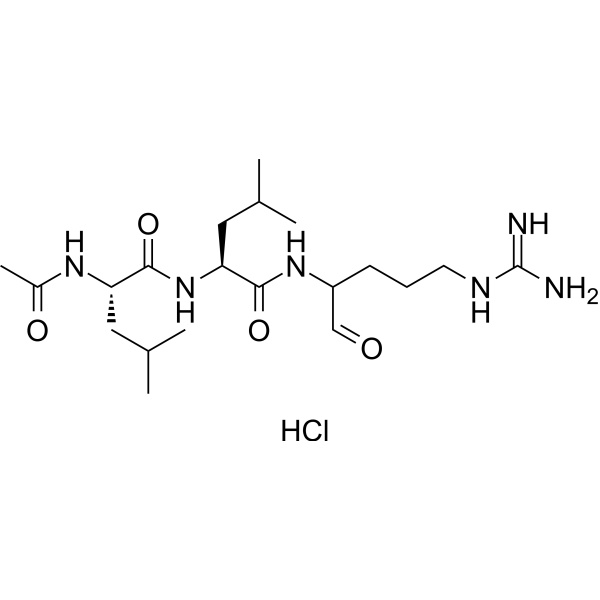
Physicochemical Properties
| Molecular Formula | C20H39CLN6O4 |
| Molecular Weight | 463.01 |
| Exact Mass | 462.272 |
| CAS # | 24125-16-4 |
| Related CAS # | 24365-47-7 |
| PubChem CID | 13209094 |
| Sequence | Ac-Leu-Leu-Arg-al.HCl; N-acetyl-L-leucyl-L-leucyl-L-argininal hydrochloride |
| SequenceShortening | LLR |
| Appearance | Typically exists as solid at room temperature |
| Boiling Point | 734.4ºC at 760 mmHg |
| Flash Point | 398ºC |
| Vapour Pressure | 7.31E-22mmHg at 25°C |
| LogP | 3.18 |
| Hydrogen Bond Donor Count | 6 |
| Hydrogen Bond Acceptor Count | 5 |
| Rotatable Bond Count | 14 |
| Heavy Atom Count | 31 |
| Complexity | 602 |
| Defined Atom Stereocenter Count | 3 |
| SMILES | CC(C)C[C@@H](C(=O)N[C@@H](CC(C)C)C(=O)N[C@@H](CCCN=C(N)N)C=O)NC(=O)C.Cl |
| InChi Key | OQQYPQNFLLAILR-FRKSIBALSA-N |
| InChi Code | InChI=1S/C20H38N6O4.ClH/c1-12(2)9-16(24-14(5)28)19(30)26-17(10-13(3)4)18(29)25-15(11-27)7-6-8-23-20(21)22;/h11-13,15-17H,6-10H2,1-5H3,(H,24,28)(H,25,29)(H,26,30)(H4,21,22,23);1H/t15-,16-,17-;/m0./s1 |
| Chemical Name | (2S)-2-acetamido-N-[(2S)-1-[[(2S)-5-(diaminomethylideneamino)-1-oxopentan-2-yl]amino]-4-methyl-1-oxopentan-2-yl]-4-methylpentanamide;hydrochloride |
| Synonyms | Leupeptin hydrochloride; Leupeptin HCl; 24125-16-4; MFCD00133457; LEUPEPTINHYDROCHLORIDE; Acetyl-Leu-Leu-Arg-al hydrochloride; C20H39ClN6O4; Leupeptin hydrochloride >90%; orb1740183; |
| HS Tariff Code | 2934.99.9001 |
| Storage |
Powder-20°C 3 years 4°C 2 years In solvent -80°C 6 months -20°C 1 month |
| Shipping Condition | Room temperature (This product is stable at ambient temperature for a few days during ordinary shipping and time spent in Customs) |
Biological Activity
| Targets |
Inhibits bovine trypsin (Ki = 72 nM), human plasmin (Ki = 35 nM), and bovine spleen cathepsin B (Ki = 3.4 μM) [1] |
| ln Vitro |
Inhibited bovine trypsin activity with a Ki of 72 nM. At 10 μg/ml, it completely blocked human plasmin-induced fibrinolysis. Weaker inhibition was observed against bovine α-chymotrypsin and thrombin. At 100 μg/ml, it did not affect the growth of rabbit kidney cells or mouse fibroblasts [1] |
| Enzyme Assay |
- Trypsin inhibition assay: Bovine trypsin was incubated with the substrate benzoyl-L-arginine-p-nitroanilide in buffer at 37°C. The release of p-nitroaniline was measured spectrophotometrically. Leupeptin Ac-LL was added at varying concentrations to determine the inhibition constant (Ki) [1] - Plasmin inhibition assay: Human plasmin was mixed with fibrinogen, and fibrinolysis was monitored. Leupeptin Ac-LL at 10 μg/ml completely inhibited plasmin-induced fibrinolysis [1] |
| Cell Assay |
- Rabbit kidney cell viability: Cells were treated with up to 100 μg/ml of Leupeptin Ac-LL for 24 hours, and cell growth was assessed by morphological observation and cell counting. No significant cytotoxicity was observed [1] |
| References |
[1]. PROTEASE-INHIBXTORY ACTIVITIES OF LEUPEPTIN ANALOGUES. The Journal of Antibiotics 1988 220-225 |
| Additional Infomation |
- Leupeptin Ac-LL is a tripeptide protease inhibitor derived from actinomycetes, with an N-terminal acetyl group and a C-terminal argininal residue. It acts as a reversible competitive inhibitor of serine and cysteine proteases [1] - The inhibitory activity of Leupeptin Ac-LL is dependent on its argininal moiety, which covalently binds to the active site of target proteases [1] |
Solubility Data
| Solubility (In Vitro) | May dissolve in DMSO (in most cases), if not, try other solvents such as H2O, Ethanol, or DMF with a minute amount of products to avoid loss of samples |
| Solubility (In Vivo) |
Note: Listed below are some common formulations that may be used to formulate products with low water solubility (e.g. < 1 mg/mL), you may test these formulations using a minute amount of products to avoid loss of samples. Injection Formulations (e.g. IP/IV/IM/SC) Injection Formulation 1: DMSO : Tween 80: Saline = 10 : 5 : 85 (i.e. 100 μL DMSO stock solution → 50 μL Tween 80 → 850 μL Saline) *Preparation of saline: Dissolve 0.9 g of sodium chloride in 100 mL ddH ₂ O to obtain a clear solution. Injection Formulation 2: DMSO : PEG300 :Tween 80 : Saline = 10 : 40 : 5 : 45 (i.e. 100 μL DMSO → 400 μLPEG300 → 50 μL Tween 80 → 450 μL Saline) Injection Formulation 3: DMSO : Corn oil = 10 : 90 (i.e. 100 μL DMSO → 900 μL Corn oil) Example: Take the Injection Formulation 3 (DMSO : Corn oil = 10 : 90) as an example, if 1 mL of 2.5 mg/mL working solution is to be prepared, you can take 100 μL 25 mg/mL DMSO stock solution and add to 900 μL corn oil, mix well to obtain a clear or suspension solution (2.5 mg/mL, ready for use in animals). Injection Formulation 4: DMSO : 20% SBE-β-CD in saline = 10 : 90 [i.e. 100 μL DMSO → 900 μL (20% SBE-β-CD in saline)] *Preparation of 20% SBE-β-CD in Saline (4°C,1 week): Dissolve 2 g SBE-β-CD in 10 mL saline to obtain a clear solution. Injection Formulation 5: 2-Hydroxypropyl-β-cyclodextrin : Saline = 50 : 50 (i.e. 500 μL 2-Hydroxypropyl-β-cyclodextrin → 500 μL Saline) Injection Formulation 6: DMSO : PEG300 : castor oil : Saline = 5 : 10 : 20 : 65 (i.e. 50 μL DMSO → 100 μLPEG300 → 200 μL castor oil → 650 μL Saline) Injection Formulation 7: Ethanol : Cremophor : Saline = 10: 10 : 80 (i.e. 100 μL Ethanol → 100 μL Cremophor → 800 μL Saline) Injection Formulation 8: Dissolve in Cremophor/Ethanol (50 : 50), then diluted by Saline Injection Formulation 9: EtOH : Corn oil = 10 : 90 (i.e. 100 μL EtOH → 900 μL Corn oil) Injection Formulation 10: EtOH : PEG300:Tween 80 : Saline = 10 : 40 : 5 : 45 (i.e. 100 μL EtOH → 400 μLPEG300 → 50 μL Tween 80 → 450 μL Saline) Oral Formulations Oral Formulation 1: Suspend in 0.5% CMC Na (carboxymethylcellulose sodium) Oral Formulation 2: Suspend in 0.5% Carboxymethyl cellulose Example: Take the Oral Formulation 1 (Suspend in 0.5% CMC Na) as an example, if 100 mL of 2.5 mg/mL working solution is to be prepared, you can first prepare 0.5% CMC Na solution by measuring 0.5 g CMC Na and dissolve it in 100 mL ddH2O to obtain a clear solution; then add 250 mg of the product to 100 mL 0.5% CMC Na solution, to make the suspension solution (2.5 mg/mL, ready for use in animals). Oral Formulation 3: Dissolved in PEG400 Oral Formulation 4: Suspend in 0.2% Carboxymethyl cellulose Oral Formulation 5: Dissolve in 0.25% Tween 80 and 0.5% Carboxymethyl cellulose Oral Formulation 6: Mixing with food powders Note: Please be aware that the above formulations are for reference only. InvivoChem strongly recommends customers to read literature methods/protocols carefully before determining which formulation you should use for in vivo studies, as different compounds have different solubility properties and have to be formulated differently. (Please use freshly prepared in vivo formulations for optimal results.) |
| Preparing Stock Solutions | 1 mg | 5 mg | 10 mg | |
| 1 mM | 2.1598 mL | 10.7989 mL | 21.5978 mL | |
| 5 mM | 0.4320 mL | 2.1598 mL | 4.3196 mL | |
| 10 mM | 0.2160 mL | 1.0799 mL | 2.1598 mL |