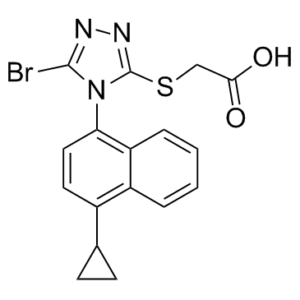
Lesinurad (formerly RDEA-594; RDEA594; trade name: Zurampic) is a potent and selective URAT1 (urate transporter 1) inhibitor approved as an anti-gout medication in 2016 by FDA. It can reduce the reuptake of uric acid from urine to blood circulation, thus lowering urate levels in the plasma. It is also an OAT (organic anion transporter) inhibitor thus may cause drug-drug interactions with other medications that are also OAT substrates. Lesinurad belongs to the so called SURI (selective uric acid reabsorption inhibitor).
Physicochemical Properties
| Molecular Formula | C17H14BRN3O2S | |
| Molecular Weight | 404.28 | |
| Exact Mass | 402.998 | |
| CAS # | 878672-00-5 | |
| Related CAS # | Lesinurad sodium;1151516-14-1 | |
| PubChem CID | 53465279 | |
| Appearance | White to off-white solid powder | |
| Density | 1.72±0.1 g/cm3 | |
| Boiling Point | 643.7±65.0 °C at 760 mmHg | |
| Flash Point | 343.1±34.3 °C | |
| Vapour Pressure | 0.0±2.0 mmHg at 25°C | |
| Index of Refraction | 1.776 | |
| LogP | 5.96 | |
| Hydrogen Bond Donor Count | 1 | |
| Hydrogen Bond Acceptor Count | 5 | |
| Rotatable Bond Count | 5 | |
| Heavy Atom Count | 24 | |
| Complexity | 479 | |
| Defined Atom Stereocenter Count | 0 | |
| InChi Key | FGQFOYHRJSUHMR-UHFFFAOYSA-N | |
| InChi Code | InChI=1S/C17H14BrN3O2S/c18-16-19-20-17(24-9-15(22)23)21(16)14-8-7-11(10-5-6-10)12-3-1-2-4-13(12)14/h1-4,7-8,10H,5-6,9H2,(H,22,23) | |
| Chemical Name |
|
|
| Synonyms |
|
|
| HS Tariff Code | 2934.99.9001 | |
| Storage |
Powder-20°C 3 years 4°C 2 years In solvent -80°C 6 months -20°C 1 month |
|
| Shipping Condition | Room temperature (This product is stable at ambient temperature for a few days during ordinary shipping and time spent in Customs) |
Biological Activity
| Targets |
Lesinurad (RDEA594) is a selective urate reabsorption inhibitor that primarily targets urate transporter 1 (URAT1, SLC22A12) with an IC50 of 1.7 μM for inhibiting urate uptake in URAT1-expressing cells; it also inhibits organic anion transporter 1 (OAT1, SLC22A6, IC50 = 6.4 μM) and OAT3 (SLC22A8, IC50 = 2.8 μM), and shows weak inhibition of OATP1B1 (SLCO1B1, IC50 > 100 μM), OATP1B3 (SLCO1B3, IC50 > 100 μM), MRP2 (ABCC2, IC50 > 100 μM), and BCRP (ABCG2, IC50 = 45 μM) [1] Lesinurad targets URAT1 as the primary molecular target for urate-lowering activity [2] Lesinurad (RDEA594) is a potent inhibitor of URAT1-mediated urate reabsorption (IC50 not specified in the abstract), and its prodrug RDEA806 is metabolized to RDEA594 in vivo [3] |
| ln Vitro |
Lesinurad is a brand-new reagent for the selective uric acid reabsorption (SURI). Renal transporters OAT1 and OAT3 were found to utilise lesinurad as a substrate; their Km values were found to be 0.85 and 2 μM, respectively [1]. A URAT1 and OAT dye that raises proximal tubular urate excretion is called lesinurad (RDEA594) [2]. Lesinurad (RDEA594) is a potentially effective urate-lowering drug that inhibits CYP2C9 and CYP2C8 with IC50 values of 14.4 μM and 16.2 μM, respectively, and shows strong p450 characteristics by preventing uric acid re-concentration. Lesinurad has an IC50 of 100 μM against CYP1A2, CYP2C19, and CYP2D6[3]. Lesinurad dose-dependently inhibited [¹⁴C]urate uptake in HEK293 cells stably expressing human URAT1, with an IC50 of 1.7 μM; it also inhibited [³H]para-aminohippuric acid (PAH) uptake in OAT1-expressing cells (IC50 = 6.4 μM) and [³H]estrone-3-sulfate (E3S) uptake in OAT3-expressing cells (IC50 = 2.8 μM). At concentrations up to 100 μM, it did not significantly inhibit OATP1B1- or OATP1B3-mediated [³H]pravastatin uptake, and only weakly inhibited BCRP-mediated [³H]mitoxantrone efflux (IC50 = 45 μM) and MRP2-mediated [³H]methotrexate efflux (IC50 > 100 μM). In human renal proximal tubule cells (HRPTC), Lesinurad (10 μM) reduced urate reabsorption by approximately 40% without affecting the uptake of other organic anions (e.g., PAH, E3S) [1] Lesinurad acts as a selective URAT1 inhibitor to block renal urate reabsorption, thereby increasing urate excretion; in in vitro assays with human kidney tissue preparations, it exhibited higher selectivity for URAT1 compared to other urate transporters (e.g., GLUT9), with no significant off-target effects on renal electrolyte transporters [2] Lesinurad (RDEA594) showed more potent in vitro urate-lowering activity than its prodrug RDEA806: RDEA594 inhibited URAT1-mediated urate uptake at nanomolar to low micromolar concentrations, while RDEA806 had no direct inhibitory activity on URAT1 and required metabolic activation to RDEA594 for biological activity [3] |
| ln Vivo |
Compared to its prodrug, RDEA806, lesinurad (RDEA594) exhibits superior pharmacokinetics. The pharmacological effects of a single dose of 300–800 mg of RDEA806 are equivalent to those exhibited by a 100 mg dose of Lesinurad [3]. In rats, oral administration of Lesinurad (10, 30, 100 mg/kg) dose-dependently increased urinary urate excretion by 25%, 60%, and 110%, respectively, and reduced serum urate levels by 15%, 35%, and 55% at 4 hours post-dosing. In a rat model of hyperuricemia induced by potassium oxonate, Lesinurad (30 mg/kg, oral) reduced serum urate levels by 40% within 2 hours and maintained the effect for 8 hours. Co-administration of Lesinurad (30 mg/kg) with probenecid (50 mg/kg) produced a synergistic increase in urinary urate excretion (180% vs 60% for Lesinurad alone) [1] In phase II/III clinical trials, Lesinurad (200 mg or 400 mg once daily) combined with xanthine oxidase inhibitors (XOIs, e.g., allopurinol, febuxostat) significantly reduced serum urate (sUA) levels in patients with gout and hyperuricemia who failed to achieve target sUA with XOIs alone: the 200 mg dose reduced sUA by an additional 1.8 mg/dL, and the 400 mg dose reduced sUA by an additional 2.3 mg/dL at 12 weeks. In a phase III trial (CLEAR 1), Lesinurad 200 mg + allopurinol achieved a sUA < 6 mg/dL in 56% of patients, compared to 27% with allopurinol alone (P < 0.001) [2] In beagle dogs, oral administration of Lesinurad (RDEA594, 5 mg/kg) resulted in a peak plasma concentration (Cmax) of 2.1 μg/mL and an area under the curve (AUC0-24h) of 8.6 μg·h/mL, with a terminal half-life (t1/2) of 3.2 hours. In contrast, its prodrug RDEA806 (5 mg/kg) had a Cmax of 1.5 μg/mL, AUC0-24h of 5.2 μg·h/mL, and t1/2 of 1.8 hours, with only 30% conversion to RDEA594. In mice, Lesinurad (10 mg/kg, oral) reduced serum urate levels by 45% at 3 hours, while RDEA806 (10 mg/kg) reduced sUA by only 15% due to incomplete metabolism [3] |
| Enzyme Assay |
1. URAT1 inhibition assay: Membrane preparations from HEK293 cells expressing human URAT1 were incubated with [¹⁴C]urate (0.1 μM) and serial concentrations of Lesinurad (0.1-100 μM) in transport buffer at 37°C for 10 minutes. Non-specific uptake was determined in the presence of 1 mM probenecid. Radioactivity was measured by liquid scintillation counting, and the IC50 for urate uptake inhibition was calculated from dose-response curves (N=3 independent experiments, each in triplicate) [1] 2. OAT1/OAT3 inhibition assay: Membranes from OAT1- or OAT3-expressing HEK293 cells were incubated with [³H]PAH (OAT1 substrate, 0.5 μM) or [³H]E3S (OAT3 substrate, 0.1 μM) and Lesinurad (0.1-100 μM) using the same method as the URAT1 assay. The IC50 values for OAT1 and OAT3 inhibition were determined by nonlinear regression analysis [1] 3. BCRP/MRP2 efflux assay: Inside-out membrane vesicles from BCRP- or MRP2-expressing cells were loaded with [³H]mitoxantrone (BCRP substrate) or [³H]methotrexate (MRP2 substrate), then incubated with Lesinurad (0.1-100 μM) at 37°C for 20 minutes. Effluxed radioactivity was measured, and the IC50 for transporter inhibition was calculated [1] |
| Cell Assay |
1. URAT1-expressing HEK293 cell uptake assay: HEK293 cells stably transfected with human URAT1 were seeded in 24-well plates and serum-starved for 2 hours. Cells were incubated with [¹⁴C]urate (0.1 μM) and serial concentrations of Lesinurad (0.1-100 μM) in HBSS buffer at 37°C for 10 minutes. The reaction was terminated by washing cells with ice-cold HBSS, and intracellular radioactivity was measured by liquid scintillation counting. Uptake was normalized to protein content, and the percentage of inhibition relative to control was calculated [1] 2. Human renal proximal tubule cell (HRPTC) assay: Primary HRPTC were cultured in collagen-coated plates and treated with Lesinurad (1, 10, 50 μM) for 1 hour. [¹⁴C]urate (0.5 μM) was added, and urate uptake was measured after 15 minutes. The uptake of other organic anions (PAH, E3S) was also assessed to evaluate the selectivity of Lesinurad [1] 3. Transporter-mediated drug interaction assay: HEK293 cells expressing OATP1B1/OATP1B3 were treated with Lesinurad (0.1-100 μM) and [³H]pravastatin (0.5 μM) for 30 minutes. Pravastatin uptake was measured to determine if Lesinurad interferes with hepatic uptake transporters [1] |
| Animal Protocol |
1. Rat hyperuricemia model: Male Sprague-Dawley rats (200-250 g) were randomly divided into vehicle and Lesinurad treatment groups (10, 30, 100 mg/kg). Hyperuricemia was induced by intraperitoneal injection of potassium oxonate (250 mg/kg) 1 hour before Lesinurad administration. Lesinurad was formulated in 0.5% methylcellulose and administered by oral gavage. Blood samples were collected from the tail vein at 0, 2, 4, 6, and 8 hours post-dosing to measure serum urate levels using a uric acid assay kit. Urine was collected over 8 hours to quantify urinary urate excretion [1] 2. Rat drug interaction model: Rats were co-administered Lesinurad (30 mg/kg) and probenecid (50 mg/kg) by oral gavage. Urine and blood samples were collected at 4 hours post-dosing to measure urate levels and evaluate synergistic effects on urate excretion [1] 3. Beagle dog pharmacokinetic study: Male beagle dogs (8-10 kg) were given a single oral dose of Lesinurad (RDEA594, 5 mg/kg) or RDEA806 (5 mg/kg) formulated in 10% ethanol/PEG400. Blood samples were collected from the cephalic vein at 0, 0.5, 1, 2, 4, 6, 8, 12, and 24 hours post-dosing. Plasma concentrations of RDEA594 and RDEA806 were measured by LC-MS/MS, and pharmacokinetic parameters (Cmax, AUC, t1/2) were calculated using non-compartmental analysis [3] 4. Mouse urate-lowering efficacy study: Male C57BL/6 mice (20-25 g) were administered Lesinurad (10 mg/kg) or RDEA806 (10 mg/kg) by oral gavage. Serum urate levels were measured at 1, 3, 6, and 12 hours post-dosing using a colorimetric assay [3] |
| ADME/Pharmacokinetics |
Absorption, Distribution and Excretion Oral lesinurad is rapidly absorbed, reaching maximum plasma concentrations (Cmax) within 1–4 h following the administration a single 200 mg dose (in either the fed or fasted state). Within 7 days following single dosing of radiolabeled lesinurad, 63% of administered radioactive dose was recovered in urine and 32% of administered radioactive dose was recovered in feces. Most of the radioactivity recovered in urine (> 60% of dose) occurred in the first 24 hours. Unchanged lesinurad in urine accounted for approximately 30% of the dose. The mean steady state volume of distribution of lesinurad was approximately 20 L following intravenous dosing. Metabolism / Metabolites Lesinurad undergoes oxidative metabolism mainly via the polymorphic cytochrome P450 CYP2C9 enzyme. Lesinurad is rapidly absorbed after oral administration in rats, with a Cmax reached at 1 hour and an oral bioavailability of approximately 85%. It is widely distributed in tissues, with the highest concentrations in the kidney, liver, and small intestine, and low concentrations in the brain (brain-to-plasma ratio < 0.1). Lesinurad is primarily metabolized by CYP3A4 and UGT2B7 in the liver, with approximately 70% of the dose excreted in urine (15% as unchanged drug) and 25% in feces within 48 hours. Its terminal half-life in rats is 2.5 hours, and in humans, the t1/2 is approximately 5-8 hours after a single 200 mg oral dose [1] In humans, Lesinurad has an oral bioavailability of ~90% after a 200 mg dose, with a Cmax of 1.2 μg/mL and AUC0-24h of 6.8 μg·h/mL. It is highly bound to human plasma proteins (99%), primarily to albumin. The major metabolic pathways are oxidation (CYP3A4) and glucuronidation (UGT2B7), with no active metabolites other than the parent compound. Approximately 60% of the dose is excreted in urine within 72 hours, with 20% as unchanged drug [2] Lesinurad (RDEA594) has superior pharmacokinetic properties compared to its prodrug RDEA806 in dogs: RDEA594 has a 40% higher Cmax, 65% higher AUC, and 78% longer t1/2 than RDEA806. RDEA806 is rapidly but incompletely metabolized to RDEA594 in vivo, with a bioactivation efficiency of only 30% in dogs and 25% in humans [3] |
| Toxicity/Toxicokinetics |
Hepatotoxicity In large clinical trials, serum enzyme elevations were rare during lesinurad therapy and no more common than with placebo, and no instances of clinically apparent liver injury attributable to lesinurad were reported. Clinical experience with lesinurad therapy has been limited, but there have yet to be reports of clinically apparent liver injury attributable to its use. Likelihood score: E (unlikely cause of clinically apparent liver injury). Protein Binding Lesinurad is extensively bound to proteins in plasma (greater than 98%), mainly to albumin. In in vitro cytotoxicity assays, Lesinurad showed no significant toxicity to HRPTC or HEK293 cells at concentrations up to 500 μM (CC50 > 500 μM). In a 28-day subchronic toxicity study in rats, oral administration of Lesinurad (50, 100, 200 mg/kg/day) caused no significant changes in body weight, food intake, or hematological parameters. Renal histology showed mild tubular vacuolization at the 200 mg/kg dose, which was reversible after a 14-day recovery period. No hepatotoxicity was observed, as serum ALT/AST levels remained normal [1] In clinical trials, Lesinurad was well-tolerated at doses of 200 mg/day; the most common adverse events (AEs) were headache (12%), fatigue (8%), and urinary tract infection (6%). At the 400 mg/day dose, the incidence of renal-related AEs (e.g., increased serum creatinine, acute kidney injury) increased to 9% (vs 3% with 200 mg/day). Lesinurad has a low potential for drug-drug interactions: it does not inhibit or induce CYP450 enzymes (CYP1A2, CYP2C9, CYP2C19, CYP2D6, CYP3A4) in vitro, and co-administration with allopurinol/febuxostat did not alter their plasma concentrations [2] In acute toxicity studies, the median lethal dose (LD50) of Lesinurad in mice was >2000 mg/kg after oral administration, and >500 mg/kg after intraperitoneal administration. RDEA806 had a similar LD50 profile, with no increased toxicity compared to RDEA594. In a 14-day toxicity study in dogs, Lesinurad (100 mg/kg/day) caused mild increases in serum urea and creatinine, which resolved after drug withdrawal [3] |
| References |
[1]. In Vitro and In Vivo Interaction Studies Between Lesinurad, a Selective Urate Reabsorption Inhibitor, and Major Liver or Kidney Transporters. Clin Drug Investig. 2016 Jun;36(6):443-52. [2]. Treatment of hyperuricemia in gout: current therapeutic options, latest developments and clinical implications. Ther Adv Musculoskelet Dis. 2016 Aug;8(4):145-59. [3]. RDEA594, a potential uric acid lowering agent througn inhibition of uric acid reuptake ,shows better pharmacokinetics rhan its prodrug RDEA806. 2008 ACR/ARHP Annual Scientific Meeting, 24-29 October 2008, USA. |
| Additional Infomation |
Lesinurad is a member of the class of triazoles that is [(3-bromo-1,2,4-triazol-5-yl)sulfanyl]acetic acid substituted at position 1 of the triazole ring by a 4-cyclopropylnaphthalen-1-yl group. Used for treatment of gout. It has a role as a uricosuric drug. It is a member of triazoles, a member of naphthalenes, a member of cyclopropanes, an organobromine compound, an aryl sulfide and a monocarboxylic acid. Lesinurad is an oral uric acid transporter 1 (URAT1) inhibitor indicated for the treatment of hyperuricemia associated with gout. It reduces serum uric acid concentration through the inhibition of URAT1, an enzyme responsible for reuptake of uric acid from the renal tubule, and OAT4, another uric acid transporter associated with diuretic-induced hyperuricemia. Marketed as the product Zurampic, it is indicated for use in combination with a xanthine oxidase inhibitor for the treatment of hyperuricemia associated with gout in patients who have not achieved target serum uric acid levels with a xanthine oxidase inhibitor alone. In August 2017, a combination oral therapy consisting of lesinurad and [DB00437] was FDA-approved under the brand name Duzallo indicated for the treatment of gout-related hyperuricemia in patients with uncontrolled gout. Lesinurad is an Urate Transporter 1 Inhibitor. The mechanism of action of lesinurad is as an Urate Transporter 1 Inhibitor, and Cytochrome P450 3A Inducer. Lesinurad is a selective inhibitor of uric acid reabsorption which is used in combination with other agents in the therapy of gout. Lesinurad has had limited clinical use, but has not been associated with serum enzyme elevations during therapy or with instances of clinically apparent liver injury. See also: Allopurinol; Lesinurad (component of). Drug Indication For use, in combination with a xanthine oxidase inhibitor, for the treatment of hyperuricemia associated with gout in patients who have not achieved target serum uric acid levels with a xanthine oxidase inhibitor alone. FDA Label Zurampic, in combination with a xanthine oxidase inhibitor, is indicated in adults for the adjunctive treatment of hyperuricaemia in gout patients (with or without tophi) who have not achieved target serum uric acid levels with an adequate dose of a xanthine oxidase inhibitor alone. , Prevention of hyperuricaemia, Treatment of hyperuricaemia Mechanism of Action Lesinurad inhibits the activity of uric acid transporter 1 (URAT1) and organic anion transporter 4 (OAT4). URAT1 is a major transporter enzyme responsible for reuptake of uric acid from the renal tubules; inhibition of URAT1 function thereby increases excretion of uric acid. Pharmacodynamics Dose-dependent reductions in serum uric acid levels and increases in urinary uric acid excretion have been observed following single and multiple oral doses of lesinurad. Lesinurad is a first-in-class selective urate reabsorption inhibitor (SURI) developed for the treatment of hyperuricemia in patients with gout. Its mechanism of action involves blocking URAT1-mediated urate reabsorption in the proximal renal tubule, thereby increasing urate excretion and reducing serum urate levels. It is approved for use in combination with XOIs in patients who fail to achieve target sUA with XOIs alone [1] Lesinurad is indicated for the treatment of hyperuricemia associated with gout in adults, in combination with an XOI (allopurinol or febuxostat). It is not recommended as monotherapy due to limited efficacy and increased renal risk at higher doses. The recommended clinical dose is 200 mg once daily, taken with food to reduce gastrointestinal irritation [2] Lesinurad (RDEA594) is the active metabolite of RDEA806, a prodrug designed to improve oral bioavailability. RDEA806 is rapidly hydrolyzed to RDEA594 in the liver by carboxylesterases, but its bioactivation is incomplete, leading to the development of RDEA594 as the clinical candidate. Lesinurad has been evaluated in multiple phase III trials (CLEAR 1, CLEAR 2, CRYSTAL) and was approved by the FDA in 2015 [3] |
Solubility Data
| Solubility (In Vitro) |
|
|||
| Solubility (In Vivo) |
Solubility in Formulation 1: ≥ 2.5 mg/mL (6.18 mM) (saturation unknown) in 10% DMSO + 40% PEG300 + 5% Tween80 + 45% Saline (add these co-solvents sequentially from left to right, and one by one), clear solution. For example, if 1 mL of working solution is to be prepared, you can add 100 μL of 25.0 mg/mL clear DMSO stock solution to 400 μL PEG300 and mix evenly; then add 50 μL Tween-80 to the above solution and mix evenly; then add 450 μL normal saline to adjust the volume to 1 mL. Preparation of saline: Dissolve 0.9 g of sodium chloride in 100 mL ddH₂ O to obtain a clear solution. Solubility in Formulation 2: ≥ 2.5 mg/mL (6.18 mM) (saturation unknown) in 10% DMSO + 90% (20% SBE-β-CD in Saline) (add these co-solvents sequentially from left to right, and one by one), clear solution. For example, if 1 mL of working solution is to be prepared, you can add 100 μL of 25.0 mg/mL clear DMSO stock solution to 900 μL of 20% SBE-β-CD physiological saline solution and mix evenly. Preparation of 20% SBE-β-CD in Saline (4°C,1 week): Dissolve 2 g SBE-β-CD in 10 mL saline to obtain a clear solution. Solubility in Formulation 3: ≥ 2.5 mg/mL (6.18 mM) (saturation unknown) in 10% DMSO + 90% Corn Oil (add these co-solvents sequentially from left to right, and one by one), clear solution. For example, if 1 mL of working solution is to be prepared, you can add 100 μL of 25.0 mg/mL clear DMSO stock solution to 900 μL of corn oil and mix evenly. (Please use freshly prepared in vivo formulations for optimal results.) |
| Preparing Stock Solutions | 1 mg | 5 mg | 10 mg | |
| 1 mM | 2.4735 mL | 12.3677 mL | 24.7353 mL | |
| 5 mM | 0.4947 mL | 2.4735 mL | 4.9471 mL | |
| 10 mM | 0.2474 mL | 1.2368 mL | 2.4735 mL |