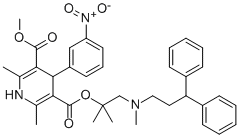
Lercanidipine (REC-15-237, Lercadip, Lerdip, Zanidip) is a 3rd generation and lipophilic CCB (calcium channel blocker) of the dihydropyridine class and a medication used to treat high blood pressure, with long lasting antihypertensive action and reno-protective effect. It works by relaxing and opening the blood vessels allowing the blood to circulate more freely around the body. This lowers the blood pressure and allows the heart to work more efficiently.
Physicochemical Properties
| Molecular Formula | C36H41N3O6 |
| Molecular Weight | 611.72724 |
| Exact Mass | 611.299 |
| CAS # | 100427-26-7 |
| Related CAS # | Lercanidipine hydrochloride;132866-11-6;(R)-Lercanidipine;185197-70-0;(R)-Lercanidipine hydrochloride;187731-34-6;Lercanidipine-d3 hydrochloride;1189954-18-4;(S)-Lercanidipine hydrochloride;184866-29-3 |
| PubChem CID | 65866 |
| Appearance | Light yellow to yellow solid powder |
| Density | 1.2±0.1 g/cm3 |
| Boiling Point | 712.5±60.0 °C at 760 mmHg |
| Melting Point | 118-120ºC |
| Flash Point | 384.7±32.9 °C |
| Vapour Pressure | 0.0±2.3 mmHg at 25°C |
| Index of Refraction | 1.580 |
| LogP | 8.04 |
| Hydrogen Bond Donor Count | 1 |
| Hydrogen Bond Acceptor Count | 8 |
| Rotatable Bond Count | 13 |
| Heavy Atom Count | 45 |
| Complexity | 1090 |
| Defined Atom Stereocenter Count | 0 |
| InChi Key | ZDXUKAKRHYTAKV-UHFFFAOYSA-N |
| InChi Code | InChI=1S/C36H41N3O6/c1-24-31(34(40)44-6)33(28-18-13-19-29(22-28)39(42)43)32(25(2)37-24)35(41)45-36(3,4)23-38(5)21-20-30(26-14-9-7-10-15-26)27-16-11-8-12-17-27/h7-19,22,30,33,37H,20-21,23H2,1-6H3 |
| Chemical Name | 5-O-[1-[3,3-diphenylpropyl(methyl)amino]-2-methylpropan-2-yl] 3-O-methyl 2,6-dimethyl-4-(3-nitrophenyl)-1,4-dihydropyridine-3,5-dicarboxylate |
| HS Tariff Code | 2934.99.9001 |
| Storage |
Powder-20°C 3 years 4°C 2 years In solvent -80°C 6 months -20°C 1 month |
| Shipping Condition | Room temperature (This product is stable at ambient temperature for a few days during ordinary shipping and time spent in Customs) |
Biological Activity
| References |
[1]. Barrios,"nV., et al., Lercanidipine is an effective and well tolerated"nantihypertensive drug regardless the cardiovascular risk profile: The"nLAURA study. Int J Clin Pract, 2006. 60(11): p. 1364-70. [2]. Burnier,"nM., M. Pruijm, and G. Wuerzner, Treatment of essential hypertension"nwith calcium channel blockers: what is the place of lercanidipine?"nExpert Opin Drug Metab Toxicol, 2009. 5(8): p. 981-7. [3]. Grassi"nG, et, al. Lercanidipine in the Management of Hypertension: An Update. J"nPharmacol Pharmacother. Oct-Dec 2017;8(4):155-165. [4]. Clinical efficacy of calcium channel blockers slow the third generation of lercanidipine in the treatment of patients with arterial hypertension and metabolic disorders (review). Georgian Med News. 2015 Feb;(239):51-6. Review. Russian. |
| Additional Infomation |
Lercanidipine is a diarylmethane. Lercanidipine is a calcium channel blocker of the dihydropyridine class. It is sold under various commercial names including Zanidip. Drug Indication For the treatment of Hypertension, management of angina pectoris and Raynaud's syndrome Mechanism of Action By deforming the channel, inhibiting ion-control gating mechanisms, and/or interfering with the release of calcium from the sarcoplasmic reticulum, Lercanidipine inhibits the influx of extracellular calcium across the myocardial and vascular smooth muscle cell membranes The decrease in intracellular calcium inhibits the contractile processes of the myocardial smooth muscle cells, causing dilation of the coronary and systemic arteries, increased oxygen delivery to the myocardial tissue, decreased total peripheral resistance, decreased systemic blood pressure, and decreased afterload. Pharmacodynamics Lercanidipine, a dihydropyridine calcium-channel blocker, is used alone or with an angiotensin-converting enzyme inhibitor, to treat hypertension, chronic stable angina pectoris, and Prinzmetal's variant angina. Lercanidipine is similar to other peripheral vasodilators. Lercanidipine inhibits the influx of extra cellular calcium across the myocardial and vascular smooth muscle cell membranes possibly by deforming the channel, inhibiting ion-control gating mechanisms, and/or interfering with the release of calcium from the sarcoplasmic reticulum. The decrease in intracellular calcium inhibits the contractile processes of the myocardial smooth muscle cells, causing dilation of the coronary and systemic arteries, increased oxygen delivery to the myocardial tissue, decreased total peripheral resistance, decreased systemic blood pressure, and decreased afterload. |
Solubility Data
| Solubility (In Vitro) | May dissolve in DMSO (in most cases), if not, try other solvents such as H2O, Ethanol, or DMF with a minute amount of products to avoid loss of samples |
| Solubility (In Vivo) |
Note: Listed below are some common formulations that may be used to formulate products with low water solubility (e.g. < 1 mg/mL), you may test these formulations using a minute amount of products to avoid loss of samples. Injection Formulations (e.g. IP/IV/IM/SC) Injection Formulation 1: DMSO : Tween 80: Saline = 10 : 5 : 85 (i.e. 100 μL DMSO stock solution → 50 μL Tween 80 → 850 μL Saline) *Preparation of saline: Dissolve 0.9 g of sodium chloride in 100 mL ddH ₂ O to obtain a clear solution. Injection Formulation 2: DMSO : PEG300 :Tween 80 : Saline = 10 : 40 : 5 : 45 (i.e. 100 μL DMSO → 400 μLPEG300 → 50 μL Tween 80 → 450 μL Saline) Injection Formulation 3: DMSO : Corn oil = 10 : 90 (i.e. 100 μL DMSO → 900 μL Corn oil) Example: Take the Injection Formulation 3 (DMSO : Corn oil = 10 : 90) as an example, if 1 mL of 2.5 mg/mL working solution is to be prepared, you can take 100 μL 25 mg/mL DMSO stock solution and add to 900 μL corn oil, mix well to obtain a clear or suspension solution (2.5 mg/mL, ready for use in animals). Injection Formulation 4: DMSO : 20% SBE-β-CD in saline = 10 : 90 [i.e. 100 μL DMSO → 900 μL (20% SBE-β-CD in saline)] *Preparation of 20% SBE-β-CD in Saline (4°C,1 week): Dissolve 2 g SBE-β-CD in 10 mL saline to obtain a clear solution. Injection Formulation 5: 2-Hydroxypropyl-β-cyclodextrin : Saline = 50 : 50 (i.e. 500 μL 2-Hydroxypropyl-β-cyclodextrin → 500 μL Saline) Injection Formulation 6: DMSO : PEG300 : castor oil : Saline = 5 : 10 : 20 : 65 (i.e. 50 μL DMSO → 100 μLPEG300 → 200 μL castor oil → 650 μL Saline) Injection Formulation 7: Ethanol : Cremophor : Saline = 10: 10 : 80 (i.e. 100 μL Ethanol → 100 μL Cremophor → 800 μL Saline) Injection Formulation 8: Dissolve in Cremophor/Ethanol (50 : 50), then diluted by Saline Injection Formulation 9: EtOH : Corn oil = 10 : 90 (i.e. 100 μL EtOH → 900 μL Corn oil) Injection Formulation 10: EtOH : PEG300:Tween 80 : Saline = 10 : 40 : 5 : 45 (i.e. 100 μL EtOH → 400 μLPEG300 → 50 μL Tween 80 → 450 μL Saline) Oral Formulations Oral Formulation 1: Suspend in 0.5% CMC Na (carboxymethylcellulose sodium) Oral Formulation 2: Suspend in 0.5% Carboxymethyl cellulose Example: Take the Oral Formulation 1 (Suspend in 0.5% CMC Na) as an example, if 100 mL of 2.5 mg/mL working solution is to be prepared, you can first prepare 0.5% CMC Na solution by measuring 0.5 g CMC Na and dissolve it in 100 mL ddH2O to obtain a clear solution; then add 250 mg of the product to 100 mL 0.5% CMC Na solution, to make the suspension solution (2.5 mg/mL, ready for use in animals). Oral Formulation 3: Dissolved in PEG400 Oral Formulation 4: Suspend in 0.2% Carboxymethyl cellulose Oral Formulation 5: Dissolve in 0.25% Tween 80 and 0.5% Carboxymethyl cellulose Oral Formulation 6: Mixing with food powders Note: Please be aware that the above formulations are for reference only. InvivoChem strongly recommends customers to read literature methods/protocols carefully before determining which formulation you should use for in vivo studies, as different compounds have different solubility properties and have to be formulated differently. (Please use freshly prepared in vivo formulations for optimal results.) |
| Preparing Stock Solutions | 1 mg | 5 mg | 10 mg | |
| 1 mM | 1.6347 mL | 8.1735 mL | 16.3471 mL | |
| 5 mM | 0.3269 mL | 1.6347 mL | 3.2694 mL | |
| 10 mM | 0.1635 mL | 0.8174 mL | 1.6347 mL |