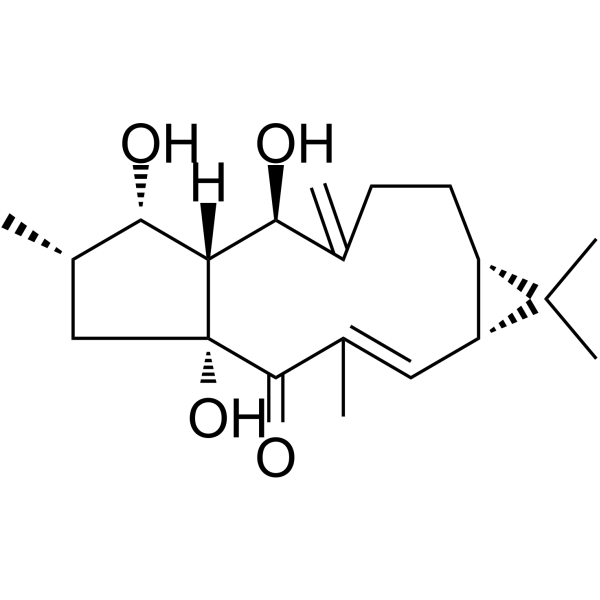
Physicochemical Properties
| Molecular Formula | C20H30O4 |
| Molecular Weight | 334.4498 |
| Exact Mass | 334.214 |
| CAS # | 34420-19-4 |
| PubChem CID | 15479845 |
| Appearance | White to off-white solid powder |
| Density | 1.2±0.1 g/cm3 |
| Boiling Point | 503.5±50.0 °C at 760 mmHg |
| Flash Point | 272.4±26.6 °C |
| Vapour Pressure | 0.0±2.9 mmHg at 25°C |
| Index of Refraction | 1.566 |
| LogP | 2.69 |
| Hydrogen Bond Donor Count | 3 |
| Hydrogen Bond Acceptor Count | 4 |
| Rotatable Bond Count | 0 |
| Heavy Atom Count | 24 |
| Complexity | 605 |
| Defined Atom Stereocenter Count | 7 |
| SMILES | C[C@H]1C[C@]2([C@H]([C@H]1O)[C@H](C(=C)CC[C@H]3[C@H](C3(C)C)/C=C(/C2=O)\C)O)O |
| InChi Key | SDBITTRHSROXCY-SVSKDHLKSA-N |
| InChi Code | InChI=1S/C20H30O4/c1-10-6-7-13-14(19(13,4)5)8-11(2)18(23)20(24)9-12(3)17(22)15(20)16(10)21/h8,12-17,21-22,24H,1,6-7,9H2,2-5H3/b11-8+/t12-,13-,14+,15-,16-,17-,20+/m0/s1 |
| Chemical Name | (1R,3E,5R,7S,11R,12R,13S,14S)-1,11,13-trihydroxy-3,6,6,14-tetramethyl-10-methylidenetricyclo[10.3.0.05,7]pentadec-3-en-2-one |
| HS Tariff Code | 2934.99.9001 |
| Storage |
Powder-20°C 3 years 4°C 2 years In solvent -80°C 6 months -20°C 1 month |
| Shipping Condition | Room temperature (This product is stable at ambient temperature for a few days during ordinary shipping and time spent in Customs) |
Biological Activity
| Targets |
P-glycoprotein (P-gp, ABCB1) (Ki = 3.2 μM for P-gp ATPase activity inhibition) [1] |
| ln Vitro |
In vitro, lathyrol has the ability to reverse the effects of MCF-7/ADR breast cancer cell lines [1]. - Lathyrol acts as a modulator of P-gp-dependent multidrug resistance (MDR). It dose-dependently enhanced the cytotoxicity of P-gp substrate chemotherapeutic drugs (doxorubicin, paclitaxel) in P-gp-overexpressing MDR cell lines (KB-V1, A2780/T), reducing their IC50 values by ~3-8 fold compared with drug-alone groups (detected by MTT assay) [1] - Lathyrol (1-10 μM) inhibited P-gp-mediated drug efflux, increasing the intracellular accumulation of P-gp substrates (rhodamine 123, doxorubicin) in KB-V1 cells in a dose-dependent manner (detected by flow cytometry) [1] - Lathyrol (0.1-10 μM) inhibited P-gp ATPase activity in a concentration-dependent manner, with a Ki value of 3.2 μM (detected by ATPase activity assay). It did not alter the protein expression level of P-gp in KB-V1 cells (detected by Western blot) [1] - Lathyrol showed low intrinsic cytotoxicity to parental sensitive cell lines (KB, A2780) and MDR cell lines (KB-V1, A2780/T) at concentrations up to 20 μM (MTT assay) [1] |
| Enzyme Assay |
- P-gp ATPase activity assay: Membrane vesicles containing overexpressed P-gp were suspended in reaction buffer. Lathyrol (0.01-100 μM) was added to the vesicles, followed by the addition of ATP to initiate the reaction. After incubation at 37°C for 30 minutes, the reaction was terminated, and the released inorganic phosphate (Pi) was quantified by a colorimetric method to calculate P-gp ATPase activity inhibition rate and Ki value [1] |
| Cell Assay |
- MDR reversal assay: P-gp-overexpressing MDR cells (KB-V1, A2780/T) and parental sensitive cells (KB, A2780) were seeded in 96-well plates. Cells were treated with Lathyrol (0.1-20 μM) alone or in combination with chemotherapeutic drugs (doxorubicin/paclitaxel) for 72 hours. MTT reagent was added, and absorbance at 570 nm was measured to calculate cell viability and IC50 values [1] - Intracellular drug accumulation assay: KB-V1 cells were loaded with P-gp fluorescent substrate (rhodamine 123) and treated with Lathyrol (1-10 μM) for 1 hour. Intracellular fluorescence intensity was detected by flow cytometry to evaluate substrate accumulation [1] - P-gp expression assay: KB-V1 cells were treated with Lathyrol (1-10 μM) for 48 hours. Cells were lysed, and proteins were extracted for Western blot analysis using anti-P-gp antibody. β-actin was used as an internal control to quantify P-gp protein level [1] |
| References |
[1]. Lathyrol diterpenes as modulators of P-glycoprotein dependent multidrug resistance: structure-activity relationship studies on Euphorbia factor L3 derivatives. J Med Chem. 2015 May 14;58(9):3720-38. |
| Additional Infomation |
Lathyrol has been reported in Euphorbia lathyris with data available. - Lathyrol is a natural diterpene compound belonging to the lathyrol-type diterpenes, isolated from Euphorbia species [1] - Its mechanism of reversing MDR involves inhibiting P-gp ATPase activity and blocking P-gp-mediated drug efflux, without downregulating P-gp protein expression [1] - Lathyrol serves as a lead compound for the development of MDR modulators, with structure-activity relationship (SAR) studies showing that its C-12, C-13, and C-14 positions are critical for P-gp modulating activity [1] |
Solubility Data
| Solubility (In Vitro) | DMSO : ≥ 100 mg/mL (~299.00 mM) |
| Solubility (In Vivo) |
Solubility in Formulation 1: ≥ 2.5 mg/mL (7.47 mM) (saturation unknown) in 10% DMSO + 90% (20% SBE-β-CD in Saline) (add these co-solvents sequentially from left to right, and one by one), clear solution. For example, if 1 mL of working solution is to be prepared, you can add 100 μL of 25.0 mg/mL clear DMSO stock solution to 900 μL of 20% SBE-β-CD physiological saline solution and mix evenly. Preparation of 20% SBE-β-CD in Saline (4°C,1 week): Dissolve 2 g SBE-β-CD in 10 mL saline to obtain a clear solution. Solubility in Formulation 2: ≥ 2.5 mg/mL (7.47 mM) (saturation unknown) in 10% DMSO + 90% Corn Oil (add these co-solvents sequentially from left to right, and one by one), clear solution. For example, if 1 mL of working solution is to be prepared, you can add 100 μL of 25.0 mg/mL clear DMSO stock solution to 900 μL of corn oil and mix evenly. (Please use freshly prepared in vivo formulations for optimal results.) |
| Preparing Stock Solutions | 1 mg | 5 mg | 10 mg | |
| 1 mM | 2.9900 mL | 14.9499 mL | 29.8998 mL | |
| 5 mM | 0.5980 mL | 2.9900 mL | 5.9800 mL | |
| 10 mM | 0.2990 mL | 1.4950 mL | 2.9900 mL |