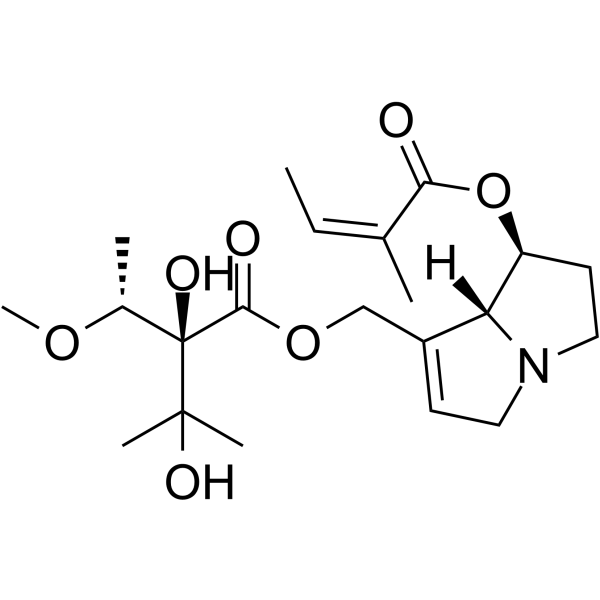
Physicochemical Properties
| Molecular Formula | C21H33NO7 |
| Molecular Weight | 411.49 |
| Exact Mass | 411.225 |
| CAS # | 303-34-4 |
| PubChem CID | 5281735 |
| Appearance |
COLORLESS PLATES Colorless leaflets from petroleum ether. |
| Density | 1.2±0.1 g/cm3 |
| Boiling Point | 519.8±50.0 °C at 760 mmHg |
| Melting Point | 97ºC |
| Flash Point | 268.1±30.1 °C |
| Vapour Pressure | 0.0±3.1 mmHg at 25°C |
| Index of Refraction | 1.545 |
| LogP | 2.85 |
| Hydrogen Bond Donor Count | 2 |
| Hydrogen Bond Acceptor Count | 8 |
| Rotatable Bond Count | 10 |
| Heavy Atom Count | 29 |
| Complexity | 699 |
| Defined Atom Stereocenter Count | 4 |
| SMILES | C/C=C(/C)\C(=O)O[C@H]1CCN2[C@@H]1C(=CC2)COC(=O)[C@@]([C@H](C)OC)(C(C)(C)O)O |
| InChi Key | QHOZSLCIKHUPSU-LPLKQDONSA-N |
| InChi Code | InChI=1S/C21H33NO7/c1-7-13(2)18(23)29-16-9-11-22-10-8-15(17(16)22)12-28-19(24)21(26,14(3)27-6)20(4,5)25/h7-8,14,16-17,25-26H,9-12H2,1-6H3/b13-7-/t14-,16-,17+,21-/m0/s1 |
| Chemical Name | [(7S,8R)-7-[(Z)-2-methylbut-2-enoyl]oxy-5,6,7,8-tetrahydro-3H-pyrrolizin-1-yl]methyl (2R)-2,3-dihydroxy-2-[(1S)-1-methoxyethyl]-3-methylbutanoate |
| HS Tariff Code | 2934.99.9001 |
| Storage |
Powder-20°C 3 years 4°C 2 years In solvent -80°C 6 months -20°C 1 month |
| Shipping Condition | Room temperature (This product is stable at ambient temperature for a few days during ordinary shipping and time spent in Customs) |
Biological Activity
| ln Vitro | Lasiocarpine is only poisonous after being metabolically converted to dehydrolasiocarpine, a toxic intermediate[1]. The pyrrolic esters, which include dehydrolasiocarpine and other probable didehydropyrrolizidine alkaloids, are highly reactive substances that target nucleophilic macromolecules like proteins and DNA. This can lead to serious toxicities, such as cancers and hepatic veno-occlusive disease[1]. Dehydrogenation, ester bond cleavage, demethylation, and other five metabolic pathways are the primary mechanisms in which lasiocarpine is metabolized in vitro[1]. |
| ADME/Pharmacokinetics |
Absorption, Distribution and Excretion LASROCARPINE (RANDOMLY LABELLED, 44% IN THE AMINO ALCOHOL) WAS ADMIN IP TO RATS (TOTAL DOSE, 5 MG) DISTRIBUTION OF LABEL AFTER 4 HR WAS AS FOLLOWS: CARCASS, 6.4%; INTESTINES, 8.6%; TESTES, 0.1%; LUNG, 0.05%; KIDNEY, 0.26%; HEART, 0.05%; SPLEEN, 0.01%; BRAIN, 0.03%; URINE, 27.2%; LIVER, 2.8%, EXPIRED CO2, 9.3% FRACTIONATION OF LIVER RESULTED IN 1.73% IN A TRICHLOROACETIC ACID EXTRACT, 0.6% IN PROTEIN, 0.48% IN LIPID & 0.005% IN NUCLEIC ACIDS. Metabolism / Metabolites STUDIES WITH LASIOCARPINE HAVE CONFIRMED THE FORMATION OF PYRROLIC METABOLITES BY THE MIXED-FUNCTION OXIDASE SYSTEM OF THE MICROSOMAL FRACTION OF RAT LIVER. DEHYDROHELIOTRIDINE HAS BEEN ISOLATED & IDENTIFIED AS A PRODUCT OF MICROSOMAL OXIDATION OF LASIOCARPINE. IN URINE ... OBTAINED 16 HR AFTER INJECTION ... TO RATS ... UNCHANGED LASIOCARPINE (1-1.5% OF DOSE), HELIOTRIDINE (1.5-3%), HELIOTRIDINE N-OXIDE (6%) & TRACES OF BASES WITH CHROMATOGRAPHIC PROPERTIES OF EUROPINE & 7-ANGELYHELIOTRIDINE (EXPECTED PRODUCTS OF PARTIAL HYDROLYSIS). ... METABOLITES IN 24-HR URINE SAMPLE ... 8.5% OF ADMIN LASIOCARPINE. HUMAN EMBRYONIC LIVER SLICES CONVERTED THE PYRROLIZIDINE ALKALOID LASIOCARPINE INTO PYRROLES, AS INDICATED BY A POS EHRLICH COLOR REACTION, WHEReAS LUNG TISSUE DID NOT. |
| Toxicity/Toxicokinetics |
Interactions LASIOCARPINE (7.8 MG/KG, IP TWICE WEEKLY FOR 4 WK, THEN ONCE A WK FOR 18 WK) DID NOT PREVENT INITIATION OF LIVER TUMORS BY AFLATOXIN B1 (2 PPM IN DIET), BUT ALTERED THE PATHOGENIC PATTERN IN THAT, IN RATS RECEIVING AFLATOXIN & LASIOCARPINE, THE LIVER TUMORS WERE ASSOC WITH POSTNECROTIC CIRRHOSIS, WHEReAS IN RATS DEVELOPING LIVER TUMORS WITH AFLATOXIN ALONE THEY WERE NOT. SENSITIVITY OF RATS TO LASIOCARPINE IS REDUCED BY FEEDING A DIET LOW IN LIPOTROPES OR BY SIMULTANEOUS ADMIN OF MERCAPTOETHYLAMINE. PREGNENOLONE-16ALPHA-CARBONITRILE, SPIRONOLACTONE, ETHYLESTRENOL, PHENOBARBITAL, & DIPHENYLHYDANTOIN PREVENTED THE MORTALITY & LIVER DAMAGE CAUSED BY SINGLE DOSE OF LASIOCARPINE (100 MG/KG, IP) WHEReAS SKF 525-A, OR PARTIAL HEPATECTOMY, GREATLY INCR LETHALITY. RATS WERE TREATED CONCURRENTLY WITH THIOACETAMIDE & THE PYRROLIZIDINE ALKALOID LASIOCARPINE. THIOACETAMIDE WAS GIVEN IP IN DOSE OF 50 MG/KG BODY WT TWICE WEEKLY & LASIOCARPINE WAS ADMIN IN THE DIET AT CONCN OF 50 PPM. THIOACETAMIDE & LASIOCARPINE PRODUCED NUMEROUS GROSSLY VISIBLE GREY NODULES IN LIVERS OF 26 OF 30 RATS. RAPID DEVELOPMENT OF LIVER LESIONS IN RATS TREATED SIMULTANEOUSLY SUGGEST THAT CELL PROLIFERATION ACCENTUATES THE DEVELOPMENT OF NEOPLASIA. For more Interactions (Complete) data for LASIOCARPINE (7 total), please visit the HSDB record page. Non-Human Toxicity Values LD50 Rat oral 150 mg/kg LD50 Rat intraperitoneal 78 mg/kg |
| References |
[1]. Species-Specific Differences in the in Vitro Metabolism of Lasiocarpine. Chem Res Toxicol. 2015 Oct 19;28(10):2034-44. |
| Additional Infomation |
Lasiocarpine can cause cancer according to an independent committee of scientific and health experts. Lasiocarpine appears as colorless plates or beige crystalline solid. (NTP, 1992) Lasiocarpine has been reported in Heliotropium ellipticum, Heliotropium arbainense, and other organisms with data available. See also: Comfrey Root (part of); Comfrey Leaf (part of). Mechanism of Action Death may be due to actual liver damage or to the upsetting of the copper storage mechanism which leads to a build-up of copper in the organ, resulting in the acute hemolytic crisis associated with chronic copper poisoning. |
Solubility Data
| Solubility (In Vivo) |
Note: Listed below are some common formulations that may be used to formulate products with low water solubility (e.g. < 1 mg/mL), you may test these formulations using a minute amount of products to avoid loss of samples. Injection Formulations (e.g. IP/IV/IM/SC) Injection Formulation 1: DMSO : Tween 80: Saline = 10 : 5 : 85 (i.e. 100 μL DMSO stock solution → 50 μL Tween 80 → 850 μL Saline) *Preparation of saline: Dissolve 0.9 g of sodium chloride in 100 mL ddH ₂ O to obtain a clear solution. Injection Formulation 2: DMSO : PEG300 :Tween 80 : Saline = 10 : 40 : 5 : 45 (i.e. 100 μL DMSO → 400 μLPEG300 → 50 μL Tween 80 → 450 μL Saline) Injection Formulation 3: DMSO : Corn oil = 10 : 90 (i.e. 100 μL DMSO → 900 μL Corn oil) Example: Take the Injection Formulation 3 (DMSO : Corn oil = 10 : 90) as an example, if 1 mL of 2.5 mg/mL working solution is to be prepared, you can take 100 μL 25 mg/mL DMSO stock solution and add to 900 μL corn oil, mix well to obtain a clear or suspension solution (2.5 mg/mL, ready for use in animals). Injection Formulation 4: DMSO : 20% SBE-β-CD in saline = 10 : 90 [i.e. 100 μL DMSO → 900 μL (20% SBE-β-CD in saline)] *Preparation of 20% SBE-β-CD in Saline (4°C,1 week): Dissolve 2 g SBE-β-CD in 10 mL saline to obtain a clear solution. Injection Formulation 5: 2-Hydroxypropyl-β-cyclodextrin : Saline = 50 : 50 (i.e. 500 μL 2-Hydroxypropyl-β-cyclodextrin → 500 μL Saline) Injection Formulation 6: DMSO : PEG300 : castor oil : Saline = 5 : 10 : 20 : 65 (i.e. 50 μL DMSO → 100 μLPEG300 → 200 μL castor oil → 650 μL Saline) Injection Formulation 7: Ethanol : Cremophor : Saline = 10: 10 : 80 (i.e. 100 μL Ethanol → 100 μL Cremophor → 800 μL Saline) Injection Formulation 8: Dissolve in Cremophor/Ethanol (50 : 50), then diluted by Saline Injection Formulation 9: EtOH : Corn oil = 10 : 90 (i.e. 100 μL EtOH → 900 μL Corn oil) Injection Formulation 10: EtOH : PEG300:Tween 80 : Saline = 10 : 40 : 5 : 45 (i.e. 100 μL EtOH → 400 μLPEG300 → 50 μL Tween 80 → 450 μL Saline) Oral Formulations Oral Formulation 1: Suspend in 0.5% CMC Na (carboxymethylcellulose sodium) Oral Formulation 2: Suspend in 0.5% Carboxymethyl cellulose Example: Take the Oral Formulation 1 (Suspend in 0.5% CMC Na) as an example, if 100 mL of 2.5 mg/mL working solution is to be prepared, you can first prepare 0.5% CMC Na solution by measuring 0.5 g CMC Na and dissolve it in 100 mL ddH2O to obtain a clear solution; then add 250 mg of the product to 100 mL 0.5% CMC Na solution, to make the suspension solution (2.5 mg/mL, ready for use in animals). Oral Formulation 3: Dissolved in PEG400 Oral Formulation 4: Suspend in 0.2% Carboxymethyl cellulose Oral Formulation 5: Dissolve in 0.25% Tween 80 and 0.5% Carboxymethyl cellulose Oral Formulation 6: Mixing with food powders Note: Please be aware that the above formulations are for reference only. InvivoChem strongly recommends customers to read literature methods/protocols carefully before determining which formulation you should use for in vivo studies, as different compounds have different solubility properties and have to be formulated differently. (Please use freshly prepared in vivo formulations for optimal results.) |
| Preparing Stock Solutions | 1 mg | 5 mg | 10 mg | |
| 1 mM | 2.4302 mL | 12.1510 mL | 24.3019 mL | |
| 5 mM | 0.4860 mL | 2.4302 mL | 4.8604 mL | |
| 10 mM | 0.2430 mL | 1.2151 mL | 2.4302 mL |