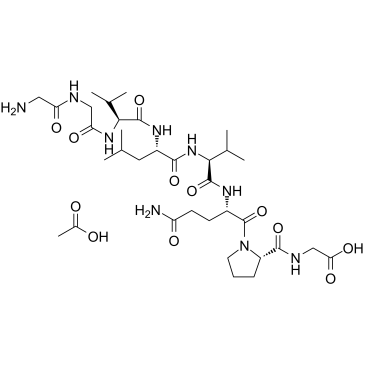
Larazotide Acetate, formerly known as AT-1001, is a novel and synthetic peptide acting as a tight junction regulator and reverses leaky junctions to their normally closed state. It is being studied in people with celiac disease.
Physicochemical Properties
| Molecular Formula | C34H59N9O12 |
| Molecular Weight | 785.9 |
| Exact Mass | 785.428 |
| Elemental Analysis | C, 51.96; H, 7.57; N, 16.04; O, 24.43 |
| CAS # | 881851-50-9 |
| Related CAS # | Larazotide;258818-34-7 |
| PubChem CID | 44146842 |
| Appearance | White to off-white solid powder |
| LogP | 3.736 |
| Hydrogen Bond Donor Count | 10 |
| Hydrogen Bond Acceptor Count | 13 |
| Rotatable Bond Count | 21 |
| Heavy Atom Count | 55 |
| Complexity | 1320 |
| Defined Atom Stereocenter Count | 5 |
| SMILES | CC(C)C[C@@H](C(=O)N[C@@H](C(C)C)C(=O)N[C@@H](CCC(=O)N)C(=O)N1CCC[C@H]1C(=O)NCC(=O)O)NC(=O)[C@H](C(C)C)NC(=O)CNC(=O)CN.CC(=O)O |
| InChi Key | NYGCNONRVCGHAT-UFIKZEAMSA-N |
| InChi Code | InChI=1S/C32H55N9O10.C2H4O2/c1-16(2)12-20(38-30(49)26(17(3)4)39-24(44)14-35-23(43)13-33)28(47)40-27(18(5)6)31(50)37-19(9-10-22(34)42)32(51)41-11-7-8-21(41)29(48)36-15-25(45)461-2(3)4/h16-21,26-27H,7-15,33H2,1-6H3,(H2,34,42)(H,35,43)(H,36,48)(H,37,50)(H,38,49)(H,39,44)(H,40,47)(H,45,46)1H3,(H,3,4)/t19-,20-,21-,26-,27-/m0./s1 |
| Chemical Name | 2-[[(2S)-1-[(2S)-5-Amino-2-[[(2S)-2-[[(2S)-2-[[(2S)-2-[[2-[(2-aminoacetyl)amino]acetyl]amino]-3-methylbutanoyl]amino]-4-methylpentanoyl]amino]-3-methylbutanoyl]amino]-5-oxopentanoyl]pyrrolidine-2-carbonyl]amino]acetic acid Acetate |
| Synonyms | Larazotide Acetate; AT-1001; AT 1001; AT1001;Larazotide acetate; 881851-50-9; Larazotide (acetate); AT-1001; Larazotide acetate [USAN]; Larazotide acetate (USAN); UNII-FO8S2IW40N; |
| HS Tariff Code | 2934.99.9001 |
| Storage |
Powder-20°C 3 years 4°C 2 years In solvent -80°C 6 months -20°C 1 month Note: Please store this product in a sealed and protected environment, avoid exposure to moisture. |
| Shipping Condition | Room temperature (This product is stable at ambient temperature for a few days during ordinary shipping and time spent in Customs) |
Biological Activity
| Targets | Zonulin; paracellular permeability and apical-basolateral polarity |
| ln Vitro | On Vero cell proliferation, larazotideacetate (1-100μM; 5 days) had an effect [1]. The varicella zoster virus (VZV) can be inhibited by larazotide acetate (1-100 μM; 3 d); the EC50 values for the OKA strain and the 07-1 strain, respectively, are 44.14 and 59.06 μM [1]. In Caco-2 cells, larazotideacetate (1 and 3 mM; 72 hours) reduces the permeability of tight junctions caused by cytokines [2]. In IEC6 cells, PTG-induced ZO-1 translocation and actin cytoskeleton rearrangement are inhibited by larazotideacetate (12.5 mM; 1 h) [2]. |
| ln Vivo | Larazotide acetate (250 μg; intraperitoneally injected twice weekly for 7 weeks) inhibits intestinal permeability in gluten-sensitive transgenic mice [1]. |
| Enzyme Assay | The recombinant SARS-CoV-2 Mpro (Proteros) (20 nM at a final concentration) was mixed with serial dilutions of AT1001 and Dabcyl-KTSAVLQSGFRKM-E(Edans)-NH2 substrate (5 μM) in 20 μL (reaction volume) assay buffer solution (20 mM HEPES, pH 7.5, 1 mM DTT, 1 mM EDTA, 100 mM NaCl, 0.01% Tween20). The appropriate volume of substrate was added in reaction buffer along with 42.5 nL compound in 100% DMSO. Finally, the appropriate volume of target enzyme was added, and the reaction started with an incubation time of 10 min. The fluorescence signal of the Edans was monitored at an emission wavelength of 500 nm by exciting at 360 nm, by means of Pherastar FSX microplate Reader. Calpeptin was used as reference to set up the experiments[1]. |
| Cell Assay |
Cytotoxicity assay [1] Cell Types: Vero cell line Tested Concentrations: 1-100 μM Incubation Duration: 5 days Experimental Results: Inhibited Vero cell growth, CC50 value was 82.5 μM. |
| Animal Protocol |
Animal/Disease Models: HLA-HCD4/DQ8 double transgenic mice [2] Doses: 250 μg Route of Administration: intraperitoneal (ip) injection; 250 μg twice a week for 7 weeks Experimental Results: Barrier function parameters improved, macrophages in lamina propria Cell count diminished to control levels. |
| References |
[1]. Peptide Derivatives of the Zonulin Inhibitor Larazotide (AT1001) as Potential Anti SARS-CoV-2: Molecular Modelling, Synthesis and Bioactivity Evaluation. Int J Mol Sci. 2021 Aug 30;22(17):9427. [2]. Larazotide acetate regulates epithelial tight junctions in vitro and in vivo. Peptides. 2012 May;35(1):86-94. |
| Additional Infomation |
A novel coronavirus, severe acute respiratory syndrome coronavirus 2 (SARS-CoV-2), has been identified as the pathogen responsible for the outbreak of a severe, rapidly developing pneumonia (Coronavirus disease 2019, COVID-19). The virus enzyme, called 3CLpro or main protease (Mpro), is essential for viral replication, making it a most promising target for antiviral drug development. Recently, we adopted the drug repurposing as appropriate strategy to give fast response to global COVID-19 epidemic, by demonstrating that the zonulin octapeptide inhibitor AT1001 (Larazotide acetate) binds Mpro catalytic domain. Thus, in the present study we tried to investigate the antiviral activity of AT1001, along with five derivatives, by cell-based assays. Our results provide with the identification of AT1001 peptide molecular framework for lead optimization step to develop new generations of antiviral agents of SARS-CoV-2 with an improved biological activity, expanding the chance for success in clinical trials.[1] Tight junctions (TJs) control paracellular permeability and apical-basolateral polarity of epithelial cells, and can be regulated by exogenous and endogenous stimuli. Dysregulated permeability is associated with pathological conditions, such as celiac disease and inflammatory bowel disease. Herein we studied the mechanism by which larazotide acetate, an 8-mer peptide and TJ regulator, inhibits the cellular changes elicited by gliadin fragments, AT-1002, and cytokines. Previously, we demonstrated that AT-1002, a 6-mer peptide derived from the Vibrio cholerae zonula occludens toxin ZOT, caused several biochemical changes in IEC6 and Caco-2 cells resulting in decreased transepithelial electrical resistance (TEER) and increased TJ permeability. In this study, larazotide acetate inhibited the redistribution and rearrangement of zonula occludens-1 (ZO-1) and actin caused by AT-1002 and gliadin fragments in Caco-2 and IEC6 cells. Functionally, larazotide acetate inhibited the AT-1002-induced TEER reduction and TJ opening in Caco-2 cells. Additionally, larazotide acetate inhibited the translocation of a gliadin 13-mer peptide, which has been implicated in celiac disease, across Caco-2 cell monolayers. Further, apically applied larazotide acetate inhibited the increase in TJ permeability elicited by basolaterally applied cytokines. Finally, when tested in vivo in gliadin-sensitized HLA-HCD4/DQ8 double transgenic mice, larazotide acetate inhibited gliadin-induced macrophage accumulation in the intestine and preserved normal TJ structure. Taken together, our data suggest that larazotide acetate inhibits changes elicited by AT-1002, gliadin, and cytokines in epithelial cells and preserves TJ structure and function in vitro and in vivo.[2] |
Solubility Data
| Solubility (In Vitro) |
H2O : ~16.67 mg/mL (~21.21 mM) DMSO : ~3.2 mg/mL (~4.07 mM) |
| Solubility (In Vivo) |
Solubility in Formulation 1: 100 mg/mL (127.24 mM) in PBS (add these co-solvents sequentially from left to right, and one by one), clear solution; with sonication. (Please use freshly prepared in vivo formulations for optimal results.) |
| Preparing Stock Solutions | 1 mg | 5 mg | 10 mg | |
| 1 mM | 1.2724 mL | 6.3621 mL | 12.7243 mL | |
| 5 mM | 0.2545 mL | 1.2724 mL | 2.5449 mL | |
| 10 mM | 0.1272 mL | 0.6362 mL | 1.2724 mL |