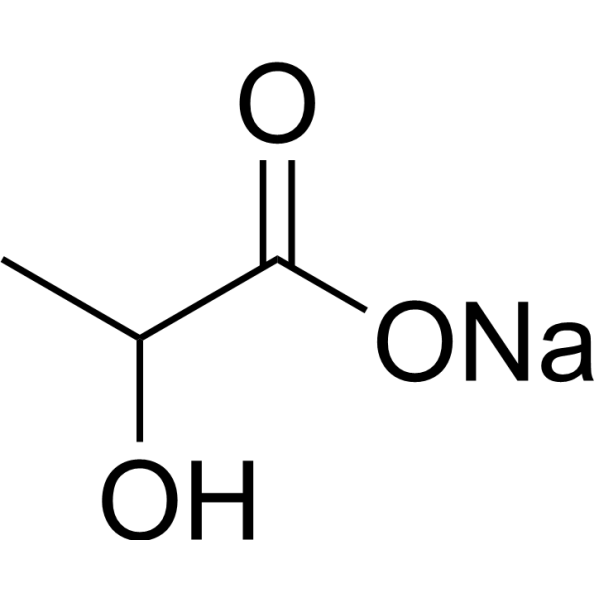
Physicochemical Properties
| Molecular Formula | C3H5NAO3 |
| Molecular Weight | 112.0598 |
| Exact Mass | 112.013 |
| CAS # | 72-17-3 |
| Related CAS # | Lactate;50-21-5;Lactate calcium;814-80-2;Lactate-d4 sodium;344299-52-1;Lactate-d3 sodium;1219802-24-0;Lactate-13C sodium;81273-81-6;Lactate-13C-1 sodium;201595-70-2;Lactate potassium;996-31-6 |
| PubChem CID | 23666456 |
| Appearance | Colorless to light yellow liquid |
| Density | 1.33 |
| Boiling Point | 227.6ºC at 760 mmHg |
| Melting Point | 17ºC |
| Flash Point | 109.9ºC |
| Index of Refraction | 1.422-1.425 |
| Hydrogen Bond Donor Count | 1 |
| Hydrogen Bond Acceptor Count | 3 |
| Rotatable Bond Count | 1 |
| Heavy Atom Count | 7 |
| Complexity | 63.2 |
| Defined Atom Stereocenter Count | 0 |
| SMILES | [Na+].O([H])C([H])(C(=O)[O-])C([H])([H])[H] |
| InChi Key | NGSFWBMYFKHRBD-UHFFFAOYSA-M |
| InChi Code | InChI=1S/C3H6O3.Na/c1-2(4)3(5)6;/h2,4H,1H3,(H,5,6);/q;+1/p-1 |
| Chemical Name | sodium;2-hydroxypropanoate |
| Synonyms | compound sodium lactate solution; SODIUM LACTATE; 72-17-3; Sodium DL-lactate; Lactic acid sodium salt; Monosodium lactate; sodium 2-hydroxypropanoate; Lacolin; |
| HS Tariff Code | 2934.99.9001 |
| Storage |
Powder-20°C 3 years 4°C 2 years In solvent -80°C 6 months -20°C 1 month |
| Shipping Condition | Room temperature (This product is stable at ambient temperature for a few days during ordinary shipping and time spent in Customs) |
Biological Activity
| Targets | Buffer; pH adjuster |
| ln Vitro | After traumatic brain injury, hypertonic sodium lactate solution enhances cognitive function (TBI). In pig models of traumatic brain injury, hypertonic sodium lactate solution also lowers intracranial pressure (ICP) and raises cerebral blood flow via arteriolar vasodilation [2][3]. Pseudomonas, lactobacilli, Enterobacteriaceae, aerobic and psychrophilic flora, and other skewed human resources are inhibited by sodium lactate [6]. |
| ln Vivo |
Design and setting: Prospective open randomized study in an adult ICU.
Patients: Thirty-four patients with isolated severe TBI (Glasgow Coma Scale |
| Animal Protocol | Measurements and results: Compared to mannitol, the effect of the lactate solution on ICP was significantly more pronounced (7 vs. 4 mmHg, P = 0.016), more prolonged (fourth-hour-ICP decrease: -5.9 +/- 1 vs. -3.2 +/- 0.9 mmHg, P = 0.009) and more frequently successful (90.4 vs. 70.4%, P = 0.053). Conclusion: Acute infusion of a sodium lactate-based hyperosmolar solution is effective in treating intracranial hypertension following traumatic brain injury. This effect is significantly more pronounced than that of an equivalent osmotic load of mannitol. Additionally, in this specific group of patients, long-term outcome was better in terms of GOS in those receiving as compared to mannitol. Larger trials are warranted to confirm our findings.[2] |
| Toxicity/Toxicokinetics |
rat LD50 intraperitoneal 2 gm/kg FAO Nutrition Meetings Report Series., 40(144), 1967 rat LD50 intravenous >1 gm/kg SENSE ORGANS AND SPECIAL SENSES: PTOSIS: EYE; BEHAVIORAL: SOMNOLENCE (GENERAL DEPRESSED ACTIVITY); LUNGS, THORAX, OR RESPIRATION: DYSPNEA Kiso to Rinsho. Clinical Report., 21(3289), 1987 mouse LD50 intravenous 2190 mg/kg Drugs in Japan, -(938), 1995 |
| References |
[1]. Brooks GA. Lactate: link between glycolytic and oxidative metabolism. Sports Med. 2007;37(4-5):341-3. [2]. Sodium lactate versus mannitol in the treatment of intracranial hypertensive episodes in severe traumatic brain-injured patients. Intensive Care Med. 2009 Mar;35(3):471-9. [3]. Lactate administration attenuates cognitive deficits following traumatic brain injury. Brain Res. 2002 Feb 22;928(1-2):156-9. [4]. Hospira, Inc. (November 2004). "Sodium Lactate (sodium lactate) Injection, Solution, Concentrate". DailyMed. U.S. National Library of Medicine. Archived from the original on 2014-01-04. Retrieved 2012-08-16. [5]. Sodium bicarbonate for the treatment of lactic acidosis. Chest. 2000 Jan;117(1):260-7. [6]. Sallam KI. Antimicrobial and antioxidant effects of sodium acetate, sodium lactate, and sodium citrate in refrigerated sliced salmon. Food Control. 2007 May;18(5):566-575. |
| Additional Infomation |
Sodium lactate is an organic sodium salt having lactate as the counterion. It has a role as a food preservative and a food acidity regulator. It is an organic sodium salt and a lactate salt. It contains a lactate. Sodium Lactate is a sodium salt of racemic or inactive lactic acid with alkalinizing and electrolyte replenishing property. Upon metabolism, sodium lactate is converted to bicarbonate, thereby increasing plasma bicarbonate, which facilitates removal of hydrogen ion and lactate from blood stream and leads to raised blood pH. Compound Sodium Lactate Solution is a multiple electrolyte, isotonic, crystalloid solution for intravenous infusion containing sodium chloride, potassium chloride, calcium chloride dihydrate, and sodium lactate, which can restore the electrolyte balance, normalize pH, and provide water for hydration. Upon intravenous administration, the compound sodium lactate solution will replace any lost body fluids and electrolytes thereby providing hydration as well as normalizing electrolyte concentrations. In addition, conversion of sodium lactate to bicarbonate increases plasma bicarbonate levels, which facilitates the removal of hydrogen ions from the blood stream, raises blood pH and normalizes the acid-base balance. The sodium salt of racemic or inactive lactic acid. It is a hygroscopic agent used intravenously as a systemic and urinary alkalizer. See also: Sodium Cation (has active moiety) ... View More ... |
Solubility Data
| Solubility (In Vitro) |
H2O : ≥ 150 mg/mL (~1338.57 mM) DMSO : ≥ 100 mg/mL (~892.38 mM) |
| Solubility (In Vivo) |
Note: Listed below are some common formulations that may be used to formulate products with low water solubility (e.g. < 1 mg/mL), you may test these formulations using a minute amount of products to avoid loss of samples. Injection Formulations (e.g. IP/IV/IM/SC) Injection Formulation 1: DMSO : Tween 80: Saline = 10 : 5 : 85 (i.e. 100 μL DMSO stock solution → 50 μL Tween 80 → 850 μL Saline) *Preparation of saline: Dissolve 0.9 g of sodium chloride in 100 mL ddH ₂ O to obtain a clear solution. Injection Formulation 2: DMSO : PEG300 :Tween 80 : Saline = 10 : 40 : 5 : 45 (i.e. 100 μL DMSO → 400 μLPEG300 → 50 μL Tween 80 → 450 μL Saline) Injection Formulation 3: DMSO : Corn oil = 10 : 90 (i.e. 100 μL DMSO → 900 μL Corn oil) Example: Take the Injection Formulation 3 (DMSO : Corn oil = 10 : 90) as an example, if 1 mL of 2.5 mg/mL working solution is to be prepared, you can take 100 μL 25 mg/mL DMSO stock solution and add to 900 μL corn oil, mix well to obtain a clear or suspension solution (2.5 mg/mL, ready for use in animals). Injection Formulation 4: DMSO : 20% SBE-β-CD in saline = 10 : 90 [i.e. 100 μL DMSO → 900 μL (20% SBE-β-CD in saline)] *Preparation of 20% SBE-β-CD in Saline (4°C,1 week): Dissolve 2 g SBE-β-CD in 10 mL saline to obtain a clear solution. Injection Formulation 5: 2-Hydroxypropyl-β-cyclodextrin : Saline = 50 : 50 (i.e. 500 μL 2-Hydroxypropyl-β-cyclodextrin → 500 μL Saline) Injection Formulation 6: DMSO : PEG300 : castor oil : Saline = 5 : 10 : 20 : 65 (i.e. 50 μL DMSO → 100 μLPEG300 → 200 μL castor oil → 650 μL Saline) Injection Formulation 7: Ethanol : Cremophor : Saline = 10: 10 : 80 (i.e. 100 μL Ethanol → 100 μL Cremophor → 800 μL Saline) Injection Formulation 8: Dissolve in Cremophor/Ethanol (50 : 50), then diluted by Saline Injection Formulation 9: EtOH : Corn oil = 10 : 90 (i.e. 100 μL EtOH → 900 μL Corn oil) Injection Formulation 10: EtOH : PEG300:Tween 80 : Saline = 10 : 40 : 5 : 45 (i.e. 100 μL EtOH → 400 μLPEG300 → 50 μL Tween 80 → 450 μL Saline) Oral Formulations Oral Formulation 1: Suspend in 0.5% CMC Na (carboxymethylcellulose sodium) Oral Formulation 2: Suspend in 0.5% Carboxymethyl cellulose Example: Take the Oral Formulation 1 (Suspend in 0.5% CMC Na) as an example, if 100 mL of 2.5 mg/mL working solution is to be prepared, you can first prepare 0.5% CMC Na solution by measuring 0.5 g CMC Na and dissolve it in 100 mL ddH2O to obtain a clear solution; then add 250 mg of the product to 100 mL 0.5% CMC Na solution, to make the suspension solution (2.5 mg/mL, ready for use in animals). Oral Formulation 3: Dissolved in PEG400 Oral Formulation 4: Suspend in 0.2% Carboxymethyl cellulose Oral Formulation 5: Dissolve in 0.25% Tween 80 and 0.5% Carboxymethyl cellulose Oral Formulation 6: Mixing with food powders Note: Please be aware that the above formulations are for reference only. InvivoChem strongly recommends customers to read literature methods/protocols carefully before determining which formulation you should use for in vivo studies, as different compounds have different solubility properties and have to be formulated differently. (Please use freshly prepared in vivo formulations for optimal results.) |
| Preparing Stock Solutions | 1 mg | 5 mg | 10 mg | |
| 1 mM | 8.9238 mL | 44.6190 mL | 89.2379 mL | |
| 5 mM | 1.7848 mL | 8.9238 mL | 17.8476 mL | |
| 10 mM | 0.8924 mL | 4.4619 mL | 8.9238 mL |