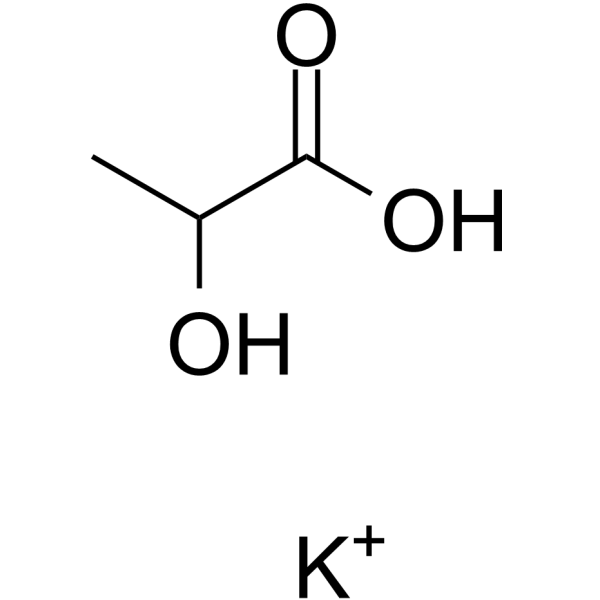
Physicochemical Properties
| Molecular Formula | C3H5KO3 |
| Molecular Weight | 128.17 |
| Exact Mass | 127.987 |
| CAS # | 996-31-6 |
| Related CAS # | Lactate;50-21-5;Lactate calcium;814-80-2;Lactate sodium;72-17-3 |
| PubChem CID | 23671663 |
| Appearance | Colorless to light yellow liquid |
| Density | 1.316 g/ml (predict) |
| Boiling Point | 227.6ºC at 760 mmHg |
| Flash Point | 109.9ºC |
| Hydrogen Bond Donor Count | 1 |
| Hydrogen Bond Acceptor Count | 3 |
| Rotatable Bond Count | 1 |
| Heavy Atom Count | 7 |
| Complexity | 63.2 |
| Defined Atom Stereocenter Count | 0 |
| SMILES | CC(C(=O)[O-])O.[K+] |
| InChi Key | PHZLMBHDXVLRIX-UHFFFAOYSA-M |
| InChi Code | InChI=1S/C3H6O3.K/c1-2(4)3(5)6;/h2,4H,1H3,(H,5,6);/q;+1/p-1 |
| Chemical Name | potassium;2-hydroxypropanoate |
| Synonyms | POTASSIUM LACTATE; 996-31-6; Potassium DL-lactate; potassium 2-hydroxypropanoate; Monopotassium lactate; Lactic acid, potassium salt; Monopotassium 2-hydroxypropanoate; potassium;2-hydroxypropanoate; |
| HS Tariff Code | 2934.99.9001 |
| Storage |
Powder-20°C 3 years 4°C 2 years In solvent -80°C 6 months -20°C 1 month |
| Shipping Condition | Room temperature (This product is stable at ambient temperature for a few days during ordinary shipping and time spent in Customs) |
Biological Activity
| ln Vitro | The purpose of this study was to evaluate the combined effects of sodium chloride (NaCl) substitutes, including potassium lactate (K-lactate) and calcium ascorbate (Ca-ascorbate), on the physicochemical and sensory characteristics of low-sodium frankfurter sausage (1.2% content of NaCl). Sausages produced with 40% substitution of NaCl with combined K-lactate and Ca-ascorbate showed a higher value of lightness (P<0.001) than sausages containing 2.0% content of NaCl (control). However, the sensory panels were unable to distinguish a difference in color intensity between the control and treatment groups. Frankfurter sausages produced with 30% K-lactate and 10% Ca-ascorbate exhibited similar water-holding capacity, textural properties, and organoleptic characteristics (P>0.05) when compared to control sausages. Thus, the use of these salt mixtures is a good way to reduce the NaCl content in meat products while maintaining the quality of meat products. These results may be useful in developing low-sodium meat products.[1] |
| ln Vivo | Frankfurter-type sausages were prepared with potassium lactate, sodium diacetate and various levels of a mixture of potassium lactate and sodium diacetate. The development of Lactobacillus sake and Listeria monocytogenes and the sensory quality were compared with a reference product without any of these additions. It was shown that addition of 2–3% of a solution, containing a mixture of 56% potassium lactate and 4% sodium diacetate to Frankfurter-type sausages inhibited the development of L. sake and L. monocytogenes bacteria inoculated on to the product during storage at 4°C. L. sake bacteria were mainly inhibited by the addition of lactates and its water activity lowering effect, resulting in a shelf-life extension with 75–125%. In Frankfurter sausage with 0.1% sodium diacetate L. sake was not inhibited, but the development of L. monocytogenes was retarded. The increase of L. monocytogenes also slowed down when L. sake numbers reached 108 cfu g−1, probably as a result of lactic acid and/or bacteriocins production in those products. A synergistic effect of the combined addition of lactate and diacetate was observed at the end of the shelf-life, where L. monocytogenes was inhibited in Frankfurters with mixtures of potassium lactate and sodium diacetate while some growth was observed in products only containing potassium lactate. Sensory properties of the product were not significantly influenced by the addition of 2–3% of solutions containing a potassium lactate/sodium diacetate mixture.[2] |
| References |
[1]. Combined effects of potassium lactate and calcium ascorbate as sodium chloride substitutes on the physicochemical and sensory characteristics of low-sodium frankfurter sausage. Meat Sci. 2014 Jan;96(1):21-5. [2]. Enhanced inhibition of Listeria monocytogenes in frankfurter sausage by the addition of potassium lactate and sodium diacetate mixtures. Food microbiology, 2003, 20(1): 133-137. |
| Additional Infomation |
Sources/Uses Used as a flavor enhancer; Used in solution as an antioxidant and synergist |
Solubility Data
| Solubility (In Vitro) | May dissolve in DMSO (in most cases), if not, try other solvents such as H2O, Ethanol, or DMF with a minute amount of products to avoid loss of samples |
| Solubility (In Vivo) |
Note: Listed below are some common formulations that may be used to formulate products with low water solubility (e.g. < 1 mg/mL), you may test these formulations using a minute amount of products to avoid loss of samples. Injection Formulations (e.g. IP/IV/IM/SC) Injection Formulation 1: DMSO : Tween 80: Saline = 10 : 5 : 85 (i.e. 100 μL DMSO stock solution → 50 μL Tween 80 → 850 μL Saline) *Preparation of saline: Dissolve 0.9 g of sodium chloride in 100 mL ddH ₂ O to obtain a clear solution. Injection Formulation 2: DMSO : PEG300 :Tween 80 : Saline = 10 : 40 : 5 : 45 (i.e. 100 μL DMSO → 400 μLPEG300 → 50 μL Tween 80 → 450 μL Saline) Injection Formulation 3: DMSO : Corn oil = 10 : 90 (i.e. 100 μL DMSO → 900 μL Corn oil) Example: Take the Injection Formulation 3 (DMSO : Corn oil = 10 : 90) as an example, if 1 mL of 2.5 mg/mL working solution is to be prepared, you can take 100 μL 25 mg/mL DMSO stock solution and add to 900 μL corn oil, mix well to obtain a clear or suspension solution (2.5 mg/mL, ready for use in animals). Injection Formulation 4: DMSO : 20% SBE-β-CD in saline = 10 : 90 [i.e. 100 μL DMSO → 900 μL (20% SBE-β-CD in saline)] *Preparation of 20% SBE-β-CD in Saline (4°C,1 week): Dissolve 2 g SBE-β-CD in 10 mL saline to obtain a clear solution. Injection Formulation 5: 2-Hydroxypropyl-β-cyclodextrin : Saline = 50 : 50 (i.e. 500 μL 2-Hydroxypropyl-β-cyclodextrin → 500 μL Saline) Injection Formulation 6: DMSO : PEG300 : castor oil : Saline = 5 : 10 : 20 : 65 (i.e. 50 μL DMSO → 100 μLPEG300 → 200 μL castor oil → 650 μL Saline) Injection Formulation 7: Ethanol : Cremophor : Saline = 10: 10 : 80 (i.e. 100 μL Ethanol → 100 μL Cremophor → 800 μL Saline) Injection Formulation 8: Dissolve in Cremophor/Ethanol (50 : 50), then diluted by Saline Injection Formulation 9: EtOH : Corn oil = 10 : 90 (i.e. 100 μL EtOH → 900 μL Corn oil) Injection Formulation 10: EtOH : PEG300:Tween 80 : Saline = 10 : 40 : 5 : 45 (i.e. 100 μL EtOH → 400 μLPEG300 → 50 μL Tween 80 → 450 μL Saline) Oral Formulations Oral Formulation 1: Suspend in 0.5% CMC Na (carboxymethylcellulose sodium) Oral Formulation 2: Suspend in 0.5% Carboxymethyl cellulose Example: Take the Oral Formulation 1 (Suspend in 0.5% CMC Na) as an example, if 100 mL of 2.5 mg/mL working solution is to be prepared, you can first prepare 0.5% CMC Na solution by measuring 0.5 g CMC Na and dissolve it in 100 mL ddH2O to obtain a clear solution; then add 250 mg of the product to 100 mL 0.5% CMC Na solution, to make the suspension solution (2.5 mg/mL, ready for use in animals). Oral Formulation 3: Dissolved in PEG400 Oral Formulation 4: Suspend in 0.2% Carboxymethyl cellulose Oral Formulation 5: Dissolve in 0.25% Tween 80 and 0.5% Carboxymethyl cellulose Oral Formulation 6: Mixing with food powders Note: Please be aware that the above formulations are for reference only. InvivoChem strongly recommends customers to read literature methods/protocols carefully before determining which formulation you should use for in vivo studies, as different compounds have different solubility properties and have to be formulated differently. (Please use freshly prepared in vivo formulations for optimal results.) |
| Preparing Stock Solutions | 1 mg | 5 mg | 10 mg | |
| 1 mM | 7.8021 mL | 39.0107 mL | 78.0214 mL | |
| 5 mM | 1.5604 mL | 7.8021 mL | 15.6043 mL | |
| 10 mM | 0.7802 mL | 3.9011 mL | 7.8021 mL |