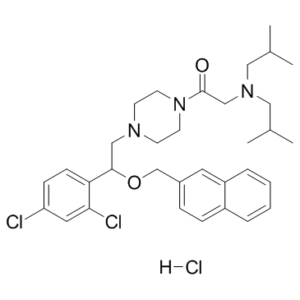
LYN-1604 HCl, the hydrochloride salt of LYN-1604, is a novel and potent activator/agonist of the UNC-51-like kinase 1 (ULK1) (EC50 = 18.94 nM) with anticancer activity. ULK1 is well-known to initiate autophagy, and the downregulation of ULK1 has been found in most breast cancer tissues. LYN-1604 interacts with three amino acid residues (LYS50, LEU53, and TYR89) in the activation site of ULK1 as monitored by site-directed mutagenesis and biochemical assays. LYN-1604 could induce cell death, associated with autophagy by the ULK complex (ULK1-mATG13-FIP200-ATG101) in MDA-MB-231 cells. LYN-1604 induced cell death involved in ATF3, RAD21, and caspase3, accompanied by autophagy and apoptosis. LYN-1604 has potential for good therapeutic effects on TNBC by targeting ULK1-modulated cell death in vivo; thus making this ULK1 agonist a novel potential small-molecule drug candidate for future TNBC therapy.
Physicochemical Properties
| Molecular Formula | C₃₃H₄₄CL₃N₃O₂ | |
| Molecular Weight | 621.08 | |
| Exact Mass | 619.249 | |
| Elemental Analysis | C, 63.82; H, 7.14; Cl, 17.12; N, 6.77; O, 5.15 | |
| CAS # | 2216753-86-3 | |
| Related CAS # | LYN-1604 dihydrochloride;2310109-38-5;LYN-1604;2088939-99-3 | |
| PubChem CID | 131801112 | |
| Appearance | White to off-white solid powder | |
| Hydrogen Bond Donor Count | 1 | |
| Hydrogen Bond Acceptor Count | 4 | |
| Rotatable Bond Count | 12 | |
| Heavy Atom Count | 41 | |
| Complexity | 750 | |
| Defined Atom Stereocenter Count | 0 | |
| SMILES | ClC1C=C(C=CC=1C(CN1CCN(C(CN(CC(C)C)CC(C)C)=O)CC1)OCC1C=CC2C=CC=CC=2C=1)Cl.Cl |
|
| InChi Key | KWFDUNOLEJSFBQ-UHFFFAOYSA-N | |
| InChi Code | InChI=1S/C33H43Cl2N3O2.ClH/c1-24(2)19-37(20-25(3)4)22-33(39)38-15-13-36(14-16-38)21-32(30-12-11-29(34)18-31(30)35)40-23-26-9-10-27-7-5-6-8-28(27)17-26;/h5-12,17-18,24-25,32H,13-16,19-23H2,1-4H3;1H | |
| Chemical Name |
|
|
| Synonyms |
|
|
| HS Tariff Code | 2934.99.9001 | |
| Storage |
Powder-20°C 3 years 4°C 2 years In solvent -80°C 6 months -20°C 1 month |
|
| Shipping Condition | Room temperature (This product is stable at ambient temperature for a few days during ordinary shipping and time spent in Customs) |
Biological Activity
| ln Vitro | LYN-1604 has the potential to be an agonist for ULK1 (enzymatic activity = 195.7% at 100 nM and IC50 = 1.66 μM against MDA-MB-231 cells) [1]. With an affinity for binding in the nanomole range (KD=291.4 nM), LYN-1604 binds to wild-type ULK1 [1]. On MDA-MB-231 cells, LYN-1604 (0.5, 1.0, and 2.0 μM) causes cell death through the ULK complex[1].. hours) dramatically increases Beclin-1 expression, degrades p62, and causes LC3-I to become LC3-II in MDA-MB-231 cells[1]. Via the ULK complex, LYN-1604 triggers autophagy that is ATG5-dependent[1]. Additionally, LYN-1604 has the ability to trigger apoptosis and boost caspase3 cleavage[1]. |
| ln Vivo | Targeting ULK1-modulated cell death, LYN-1604 (low dose: 25 mg/kg; medium dose: 50 mg/kg; high dose: 100 mg/kg) is an intragastric drug administered once daily for 14 days that reduces the growth of xenograft TNBC [1]. |
| Cell Assay |
Cell Viability Assay[1] Cell Types: MDA-MB-231 cells Tested Concentrations: 0.5, 1.0 and 2.0 μM Incubation Duration: Experimental Results: Induced cell death. Autophagy ratio was increased in a dose-dependent manner. Western Blot Analysis[1] Cell Types: MDA-MB-231 cells Tested Concentrations: 0, 0.5, 1, and 2 μM Incubation Duration: 24 hrs (hours) Experimental Results: Induced remarkable up -regulation of Beclin-1 and degradation of p62, as well as transformation of LC3-I to LC3-II. |
| Animal Protocol |
Animal/Disease Models: 24 female nude mice (BALB/c, 6-8 weeks, 20-22 g)[1] Doses: Low dose, 25 mg/kg; median dose, 50 mg/kg; high dose, 100 mg/kg Route of Administration: intragastric (po) administration; one time/day for 14 days Experimental Results: Dramatically inhibited the growth of xenograft MDA-MB-231 cells. The body weights of mice were stable. By the end of the experiment, the liver and spleen weight indexes of mice were slightly increased in parts of the groups, while the kidney weight index was not affected in all dose groups. |
| References |
[1]. Discovery of a small molecule targeting ULK1-modulated cell death of triple negative breast cancer in vitro and in vivo. Chem Sci. 2017 Apr 1;8(4):2687-2701. |
Solubility Data
| Solubility (In Vitro) |
|
|||
| Solubility (In Vivo) |
Solubility in Formulation 1: ≥ 2.5 mg/mL (4.03 mM) (saturation unknown) in 10% DMSO + 40% PEG300 + 5% Tween80 + 45% Saline (add these co-solvents sequentially from left to right, and one by one), clear solution. For example, if 1 mL of working solution is to be prepared, you can add 100 μL of 25.0 mg/mL clear DMSO stock solution to 400 μL PEG300 and mix evenly; then add 50 μL Tween-80 to the above solution and mix evenly; then add 450 μL normal saline to adjust the volume to 1 mL. Preparation of saline: Dissolve 0.9 g of sodium chloride in 100 mL ddH₂ O to obtain a clear solution. Solubility in Formulation 2: ≥ 2.5 mg/mL (4.03 mM) (saturation unknown) in 10% DMSO + 90% (20% SBE-β-CD in Saline) (add these co-solvents sequentially from left to right, and one by one), clear solution. For example, if 1 mL of working solution is to be prepared, you can add 100 μL of 25.0 mg/mL clear DMSO stock solution to 900 μL of 20% SBE-β-CD physiological saline solution and mix evenly. Preparation of 20% SBE-β-CD in Saline (4°C,1 week): Dissolve 2 g SBE-β-CD in 10 mL saline to obtain a clear solution. Solubility in Formulation 3: ≥ 2.5 mg/mL (4.03 mM) (saturation unknown) in 10% DMSO + 90% Corn Oil (add these co-solvents sequentially from left to right, and one by one), clear solution. For example, if 1 mL of working solution is to be prepared, you can add 100 μL of 25.0 mg/mL clear DMSO stock solution to 900 μL of corn oil and mix evenly. (Please use freshly prepared in vivo formulations for optimal results.) |
| Preparing Stock Solutions | 1 mg | 5 mg | 10 mg | |
| 1 mM | 1.6101 mL | 8.0505 mL | 16.1010 mL | |
| 5 mM | 0.3220 mL | 1.6101 mL | 3.2202 mL | |
| 10 mM | 0.1610 mL | 0.8050 mL | 1.6101 mL |