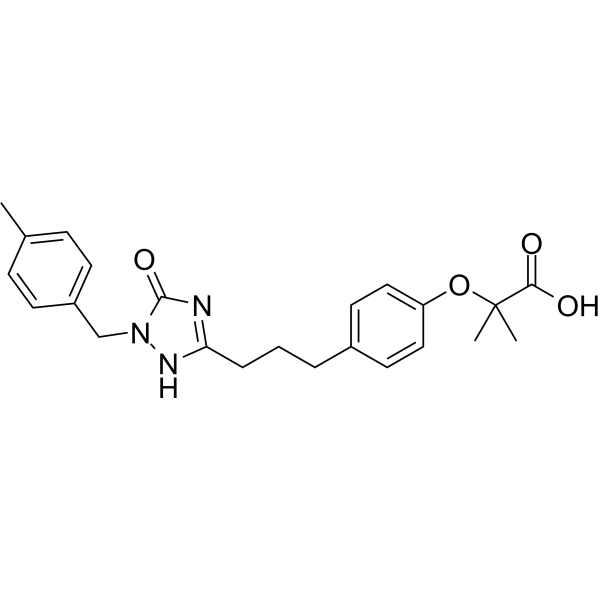
LY518674 (LY-518674; LY674) is a novel and potent PPAR-alpha agonist (EC50 = 42 nM for human PPARα) with the potential to be used for the treatment of atherosclerosis. LY518674 reduces triglycerides in and increased HDL-C.
Physicochemical Properties
| Molecular Formula | C23H27N3O4 |
| Molecular Weight | 409.486 |
| Exact Mass | 409.2 |
| Elemental Analysis | C, 67.46; H, 6.65; N, 10.26; O, 15.63 |
| CAS # | 425671-29-0 |
| PubChem CID | 135449333 |
| Appearance | Light yellow to yellow solid powder |
| Density | 1.21g/cm3 |
| Boiling Point | 575.852ºC at 760 mmHg |
| Flash Point | 302.065ºC |
| Index of Refraction | 1.594 |
| LogP | 3.345 |
| Hydrogen Bond Donor Count | 2 |
| Hydrogen Bond Acceptor Count | 5 |
| Rotatable Bond Count | 9 |
| Heavy Atom Count | 30 |
| Complexity | 632 |
| Defined Atom Stereocenter Count | 0 |
| InChi Key | PNHFDVSKDSLUFH-UHFFFAOYSA-N |
| InChi Code | InChI=1S/C23H27N3O4/c1-16-7-9-18(10-8-16)15-26-22(29)24-20(25-26)6-4-5-17-11-13-19(14-12-17)30-23(2,3)21(27)28/h7-14H,4-6,15H2,1-3H3,(H,27,28)(H,24,25,29) |
| Chemical Name | 2-methyl-2-[4-[3-[1-[(4-methylphenyl)methyl]-5-oxo-4H-1,2,4-triazol-3-yl]propyl]phenoxy]propanoic acid |
| Synonyms | LY 518674; LY674; LY-518674; LY-674; Ly 518674; UNII-U8I57RC739; U8I57RC739; CHEMBL424133; LY518674; LY674 |
| HS Tariff Code | 2934.99.9001 |
| Storage |
Powder-20°C 3 years 4°C 2 years In solvent -80°C 6 months -20°C 1 month |
| Shipping Condition | Room temperature (This product is stable at ambient temperature for a few days during ordinary shipping and time spent in Customs) |
Biological Activity
| Targets | hPPARα (EC50 = 42 nM)[1] |
| ln Vitro | The discovery and SAR of a novel series of potent and selective PPARα antagonists are herein described. Exploration of replacements for the labile acyl sulfonamide linker led to a biaryl sulfonamide series of which compound 33 (LY518674)proved to be suitable for further profiling in vivo. Compound 33 (LY518674) demonstrated excellent potency, selectivity against other nuclear hormone receptors, and good pharmacokinetics in mouse[1]. |
| ln Vivo | In the body, LY518674 can raise HDL-C and lower triglycerides[2]. Without significantly affecting high-density lipoprotein cholesterol (HDL-C) or apoA-I steady-state levels, LY518674 dramatically boosts apoA-I turnover [3]. |
| Animal Protocol |
Context: Fibrates are weak agonists of peroxisome proliferator-activated receptor alpha (PPAR-alpha). No trials have reported effects of more potent and selective agents.[2] Objectives: To examine the safety and efficacy of LY518674, a PPAR-alpha agonist. Design, setting, and participants: Two multicenter, randomized, double-blind, placebo-controlled trials: 1 in patients with elevated triglycerides and low HDL-C (atherogenic dyslipidemia), the other in patients with elevated LDL-C (hypercholesterolemia). Between August 2005 and August 2006, the dyslipidemia study randomized 309 patients at US centers; the hypercholesterolemia study, 304 patients. Interventions: Dyslipidemia study: placebo, fenofibrate (200 mg), or LY518674 (10, 25, 50, or 100 microg) for 12 weeks. Hypercholesterolemia study: placebo or atorvastatin (10 or 40 mg) for 4 weeks, then placebo or LY518674 (10 or 50 microg) for 12 more weeks.[2] Aims: Fibrate medications weakly stimulate the nuclear receptor peroxisome proliferator-activated receptor-α (PPAR-α) and are currently employed clinically in patients with dyslipidaemia. The potent and selective agonist of PPAR-α LY518674 is known to substantially increase apolipoprotein A-I (apoA-I) turnover without major impact on steady-state levels of apoA-I or high-density lipoprotein-cholesterol (HDL-C). We sought to determine whether therapy with a PPAR-α agonist impacts cholesterol efflux capacity, a marker of HDL function.[3] Methods and results: Cholesterol efflux capacity was measured at baseline and after 8 weeks of therapy in a randomized, placebo-controlled trial involving participants with metabolic syndrome treated with either LY518674 100 μg daily (n = 13) or placebo (n = 15). Efflux capacity assessment was quantified using a previously validated ex vivo assay that measures the ability of apolipoprotein-B depleted plasma to mobilize cholesterol from macrophages. LY518674 led to a 15.7% increase from baseline (95% CI 3.3-28.1%; P = 0.02, P vs. placebo = 0.01) in efflux capacity. The change in apoA-I production rate in the active treatment arm was strongly linked to change in cholesterol efflux capacity (r = 0.67, P = 0.01).[3] Conclusions: Potent stimulation of PPAR-α leads to accelerated turnover of apoA-I and an increase in cholesterol efflux capacity in metabolic syndrome patients despite no change in HDL-C or apoA-I levels. This finding reinforces the notion that changes in HDL-C levels may poorly predict impact on functionality and thus has implications for ongoing pharmacologic efforts to enhance apoA-I metabolism.[3] |
| ADME/Pharmacokinetics | Compound 33 (LY518674) demonstrated excellent potency, selectivity against other nuclear hormone receptors, and good pharmacokinetics in mouse[1]. |
| References |
[1]. Identification of the first potent, selective and bioavailable PPARα antagonist. Bioorg Med Chem Lett. 2014 May 15;24(10):2267-72. [2]. Effects of a potent and selective PPAR-alpha agonist in patients with atherogenic dyslipidemia or hypercholesterolemia: two randomized controlled trials. JAMA. 2007 Mar 28;297(12):1362-73. [3]. Potent peroxisome proliferator-activated receptor-α agonist treatment increases cholesterol efflux capacity in humans with the metabolic syndrome. Eur Heart J. 2015 Nov 14;36(43):3020-2. |
| Additional Infomation | LY518674 has been used in trials studying the treatment of Metabolic Syndrome X. |
Solubility Data
| Solubility (In Vitro) | DMSO : ~250 mg/mL (~610.53 mM) |
| Solubility (In Vivo) |
Solubility in Formulation 1: ≥ 2.08 mg/mL (5.08 mM) (saturation unknown) in 10% DMSO + 40% PEG300 + 5% Tween80 + 45% Saline (add these co-solvents sequentially from left to right, and one by one), clear solution. For example, if 1 mL of working solution is to be prepared, you can add 100 μL of 20.8 mg/mL clear DMSO stock solution to 400 μL PEG300 and mix evenly; then add 50 μL Tween-80 to the above solution and mix evenly; then add 450 μL normal saline to adjust the volume to 1 mL. Preparation of saline: Dissolve 0.9 g of sodium chloride in 100 mL ddH₂ O to obtain a clear solution. Solubility in Formulation 2: ≥ 2.08 mg/mL (5.08 mM) (saturation unknown) in 10% DMSO + 90% (20% SBE-β-CD in Saline) (add these co-solvents sequentially from left to right, and one by one), clear solution. For example, if 1 mL of working solution is to be prepared, you can add 100 μL of 20.8 mg/mL clear DMSO stock solution to 900 μL of 20% SBE-β-CD physiological saline solution and mix evenly. Preparation of 20% SBE-β-CD in Saline (4°C,1 week): Dissolve 2 g SBE-β-CD in 10 mL saline to obtain a clear solution. Solubility in Formulation 3: ≥ 2.08 mg/mL (5.08 mM) (saturation unknown) in 10% DMSO + 90% Corn Oil (add these co-solvents sequentially from left to right, and one by one), clear solution. For example, if 1 mL of working solution is to be prepared, you can add 100 μL of 20.8 mg/mL clear DMSO stock solution to 900 μL of corn oil and mix evenly. (Please use freshly prepared in vivo formulations for optimal results.) |
| Preparing Stock Solutions | 1 mg | 5 mg | 10 mg | |
| 1 mM | 2.4421 mL | 12.2103 mL | 24.4206 mL | |
| 5 mM | 0.4884 mL | 2.4421 mL | 4.8841 mL | |
| 10 mM | 0.2442 mL | 1.2210 mL | 2.4421 mL |