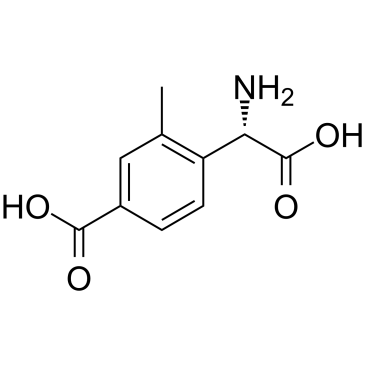
LY367385 (LY-367385) is a novel and potent mGlu1a receptor antagonist (IC50 = 8.8 μM) with neuroprotective, anticonvulsant and antiepileptic effects. It inhibits of quisqualate-induced phosphoinositide (PI) hydrolysis.
Physicochemical Properties
| Molecular Formula | C10H11NO4 |
| Molecular Weight | 209.2 |
| Exact Mass | 209.069 |
| CAS # | 198419-91-9 |
| Related CAS # | LY367385 hydrochloride;2829282-00-8 |
| PubChem CID | 5311261 |
| Appearance | White to off-white solid powder |
| LogP | 1.477 |
| Hydrogen Bond Donor Count | 3 |
| Hydrogen Bond Acceptor Count | 5 |
| Rotatable Bond Count | 3 |
| Heavy Atom Count | 15 |
| Complexity | 266 |
| Defined Atom Stereocenter Count | 1 |
| SMILES | CC1=C(C=CC(=C1)C(=O)O)[C@@H](C(=O)O)N |
| InChi Key | SGIKDIUCJAUSRD-QMMMGPOBSA-N |
| InChi Code | InChI=1S/C10H11NO4/c1-5-4-6(9(12)13)2-3-7(5)8(11)10(14)15/h2-4,8H,11H2,1H3,(H,12,13)(H,14,15)/t8-/m0/s1 |
| Chemical Name | 4-[(S)-amino(carboxy)methyl]-3-methylbenzoic acid |
| Synonyms | LY-367385 LY 367385 LY367385 |
| HS Tariff Code | 2934.99.9001 |
| Storage |
Powder-20°C 3 years 4°C 2 years In solvent -80°C 6 months -20°C 1 month |
| Shipping Condition | Room temperature (This product is stable at ambient temperature for a few days during ordinary shipping and time spent in Customs) |
Biological Activity
| Targets |
|
|
| ln Vitro | LY367385 coupled with N-methyl-D-aspartate (NMDA) during the toxic pulse reduces neuronal degeneration in a concentration-dependent manner, with a maximum decrease of NMDA toxicity of 40 to 60%. LY367385 is more effective than LY367366, and neither chemical has an effect on neuronal viability in general. LY367385 has strong neuroprotective properties, causing a 50% reduction in (S)-3,5-Dihydroxyphenylglycine (DHPG) potentiation at a dose of 10 nM. Under experimental conditions, at greater antagonist doses, LY367385 totally inhibited the amplification of NMDA toxicity by DHPG[2]. | |
| ln Vivo | Intracerebroventricular (icv) administration of LY367385 has been observed in DBA/2 and lh/lh lethargic mice, as well as targeted administration of LY367385 into the inferior colliculus of genetically epilepsy-prone rats (GEPR). LY367385 quickly and temporarily suppresses sound-induced clonic convulsions in DBA/2 mice (ED50 = 12 nM, icv, 5 min). When LY367385, 250 nM, is administered to sluggish mice, the occurrence of spontaneous spike and wave discharges on the electroencephalogram is dramatically reduced[3]. This effect lasts for 30 to more than 150 minutes. In rats predisposed to epilepsy genetically, LY367385 lessens clonic seizures brought on by sound. After 2-4 hours, LY367385, 160 nM bilaterally, completely inhibits clonic seizures[3]. | |
| References |
[1]. (+)-2-Methyl-4-carboxyphenylglycine (LY 367385) selectively antagonises metabotropic glutamate mGluR1 receptors. Bioorg.Med.Chem.Lett. November 1997, 7 (21): 2777-2780. [2]. Neuroprotective activity of the potent and selective mGlu1a metabotropic glutamate receptor antagonist, (+)-2-methyl-4 carboxyphenylglycine (LY367385): comparison with LY357366, a broader spectrum antagonist with equal affinity for mGlu1a. [3]. Anticonvulsant actions of LY 367385 ((+)-2-methyl-4-carboxyphenylglycine) and AIDA ((RS)-1-aminoindan-1,5-dicarboxylic acid). Eur J Pharmacol. 1999 Feb 26;368(1):17-24. |
Solubility Data
| Solubility (In Vitro) | May dissolve in DMSO (in most cases), if not, try other solvents such as H2O, Ethanol, or DMF with a minute amount of products to avoid loss of samples |
| Solubility (In Vivo) |
Note: Listed below are some common formulations that may be used to formulate products with low water solubility (e.g. < 1 mg/mL), you may test these formulations using a minute amount of products to avoid loss of samples. Injection Formulations (e.g. IP/IV/IM/SC) Injection Formulation 1: DMSO : Tween 80: Saline = 10 : 5 : 85 (i.e. 100 μL DMSO stock solution → 50 μL Tween 80 → 850 μL Saline) *Preparation of saline: Dissolve 0.9 g of sodium chloride in 100 mL ddH ₂ O to obtain a clear solution. Injection Formulation 2: DMSO : PEG300 :Tween 80 : Saline = 10 : 40 : 5 : 45 (i.e. 100 μL DMSO → 400 μLPEG300 → 50 μL Tween 80 → 450 μL Saline) Injection Formulation 3: DMSO : Corn oil = 10 : 90 (i.e. 100 μL DMSO → 900 μL Corn oil) Example: Take the Injection Formulation 3 (DMSO : Corn oil = 10 : 90) as an example, if 1 mL of 2.5 mg/mL working solution is to be prepared, you can take 100 μL 25 mg/mL DMSO stock solution and add to 900 μL corn oil, mix well to obtain a clear or suspension solution (2.5 mg/mL, ready for use in animals). Injection Formulation 4: DMSO : 20% SBE-β-CD in saline = 10 : 90 [i.e. 100 μL DMSO → 900 μL (20% SBE-β-CD in saline)] *Preparation of 20% SBE-β-CD in Saline (4°C,1 week): Dissolve 2 g SBE-β-CD in 10 mL saline to obtain a clear solution. Injection Formulation 5: 2-Hydroxypropyl-β-cyclodextrin : Saline = 50 : 50 (i.e. 500 μL 2-Hydroxypropyl-β-cyclodextrin → 500 μL Saline) Injection Formulation 6: DMSO : PEG300 : castor oil : Saline = 5 : 10 : 20 : 65 (i.e. 50 μL DMSO → 100 μLPEG300 → 200 μL castor oil → 650 μL Saline) Injection Formulation 7: Ethanol : Cremophor : Saline = 10: 10 : 80 (i.e. 100 μL Ethanol → 100 μL Cremophor → 800 μL Saline) Injection Formulation 8: Dissolve in Cremophor/Ethanol (50 : 50), then diluted by Saline Injection Formulation 9: EtOH : Corn oil = 10 : 90 (i.e. 100 μL EtOH → 900 μL Corn oil) Injection Formulation 10: EtOH : PEG300:Tween 80 : Saline = 10 : 40 : 5 : 45 (i.e. 100 μL EtOH → 400 μLPEG300 → 50 μL Tween 80 → 450 μL Saline) Oral Formulations Oral Formulation 1: Suspend in 0.5% CMC Na (carboxymethylcellulose sodium) Oral Formulation 2: Suspend in 0.5% Carboxymethyl cellulose Example: Take the Oral Formulation 1 (Suspend in 0.5% CMC Na) as an example, if 100 mL of 2.5 mg/mL working solution is to be prepared, you can first prepare 0.5% CMC Na solution by measuring 0.5 g CMC Na and dissolve it in 100 mL ddH2O to obtain a clear solution; then add 250 mg of the product to 100 mL 0.5% CMC Na solution, to make the suspension solution (2.5 mg/mL, ready for use in animals). Oral Formulation 3: Dissolved in PEG400 Oral Formulation 4: Suspend in 0.2% Carboxymethyl cellulose Oral Formulation 5: Dissolve in 0.25% Tween 80 and 0.5% Carboxymethyl cellulose Oral Formulation 6: Mixing with food powders Note: Please be aware that the above formulations are for reference only. InvivoChem strongly recommends customers to read literature methods/protocols carefully before determining which formulation you should use for in vivo studies, as different compounds have different solubility properties and have to be formulated differently. (Please use freshly prepared in vivo formulations for optimal results.) |
| Preparing Stock Solutions | 1 mg | 5 mg | 10 mg | |
| 1 mM | 4.7801 mL | 23.9006 mL | 47.8011 mL | |
| 5 mM | 0.9560 mL | 4.7801 mL | 9.5602 mL | |
| 10 mM | 0.4780 mL | 2.3901 mL | 4.7801 mL |