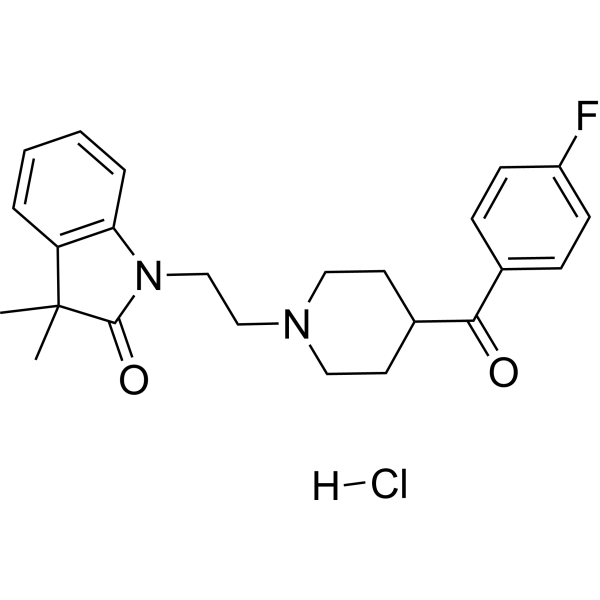
Physicochemical Properties
| Molecular Formula | C24H28CLFN2O2 |
| Molecular Weight | 430.94 |
| Exact Mass | 430.182 |
| CAS # | 192927-92-7 |
| PubChem CID | 11957576 |
| Appearance | White to off-white solid powder |
| LogP | 4.849 |
| Hydrogen Bond Donor Count | 1 |
| Hydrogen Bond Acceptor Count | 4 |
| Rotatable Bond Count | 5 |
| Heavy Atom Count | 30 |
| Complexity | 606 |
| Defined Atom Stereocenter Count | 0 |
| SMILES | Cl[H].FC1C([H])=C([H])C(=C([H])C=1[H])C(C1([H])C([H])([H])C([H])([H])N(C([H])([H])C([H])([H])N2C3=C([H])C([H])=C([H])C([H])=C3C(C([H])([H])[H])(C([H])([H])[H])C2=O)C([H])([H])C1([H])[H])=O |
| Synonyms | LY-310762; LY 310762; LY310762 |
| HS Tariff Code | 2934.99.9001 |
| Storage |
Powder-20°C 3 years 4°C 2 years In solvent -80°C 6 months -20°C 1 month Note: Please store this product in a sealed and protected environment, avoid exposure to moisture. |
| Shipping Condition | Room temperature (This product is stable at ambient temperature for a few days during ordinary shipping and time spent in Customs) |
Biological Activity
| ln Vitro | In guinea pig cortical slices, LY310762 (0.01-1 µM) exhibits potassium-induced increase of [3H]5-HT efflux, with an EC50 value of 31 nM [1]. The decrease in excitatory postsynaptic potential (EPSC) caused by sumatriptan is largely, albeit not fully, blocked by LY310762 (10 µM) [3]. |
| ln Vivo | Fluoxetine, a selective serotonin reuptake inhibitor, produces extracellular 5-HT concentrations in vivo. LY310762 (10 mg/kg; i.p.; single dose) greatly boosts these concentrations [1]. In a rat model of phenylephrine infusion, LY310762 (1 mg/kg; intravenous injection; single dosage) completely eliminates the vasodilatory effects of 5-HT [2]. |
| Animal Protocol |
Animal/Disease Models: Dunkin Hartley guinea pig (female; 350-400 g, Harlan) [1]. Doses: 10 mg/kg Route of Administration: intraperitoneal (ip) injection; Single Experimental Results:Further significant enhancement of 5-HT response to fluoxetine. Animal/Disease Models: Male Wistar rat (270-330 g; phenylephrine infusion rat model) [2]. Doses: 1 mg/kg Route of Administration: intravenous (iv) (iv)injection; Single Experimental Results:Complete elimination of the vasodilatory effect of 5-HT. |
| References |
[1]. The role of the 5-HT1D receptor as a presynaptic autoreceptor in the guinea pig. Eur J Pharmacol. 2004 Jun 16;493(1-3):85-93. [2]. Pharmacological evidence that 5-HT1D activation induces renal vasodilation by NO pathway in rats. Clin Exp Pharmacol Physiol. 2015 Jun;42(6):640-7. [3]. Choi IS, Cho JH, An CH, Jung JK, Hur YK, Choi JK, Jang IS. 5-HT(1B) receptors inhibit glutamate release from primary afferent terminals in rat medullary dorsal horn neurons. Br J Pharmacol. 2012 Sep;167(2):356-67. |
| Additional Infomation | LY-310762 hydrochloride is a hydrochloride resulting from the formal reation of equimolar amount of LY-310762 with hydrogen chloride. A potent and selective antagonist for the 5-hydroxytryptamine 1D (5-HT1D) receptor. It has a role as a receptor modulator and a serotonergic antagonist. It contains a LY-310762(1+). |
Solubility Data
| Solubility (In Vitro) | DMSO : ~18.33 mg/mL (~42.53 mM) |
| Solubility (In Vivo) |
Solubility in Formulation 1: ≥ 1.83 mg/mL (4.25 mM) (saturation unknown) in 10% DMSO + 40% PEG300 + 5% Tween80 + 45% Saline (add these co-solvents sequentially from left to right, and one by one), clear solution. For example, if 1 mL of working solution is to be prepared, you can add 100 μL of 18.3 mg/mL clear DMSO stock solution to 400 μL PEG300 and mix evenly; then add 50 μL Tween-80 to the above solution and mix evenly; then add 450 μL normal saline to adjust the volume to 1 mL. Preparation of saline: Dissolve 0.9 g of sodium chloride in 100 mL ddH₂ O to obtain a clear solution. Solubility in Formulation 2: ≥ 1.83 mg/mL (4.25 mM) (saturation unknown) in 10% DMSO + 90% (20% SBE-β-CD in Saline) (add these co-solvents sequentially from left to right, and one by one), clear solution. For example, if 1 mL of working solution is to be prepared, you can add 100 μL of 18.3 mg/mL clear DMSO stock solution to 900 μL of 20% SBE-β-CD physiological saline solution and mix evenly. Preparation of 20% SBE-β-CD in Saline (4°C,1 week): Dissolve 2 g SBE-β-CD in 10 mL saline to obtain a clear solution. Solubility in Formulation 3: ≥ 1.83 mg/mL (4.25 mM) (saturation unknown) in 10% DMSO + 90% Corn Oil (add these co-solvents sequentially from left to right, and one by one), clear solution. For example, if 1 mL of working solution is to be prepared, you can add 100 μL of 18.3 mg/mL clear DMSO stock solution to 900 μL of corn oil and mix evenly. (Please use freshly prepared in vivo formulations for optimal results.) |
| Preparing Stock Solutions | 1 mg | 5 mg | 10 mg | |
| 1 mM | 2.3205 mL | 11.6025 mL | 23.2051 mL | |
| 5 mM | 0.4641 mL | 2.3205 mL | 4.6410 mL | |
| 10 mM | 0.2321 mL | 1.1603 mL | 2.3205 mL |