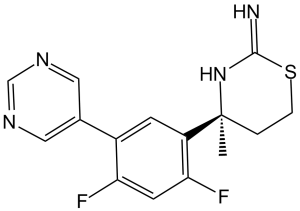
LY2811376 (LY-2811376; LY 2811376) is a novel, potent, selective and the first orally bioavailable non-peptidic β-secretase (BACE1) inhibitor with the potential for the treatment of Alzheimer's Disease (AD). It inhibits BACE1 with an IC50 of 239 nM, and is able to decrease Aβ secretion with EC50 of 300 nM. LY2811376 was identified by fragment-based screening, and was able to lower Aβ levels in a mouse model of Alzheimer's disease as well as in normal dogs.
Physicochemical Properties
| Molecular Formula | C15H14F2N4S | |
| Molecular Weight | 320.36 | |
| Exact Mass | 320.09 | |
| CAS # | 1194044-20-6 | |
| Related CAS # |
|
|
| PubChem CID | 44251605 | |
| Appearance | White to khaki solid powder | |
| Density | 1.4±0.1 g/cm3 | |
| Boiling Point | 486.5±55.0 °C at 760 mmHg | |
| Flash Point | 248.0±31.5 °C | |
| Vapour Pressure | 0.0±1.2 mmHg at 25°C | |
| Index of Refraction | 1.662 | |
| LogP | 1.45 | |
| Hydrogen Bond Donor Count | 1 | |
| Hydrogen Bond Acceptor Count | 6 | |
| Rotatable Bond Count | 2 | |
| Heavy Atom Count | 22 | |
| Complexity | 430 | |
| Defined Atom Stereocenter Count | 1 | |
| SMILES | C[C@]1(CCSC(=N1)N)C2=C(C=C(C(=C2)C3=CN=CN=C3)F)F |
|
| InChi Key | MJQMRGWYPNIERM-HNNXBMFYSA-N | |
| InChi Code | InChI=1S/C15H14F2N4S/c1-15(2-3-22-14(18)21-15)11-4-10(12(16)5-13(11)17)9-6-19-8-20-7-9/h4-8H,2-3H2,1H3,(H2,18,21)/t15-/m0/s1 | |
| Chemical Name | (4S)-4-(2,4-difluoro-5-pyrimidin-5-ylphenyl)-4-methyl-5,6-dihydro-1,3-thiazin-2-amine | |
| Synonyms |
|
|
| HS Tariff Code | 2934.99.9001 | |
| Storage |
Powder-20°C 3 years 4°C 2 years In solvent -80°C 6 months -20°C 1 month |
|
| Shipping Condition | Room temperature (This product is stable at ambient temperature for a few days during ordinary shipping and time spent in Customs) |
Biological Activity
| Targets |
LY2811376 specifically targets β-site amyloid precursor protein cleaving enzyme 1 (BACE1) (Ki = 0.7 nM; IC50 = 1.3 nM) [1] |
| ln Vitro |
Treatment with LY2811376 causes a concentration-dependent reduction in Aβ release in a human embryonic kidney cell line that overexpresses APP; the half-maximal effective concentration (EC50) is around 300 nM. When LY2811376 is administered to PDAPP transgenic mouse primary neuronal cells, Aβ production decreases in a concentration-dependent manner, with an approximate EC50 of 100 nM[1]. Good ADME characteristics and selectivity are exhibited by LY2811376 (BACE1 IC50=240 nM, cellular potency IC50=300 nM, and cathepsin D selectivity: around 10- and 65-fold, respectively)[3]. In a dose-dependent way, LY2811376 lowers the Aβ40 levels in cortex and plasma without affecting weight or health[4]. In recombinant human BACE1 enzyme assays, LY2811376 inhibited BACE1 activity with an IC50 of 1.3 nM and Ki of 0.7 nM, showing high selectivity over other aspartyl proteases (e.g., cathepsin D, renin) with IC50 values > 10,000 nM [1] - In APP-overexpressing human embryonic kidney (HEK293-APP) cells, LY2811376 dose-dependently reduced Aβ40 and Aβ42 secretion. At 10 nM, it decreased Aβ40 by 70% and Aβ42 by 73% compared to vehicle; maximum inhibition (≈92% for both peptides) was observed at 100 nM [1] - In primary rat hippocampal neurons, LY2811376 (1-100 nM) suppressed endogenous Aβ production without affecting cell viability (assessed by MTT assay) or total APP expression (detected by Western blot) [1] |
| ln Vivo |
As the proximal cleavage products of APP proteolysis by BACE1, LY2811376 (10, 30, and 100 mg/kg, po) causes dose-dependent, substantial decreases in Aβ as well as sAPPβ and C99. In PDAPP mice, LY2811376 causes dose-dependent reductions in all APP-related PD indicators of BACE1 inhibition. The CSF sampling study's investigation of low (30 mg) and high (90 mg) dosages of LY2811376 is based on the PK and plasma Aβ1-40 PD found in the SAD study[1]. In mouse cortex, LY2811376 (30 mg/kg, po) can cause a 60% reduction in soluble Aβs[2]. In mice, LY2811376 (100 mg/kg, po) reduces the development and density of spines. The frequency of sEPSC and mEPSC are decreased by LY2811376 (100 mg/kg every 12 hours for 16 days), while the effects of LY2811376 on the amplitude of sEPSC are not significant[4]. In C57BL/6 mice, oral administration of LY2811376 (3, 10, 30 mg/kg) dose-dependently reduced cerebrospinal fluid (CSF) and brain Aβ levels. The 30 mg/kg dose decreased CSF Aβ40 by 80%, CSF Aβ42 by 82%, and brain soluble Aβ42 by 78% at 6 hours post-dosing [1] - In beagle dogs, oral dosing of LY2811376 (1, 3, 10 mg/kg) resulted in dose-related reductions in CSF Aβ40 (max 85% reduction at 10 mg/kg) and plasma Aβ40 (max 70% reduction at 10 mg/kg) at 4 hours post-administration [1] - In healthy human volunteers (phase 1 study), single oral doses of LY2811376 (10, 30, 90 mg) caused dose-dependent decreases in CSF Aβ40 and Aβ42. The 90 mg dose reduced CSF Aβ40 by 72% and Aβ42 by 75% at 8 hours post-dosing, with effects lasting ≥24 hours [1] - In C57BL/6 mice treated with LY2811376 (10 mg/kg/day, oral) for 4 weeks, hippocampal long-term potentiation (LTP) was impaired by 45% compared to vehicle-treated mice. In the Morris water maze test, these mice showed increased escape latency (by 38%) and decreased time spent in the target quadrant (by 42%), indicating cognitive function impairment [4] |
| Enzyme Assay |
Recombinant human BACE1 was incubated with a fluorogenic peptide substrate (mimicking the APP β-cleavage site) and various concentrations of LY2811376 (0.01-100 nM) in assay buffer at 37°C for 60 minutes. Fluorescence intensity (excitation 340 nm, emission 410 nm) was measured to evaluate enzyme activity. IC50 values were calculated from dose-response inhibition curves, and Ki was determined using the Cheng-Prusoff equation [1] - For selectivity evaluation, recombinant cathepsin D, renin, and other aspartyl proteases were incubated with their specific fluorogenic substrates and LY2811376 (0.1-10,000 nM) under optimal reaction conditions. Enzyme activity was quantified, and IC50 values were derived to assess cross-reactivity [1] |
| Cell Assay |
HEK293-APP cells were seeded in 24-well plates at 1.5×10⁵ cells/well and cultured for 24 hours. LY2811376 was added at concentrations of 0.1, 1, 10, 100 nM, and cells were incubated for 24 hours. Culture supernatants were collected, and Aβ40/Aβ42 levels were quantified by sandwich ELISA [1] - Primary rat hippocampal neurons were isolated from embryonic day 18 rats and plated in 96-well plates. After 7 days of in vitro culture, neurons were treated with LY2811376 (1-100 nM) for 24 hours. Endogenous Aβ in supernatants was measured by ELISA, and cell viability was assessed by MTT assay. APP and β-CTF levels were analyzed by Western blot with specific antibodies [1] |
| Animal Protocol |
Dissolved in 7% Pharmasolve; 10, 30, and 100 mg/kg; p.o. administration PDAPP transgenic mice. Mice (PK/PD study): Male C57BL/6 mice (8-10 weeks old) were fasted overnight before oral administration of LY2811376 (dissolved in 0.5% methylcellulose) at doses of 3, 10, 30 mg/kg. CSF (via cisternal puncture) and brain tissue were collected at 1, 3, 6, 12, 24 hours post-dosing. Aβ levels were measured by ELISA, and plasma/drug concentrations in brain were determined by LC-MS/MS [1] - Dogs: Beagle dogs (10-15 kg) were administered LY2811376 (dissolved in 0.5% methylcellulose) orally at 1, 3, 10 mg/kg. CSF and plasma were collected at 1, 2, 4, 8, 12, 24 hours post-dosing. Aβ levels and drug concentrations were quantified by ELISA and LC-MS/MS, respectively [1] - Humans: Healthy volunteers (20-55 years old) were enrolled in a randomized, double-blind, placebo-controlled phase 1 study. Participants received single oral doses of LY2811376 (10, 30, 90 mg) or placebo. CSF (via lumbar puncture) and plasma were collected at baseline and 2, 4, 8, 12, 24, 48 hours post-dosing. Aβ40/Aβ42 levels and drug concentrations were analyzed [1] - Mice (synaptic plasticity/cognition study): Male C57BL/6 mice (6 weeks old) were administered LY2811376 (10 mg/kg/day) or vehicle via oral gavage for 4 weeks. Hippocampal LTP was recorded using electrophysiological techniques. Cognitive function was evaluated by the Morris water maze test (5 days of training, 1 day of probe trial) [4] |
| ADME/Pharmacokinetics |
In mice, oral administration of LY2811376 (30 mg/kg) resulted in a plasma Cmax of 156 ng/mL (Tmax = 1.5 hours), oral bioavailability of 45%, and terminal elimination half-life (t1/2) of 3.8 hours. Brain/plasma concentration ratio was 0.32, and CSF/plasma ratio was 0.27, indicating effective blood-brain barrier penetration [1] - In dogs, oral dosing of LY2811376 (10 mg/kg) yielded a plasma Cmax of 112 ng/mL (Tmax = 2 hours), oral bioavailability of 62%, and t1/2 of 5.2 hours. CSF/plasma ratio was 0.33 [1] - In humans, oral administration of LY2811376 (90 mg) led to a plasma Cmax of 98 ng/mL (Tmax = 3 hours), oral bioavailability of 40%, and t1/2 of 7.5 hours. CSF drug concentrations remained above the in vitro IC50 for BACE1 for ≥24 hours [1] - LY2811376 is metabolized primarily by CYP3A4 and CYP2C9 in the liver; major metabolites are inactive and excreted via feces (≈68%) and urine (≈25%) [1] |
| Toxicity/Toxicokinetics |
In acute toxicity studies in mice and dogs, LY2811376 showed no overt toxicity at oral doses up to 400 mg/kg [1] - In the phase 1 human study, LY2811376 was well-tolerated at doses up to 90 mg. Adverse events were mild to moderate, with the most common being dizziness (7%) and nausea (4%); no serious adverse events were reported [1] - Plasma protein binding of LY2811376 is 93-95% in mice, 91-94% in dogs, and 92-96% in humans, with no concentration-dependent binding [1] - No significant changes in liver function tests (ALT, AST) or renal function (creatinine, BUN) were observed in animals or humans treated with LY2811376 [1] |
| References |
[1]. Robust central reduction of amyloid-β in humans with an orally available, non-peptidic β-secretase inhibitor. J Neurosci. 2011 Nov 16;31(46):16507-16516. [2]. Near-infrared fluorescence molecular imaging of amyloid beta species and monitoring therapy in animal models of Alzheimer's disease. Proc Natl Acad Sci U S A. 2015 Aug 4;112(31):9734-9. [3]. Prospects of β-Secretase Inhibitors for the Treatment of Alzheimer's Disease. ChemMedChem. 2015 Sep;10(9):1463-6. [4]. Pharmacological inhibition of BACE1 impairs synaptic plasticity and cognitive functions. Biol Psychiatry. 2015 Apr 15;77(8):729-39. |
| Additional Infomation |
LY2811376 has been used in trials studying the basic science of Alzheimer's Disease. (S)-4-(2,4-Difluoro-5-(pyrimidin-5-yl)phenyl)-4-methyl-5,6-dihydro-4H-1,3-thiazin-2-amine has been reported in Aspergillus terreus with data available. LY2811376 is a potent, selective, orally bioavailable non-peptidic BACE1 inhibitor, targeting the rate-limiting enzyme in Aβ peptide production [1] - Its mechanism of action involves binding to the active site of BACE1, blocking β-cleavage of APP, thereby reducing the generation of Aβ40 and Aβ42 peptides implicated in Alzheimer's disease (AD) pathogenesis [1] - Chronic pharmacological inhibition of BACE1 by LY2811376 impairs hippocampal synaptic plasticity (LTP) and cognitive functions in mice, suggesting potential risks of long-term BACE1 inhibition [4] - The drug demonstrates favorable pharmacokinetic properties, including good oral absorption, effective penetration of the blood-brain barrier, and sustained CSF drug levels, supporting its potential for once-daily dosing in AD therapy [1] - Phase 1 clinical data confirmed dose-dependent and sustained reductions in CSF Aβ levels in healthy humans, providing proof-of-concept for BACE1 inhibition as an AD therapeutic strategy [1] |
Solubility Data
| Solubility (In Vitro) |
|
|||
| Solubility (In Vivo) |
Solubility in Formulation 1: ≥ 2.5 mg/mL (7.80 mM) (saturation unknown) in 10% DMSO + 40% PEG300 + 5% Tween80 + 45% Saline (add these co-solvents sequentially from left to right, and one by one), clear solution. For example, if 1 mL of working solution is to be prepared, you can add 100 μL of 25.0 mg/mL clear DMSO stock solution to 400 μL PEG300 and mix evenly; then add 50 μL Tween-80 to the above solution and mix evenly; then add 450 μL normal saline to adjust the volume to 1 mL. Preparation of saline: Dissolve 0.9 g of sodium chloride in 100 mL ddH₂ O to obtain a clear solution. Solubility in Formulation 2: ≥ 2.5 mg/mL (7.80 mM) (saturation unknown) in 10% DMSO + 90% (20% SBE-β-CD in Saline) (add these co-solvents sequentially from left to right, and one by one), clear solution. For example, if 1 mL of working solution is to be prepared, you can add 100 μL of 25.0 mg/mL clear DMSO stock solution to 900 μL of 20% SBE-β-CD physiological saline solution and mix evenly. Preparation of 20% SBE-β-CD in Saline (4°C,1 week): Dissolve 2 g SBE-β-CD in 10 mL saline to obtain a clear solution. Solubility in Formulation 3: ≥ 2.5 mg/mL (7.80 mM) (saturation unknown) in 10% DMSO + 90% Corn Oil (add these co-solvents sequentially from left to right, and one by one), clear solution. For example, if 1 mL of working solution is to be prepared, you can add 100 μL of 25.0 mg/mL clear DMSO stock solution to 900 μL of corn oil and mix evenly. Solubility in Formulation 4: 30% PEG400+0.5% Tween80+5% propylene glycol: 30 mg/mL (Please use freshly prepared in vivo formulations for optimal results.) |
| Preparing Stock Solutions | 1 mg | 5 mg | 10 mg | |
| 1 mM | 3.1215 mL | 15.6074 mL | 31.2149 mL | |
| 5 mM | 0.6243 mL | 3.1215 mL | 6.2430 mL | |
| 10 mM | 0.3121 mL | 1.5607 mL | 3.1215 mL |