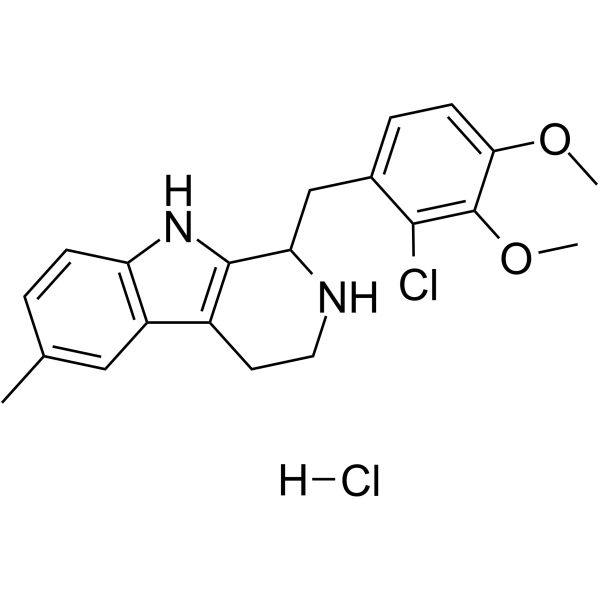
Physicochemical Properties
| Molecular Formula | C21H24CL2N2O2 |
| Molecular Weight | 407.33 |
| Exact Mass | 406.121 |
| CAS # | 172895-39-5 |
| PubChem CID | 9953184 |
| Appearance | Light yellow to light brown solid powder |
| LogP | 5.707 |
| Hydrogen Bond Donor Count | 3 |
| Hydrogen Bond Acceptor Count | 3 |
| Rotatable Bond Count | 4 |
| Heavy Atom Count | 27 |
| Complexity | 479 |
| Defined Atom Stereocenter Count | 0 |
| InChi Key | KPXKZZURYAXZQE-UHFFFAOYSA-N |
| InChi Code | InChI=1S/C21H23ClN2O2.ClH/c1-12-4-6-16-15(10-12)14-8-9-23-17(20(14)24-16)11-13-5-7-18(25-2)21(26-3)19(13)22;/h4-7,10,17,23-24H,8-9,11H2,1-3H3;1H |
| Chemical Name | 1-[(2-chloro-3,4-dimethoxyphenyl)methyl]-6-methyl-2,3,4,9-tetrahydro-1H-pyrido[3,4-b]indole;hydrochloride |
| HS Tariff Code | 2934.99.9001 |
| Storage |
Powder-20°C 3 years 4°C 2 years In solvent -80°C 6 months -20°C 1 month Note: Please store this product in a sealed and protected environment (e.g. under nitrogen), avoid exposure to moisture and light. |
| Shipping Condition | Room temperature (This product is stable at ambient temperature for a few days during ordinary shipping and time spent in Customs) |
Biological Activity
| Targets | 5-HT2B Receptor 9.8 (pKi) 5-HT2A Receptor 7.7 (pKi) 5-HT2C Receptor 7.6 (pKi) |
| ln Vitro | With a pKi of 9.7 for the human cloned 5-HT2B receptor and 100-fold higher selectivity over the human 5-HT2C and 5-HT2A sites, LY266097 is an extremely selective 5-HT2B receptor antagonist[2]. |
| ln Vivo | The 2-day injection of 0.6 mg/kg of LY266097 reverses the reduction in dopamine (DA) caused by escitalopram[1]. Pyramidal neuron firing and burst activity are increased when LY266097 is administered either on its own or in conjunction with escapilopram over the final three days of a 14-day regimen[1]. |
| Animal Protocol |
Animal/Disease Models: Male SD (Sprague-Dawley) rats weighing 250-350 g[1] Doses: 0.6 mg/kg Route of Administration: Administered ip alone or concomitantly with Escitalopram (2 mg/kg) for 2 days Experimental Results: Short -term administration (0.6 mg/kg/day for 2 days; ip) alone had no effect on these parameters, its co-administration counteracted the inhibitory effect of escitalopram on the firing activity of DA neurons, resulting in a recovery to control level. |
| References |
[1]. Serotonin-2B receptor antagonism increases the activity of dopamine and glutamate neurons in the presence of selective serotonin reuptake inhibition. Neuropsychopharmacology. 2020 Nov;45(12):2098-2105. [2]. New therapeutic opportunities for 5-HT 2 receptor ligands. Pharmacol Ther. 2017 Feb;170:14-36. |
Solubility Data
| Solubility (In Vitro) | DMSO: 62.5 mg/mL (153.44 mM) |
| Solubility (In Vivo) |
Solubility in Formulation 1: 2.08 mg/mL (5.11 mM) in 10% DMSO + 90% (20% SBE-β-CD in Saline) (add these co-solvents sequentially from left to right, and one by one), suspension solution; with sonication. For example, if 1 mL of working solution is to be prepared, you can add 100 μL of 20.8 mg/mL clear DMSO stock solution to 900 μL of 20% SBE-β-CD physiological saline solution and mix evenly. Preparation of 20% SBE-β-CD in Saline (4°C,1 week): Dissolve 2 g SBE-β-CD in 10 mL saline to obtain a clear solution. (Please use freshly prepared in vivo formulations for optimal results.) |
| Preparing Stock Solutions | 1 mg | 5 mg | 10 mg | |
| 1 mM | 2.4550 mL | 12.2751 mL | 24.5501 mL | |
| 5 mM | 0.4910 mL | 2.4550 mL | 4.9100 mL | |
| 10 mM | 0.2455 mL | 1.2275 mL | 2.4550 mL |