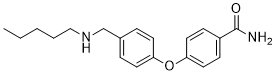
LY2048978 is a novel and potent kappa-selective antagonist
Physicochemical Properties
| Molecular Formula | C19H24N2O2 |
| Molecular Weight | 312.41 |
| Exact Mass | 312.1838 |
| Elemental Analysis | C, 73.05; H, 7.74; N, 8.97; O, 10.24 |
| CAS # | 676495-11-7 |
| Appearance | Solid powder |
| LogP | 5 |
| InChi Key | O=C(N)C1=CC=C(OC2=CC=C(CNCCCCC)C=C2)C=C1 |
| InChi Code | InChI=1S/C19H24N2O2/c1-2-3-4-13-21-14-15-5-9-17(10-6-15)23-18-11-7-16(8-12-18)19(20)22/h5-12,21H,2-4,13-14H2,1H3,(H2,20,22) |
| Chemical Name | 4-{4-[(Pentylamino)methyl]phenoxy}benzamide |
| Synonyms | LY2048978; LY 2048978; LY-2048978 |
| HS Tariff Code | 2934.99.9001 |
| Storage |
Powder-20°C 3 years 4°C 2 years In solvent -80°C 6 months -20°C 1 month |
| Shipping Condition | Room temperature (This product is stable at ambient temperature for a few days during ordinary shipping and time spent in Customs) |
Biological Activity
| Targets | kappa opioid |
| ln Vivo |
Reversal of kappa-agonist-induced analgesia[1] The functional selectivity of LY2456302 at kappa vs. mu opioid receptors was determined in vivo by measuring reversal of the analgesic effects of the kappa agonist U-69593 and mu agonist morphine, previously demonstrated in the formalin model of acute sensitization. This procedure has been described in detail previously (Shannon and Lutz, 2000) and utilizes the commercially available startle behavior chambers that detect movements by means of an accelerometer. Briefly, male Sprague-Dawley rats, weighing approximately 200–210 g, were administered vehicle or LY2456302 and 30 min later, were administered vehicle, subcutaneous (SC) morphine (10 mg/kg) or U-69593 (1 mg/kg), n = 8 animals per treatment group. A novel, nonselective opioid antagonist LY2048978 (Statnick et al., under review) was used as the quality control in the U-69593 and morphine reversal studies with LY2456302 at a PO dose of 3 and 0.6 mg/kg, respectively (Table 1). Naltrexone was used as the quality control in the U-69593 and morphine reversal studies (doses of 0.2 and 0.02 mg/kg SC, respectively). The dose and route of administration of LY2048978 or naltrexone used as quality controls had been previously established as approximate ED50 doses for antagonizing the analgesic effects of U-69593 and morphine. Animals were then individually placed in confinement cylinders (i.d. 8.5 cm; length 16 cm) on the recording equipment for a 30-min acclimation. Formalin (50 μl of a 5% solution in saline) was then administered SC into the plantar surface of the right hindpaw, and the animals were immediately placed back into the confinement cylinders. In a separate experiment, the long-lasting functional effects of LY2456302 at the kappa opioid receptor were determined by pretreating animals with a single dose of vehicle (1 ml/kg PO), LY2456302 (3 mg/kg PO), nor-BNI (10 mg/kg SC), or JDTic (10 mg/kg SC) 1-wk prior to U-69593 (1 mg/kg SC), which was administered 30 min prior to the formalin test |
| Enzyme Assay | In vitro receptor binding and functional activity. In vitro opioid receptor binding and [35S]-GTPγS binding experiments were conducted as previously described (Mitch et al., 2011). Briefly, radioligand displacement studies with [3H]diprenorphine were carried out using membranes prepared from CHO cells expressing cloned human κ and μ opioid receptors or HEK293 cells expressing the cloned δ opioid receptor. Concentrations causing 50% inhibition (IC50) of [3H]-diprenorphine binding were determined from 11-point concentration response curves in assay buffer containing sodium and guanosine diphosphate (GDP). Naltrexone was included as a control at 10 μM to define nonspecific binding and was also tested as a comparator molecule in concentration response curves[1]. |
| References | [1]. LY2456302 is a novel, potent, orally-bioavailable small molecule kappa-selective antagonist with activity in animal models predictive of efficacy in mood and addictive disorders. Neuropharmacology. 2014 Feb;77:131-44. |
Solubility Data
| Solubility (In Vitro) | Typically soluble in DMSO (e.g. 10 mM) |
| Solubility (In Vivo) |
Note: Listed below are some common formulations that may be used to formulate products with low water solubility (e.g. < 1 mg/mL), you may test these formulations using a minute amount of products to avoid loss of samples. Injection Formulations (e.g. IP/IV/IM/SC) Injection Formulation 1: DMSO : Tween 80: Saline = 10 : 5 : 85 (i.e. 100 μL DMSO stock solution → 50 μL Tween 80 → 850 μL Saline) *Preparation of saline: Dissolve 0.9 g of sodium chloride in 100 mL ddH ₂ O to obtain a clear solution. Injection Formulation 2: DMSO : PEG300 :Tween 80 : Saline = 10 : 40 : 5 : 45 (i.e. 100 μL DMSO → 400 μLPEG300 → 50 μL Tween 80 → 450 μL Saline) Injection Formulation 3: DMSO : Corn oil = 10 : 90 (i.e. 100 μL DMSO → 900 μL Corn oil) Example: Take the Injection Formulation 3 (DMSO : Corn oil = 10 : 90) as an example, if 1 mL of 2.5 mg/mL working solution is to be prepared, you can take 100 μL 25 mg/mL DMSO stock solution and add to 900 μL corn oil, mix well to obtain a clear or suspension solution (2.5 mg/mL, ready for use in animals). Injection Formulation 4: DMSO : 20% SBE-β-CD in saline = 10 : 90 [i.e. 100 μL DMSO → 900 μL (20% SBE-β-CD in saline)] *Preparation of 20% SBE-β-CD in Saline (4°C,1 week): Dissolve 2 g SBE-β-CD in 10 mL saline to obtain a clear solution. Injection Formulation 5: 2-Hydroxypropyl-β-cyclodextrin : Saline = 50 : 50 (i.e. 500 μL 2-Hydroxypropyl-β-cyclodextrin → 500 μL Saline) Injection Formulation 6: DMSO : PEG300 : castor oil : Saline = 5 : 10 : 20 : 65 (i.e. 50 μL DMSO → 100 μLPEG300 → 200 μL castor oil → 650 μL Saline) Injection Formulation 7: Ethanol : Cremophor : Saline = 10: 10 : 80 (i.e. 100 μL Ethanol → 100 μL Cremophor → 800 μL Saline) Injection Formulation 8: Dissolve in Cremophor/Ethanol (50 : 50), then diluted by Saline Injection Formulation 9: EtOH : Corn oil = 10 : 90 (i.e. 100 μL EtOH → 900 μL Corn oil) Injection Formulation 10: EtOH : PEG300:Tween 80 : Saline = 10 : 40 : 5 : 45 (i.e. 100 μL EtOH → 400 μLPEG300 → 50 μL Tween 80 → 450 μL Saline) Oral Formulations Oral Formulation 1: Suspend in 0.5% CMC Na (carboxymethylcellulose sodium) Oral Formulation 2: Suspend in 0.5% Carboxymethyl cellulose Example: Take the Oral Formulation 1 (Suspend in 0.5% CMC Na) as an example, if 100 mL of 2.5 mg/mL working solution is to be prepared, you can first prepare 0.5% CMC Na solution by measuring 0.5 g CMC Na and dissolve it in 100 mL ddH2O to obtain a clear solution; then add 250 mg of the product to 100 mL 0.5% CMC Na solution, to make the suspension solution (2.5 mg/mL, ready for use in animals). Oral Formulation 3: Dissolved in PEG400 Oral Formulation 4: Suspend in 0.2% Carboxymethyl cellulose Oral Formulation 5: Dissolve in 0.25% Tween 80 and 0.5% Carboxymethyl cellulose Oral Formulation 6: Mixing with food powders Note: Please be aware that the above formulations are for reference only. InvivoChem strongly recommends customers to read literature methods/protocols carefully before determining which formulation you should use for in vivo studies, as different compounds have different solubility properties and have to be formulated differently. (Please use freshly prepared in vivo formulations for optimal results.) |
| Preparing Stock Solutions | 1 mg | 5 mg | 10 mg | |
| 1 mM | 3.2009 mL | 16.0046 mL | 32.0092 mL | |
| 5 mM | 0.6402 mL | 3.2009 mL | 6.4018 mL | |
| 10 mM | 0.3201 mL | 1.6005 mL | 3.2009 mL |