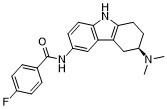
LY-344864 (LY344864) is a novel, potent and selective receptor agonist of 5-HT1F with Ki of 6 nM. Compared to the 56 other serotonergic and non-serotonergic neuronal binding sites that were studied, it exhibits negligible affinity. It has been demonstrated that LY344864 is a full agonist, having an impact comparable to that of serotonin.
Physicochemical Properties
| Molecular Formula | C21H22FN3O |
| Molecular Weight | 351.43 |
| Exact Mass | 351.174 |
| Elemental Analysis | C, 71.77; H, 6.31; F, 5.41; N, 11.96; O, 4.55 |
| CAS # | 186544-26-3 |
| Related CAS # | LY 344864 S-enantiomer; 186544-27-4; LY 344864 racemate; 186543-64-6; LY 344864 hydrochloride; 1217756-94-9 |
| PubChem CID | 5311097 |
| Appearance | White to off-white solid powder |
| Density | 1.3±0.1 g/cm3 |
| Boiling Point | 471.9±45.0 °C at 760 mmHg |
| Flash Point | 239.2±28.7 °C |
| Vapour Pressure | 0.0±1.2 mmHg at 25°C |
| Index of Refraction | 1.658 |
| LogP | 3.43 |
| Hydrogen Bond Donor Count | 2 |
| Hydrogen Bond Acceptor Count | 3 |
| Rotatable Bond Count | 3 |
| Heavy Atom Count | 26 |
| Complexity | 506 |
| Defined Atom Stereocenter Count | 1 |
| SMILES | O=C(NC1=CC2=C(NC3=C2C[C@H](N(C)C)CC3)C=C1)C4=CC=C(F)C=C4 |
| InChi Key | OKUHLSYESBLBCP-PKLMIRHRSA-N |
| InChi Code | InChI=1S/C21H22FN3O.ClH/c1-25(2)16-8-10-20-18(12-16)17-11-15(7-9-19(17)24-20)23-21(26)13-3-5-14(22)6-4-13;/h3-7,9,11,16,24H,8,10,12H2,1-2H3,(H,23,26);1H/t16-;/m1./s1 |
| Chemical Name | N-[(6R)-6-(dimethylamino)-6,7,8,9-tetrahydro-5H-carbazol-3-yl]-4-fluorobenzamide;hydrochloride |
| Synonyms | LY-344864; LY 344864; LY344864; LY-344864 free base |
| HS Tariff Code | 2934.99.9001 |
| Storage |
Powder-20°C 3 years 4°C 2 years In solvent -80°C 6 months -20°C 1 month |
| Shipping Condition | Room temperature (This product is stable at ambient temperature for a few days during ordinary shipping and time spent in Customs) |
Biological Activity
| Targets |
human 5-HT1F Receptor ( IC50 = 0.006 μM ); human 5-HT1A Receptor ( IC50 = 0.530 μM ); human 5-HT1B Receptor ( IC50 = 0.549 μM ); human 5-HT1D Receptor ( IC50 = 0.575 μM ); human 5-HT1E Receptor ( IC50 = 1.415 μM ); human 5-HT2B Receptor ( IC50 = 1.695 μM ); Human 5-HT2A Receptor ( IC50 = 3.499 μM ); Human 5-HT3A Receptor ( IC50 = 3.935 mM ); Human 5-HT7 Receptor ( IC50 = 4.851 μM ); rat α2-adrenergic receptor ( IC50 = 3.69 μM ); rat α1-adrenergic receptor ( IC50 = 5.06 μM ) |
| ln Vitro | LY 344864 binds to human 5-HT1F, 5-HT1A, 5-HT1B, 5-HT1D, 5-HT1E, 5-HT3A, 5-HT2B, 5-HT2C, and 5-HT7, as well as rat α1-adrenergic and rat α2-adrenergic receptors with Kis of 0.006, 0.530, 0.549, 0.575, 1.415, 3.935, 1.695, 3.499, 4.851, 5.06 and 3.69 μM, respectively[1]. LY 344864 is a inducer of mitochondrial biogenesis[2]. |
| ln Vivo | LY 344864 (0-10 ng/kg; oral or intravenous; once) inhibits neurogenic dural inflammation in a rat migraine model [1]. LY 344864 (1 mg/kg; intravenous injection; once) can cross the blood-brain barrier to a certain extent in rats [1]. LY 344864 (2 mg/kg; i.p.; daily for 14 days) attenuates dopaminergic neuron loss and improves behavioral endpoints in a mouse model of Parkinson's disease [2]. Animal model: Male Wistar rat, migraine model [1] Dosage: 1-10 ng/kg (oral), 0.3-2 ng/kg (intravenous injection) Administration method: oral, 75 minutes before trigeminal nerve stimulation or intravenously Injection, stimulation results 10 minutes before trigeminal nerve stimulation: When injected intravenously 10 minutes before stimulation, it can inhibit inflammation, with an ID50 (median infectious dose) of 0.6 ng/kg. When administered orally 75 minutes before trigeminal nerve stimulation, an ID50 of 1.2 ng/kg was obtained. Animal model: Male C57BL/6 mice, Parkinson's disease model [2] Dose: 2 mg/kg Administration: intraperitoneal injection, starting 7 days after injury, daily for 14 days Results: Compared with vehicle, Attenuated TH-ir loss in the striatum and substantia nigra-treated lesioned animals also increased locomotor activity in 6-hydroxydopamine-lesioned mice, whereas vehicle treatment had no effect. |
| Animal Protocol |
Male Wistar rats, migraine pain model 1-10 ng/kg (oral), 0.3-2 ng/kg (intravenous) Oral, 75 minutes before trigeminal stimulation or intravenous, 10 minutes before trigeminal stimulation |
| References |
[1]. Characterization of LY344864 as a pharmacological tool to study 5-HT1F receptors: binding affinities, brain penetration and activity in the neurogenic dural inflammation model of migraine. Life Sci. 1997;61(21):2117-26. [2]. 5-HT1F receptor-mediated mitochondrial biogenesis for the treatment of Parkinson's disease. Br J Pharmacol. 2018 Jan;175(2):348-358. |
| Additional Infomation | N-[(6R)-6-(dimethylamino)-6,7,8,9-tetrahydro-5H-carbazol-3-yl]-4-fluorobenzamide is a member of carbazoles. |
Solubility Data
| Solubility (In Vitro) | DMSO: ~100 mg/mL (~284.6 mM) |
| Solubility (In Vivo) |
Solubility in Formulation 1: ≥ 2.5 mg/mL (7.11 mM) (saturation unknown) in 10% DMSO + 40% PEG300 + 5% Tween80 + 45% Saline (add these co-solvents sequentially from left to right, and one by one), clear solution. For example, if 1 mL of working solution is to be prepared, you can add 100 μL of 25.0 mg/mL clear DMSO stock solution to 400 μL PEG300 and mix evenly; then add 50 μL Tween-80 to the above solution and mix evenly; then add 450 μL normal saline to adjust the volume to 1 mL. Preparation of saline: Dissolve 0.9 g of sodium chloride in 100 mL ddH₂ O to obtain a clear solution. Solubility in Formulation 2: ≥ 2.5 mg/mL (7.11 mM) (saturation unknown) in 10% DMSO + 90% (20% SBE-β-CD in Saline) (add these co-solvents sequentially from left to right, and one by one), clear solution. For example, if 1 mL of working solution is to be prepared, you can add 100 μL of 25.0 mg/mL clear DMSO stock solution to 900 μL of 20% SBE-β-CD physiological saline solution and mix evenly. Preparation of 20% SBE-β-CD in Saline (4°C,1 week): Dissolve 2 g SBE-β-CD in 10 mL saline to obtain a clear solution. Solubility in Formulation 3: ≥ 2.5 mg/mL (7.11 mM) (saturation unknown) in 10% DMSO + 90% Corn Oil (add these co-solvents sequentially from left to right, and one by one), clear solution. For example, if 1 mL of working solution is to be prepared, you can add 100 μL of 25.0 mg/mL clear DMSO stock solution to 900 μL of corn oil and mix evenly. (Please use freshly prepared in vivo formulations for optimal results.) |
| Preparing Stock Solutions | 1 mg | 5 mg | 10 mg | |
| 1 mM | 2.8455 mL | 14.2276 mL | 28.4552 mL | |
| 5 mM | 0.5691 mL | 2.8455 mL | 5.6910 mL | |
| 10 mM | 0.2846 mL | 1.4228 mL | 2.8455 mL |