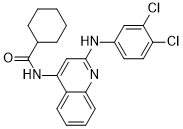
Physicochemical Properties
| Molecular Formula | C22H21CL2N3O |
| Molecular Weight | 414.33 |
| Exact Mass | 413.106 |
| CAS # | 1116652-18-6 |
| Related CAS # | 1116652-18-6; |
| PubChem CID | 25191023 |
| Appearance | Typically exists as solid at room temperature |
| LogP | 6.875 |
| Hydrogen Bond Donor Count | 2 |
| Hydrogen Bond Acceptor Count | 3 |
| Rotatable Bond Count | 4 |
| Heavy Atom Count | 28 |
| Complexity | 528 |
| Defined Atom Stereocenter Count | 0 |
| SMILES | ClC=1C=CC(=CC1Cl)N=C2NC3=CC=CC=C3C(=C2)NC(C4CCCCC4)=O |
| InChi Key | UWEIQVQNNLVOEI-UHFFFAOYSA-N |
| InChi Code | InChI=1S/C22H21Cl2N3O/c23-17-11-10-15(12-18(17)24)25-21-13-20(16-8-4-5-9-19(16)26-21)27-22(28)14-6-2-1-3-7-14/h4-5,8-14H,1-3,6-7H2,(H2,25,26,27,28) |
| Chemical Name | N-[2-[(3,4-Dichlorophenyl)amino]-4-quinolinyl]-cyclohexanecarboxamide |
| Synonyms | LUF6096 LUF 6096LUF-6096CF-602 CF602 CF 602 |
| HS Tariff Code | 2934.99.9001 |
| Storage |
Powder-20°C 3 years 4°C 2 years In solvent -80°C 6 months -20°C 1 month |
| Shipping Condition | Room temperature (This product is stable at ambient temperature for a few days during ordinary shipping and time spent in Customs) |
Biological Activity
| ln Vitro | The dissociation rate of 125I-AB-MECA from A3 receptors in CHO cell membranes is halved by 2.5 times with LUF6096 (10 μM; 30-120 minutes) [1]. Forskolin-stimulated cAMP generation in CHO cells can be inhibited and the intrinsic activity of Cl-IB-MECA considerably enhanced by LUF6096 (10 μM; 15 min pretreatment) [1]. |
| ln Vivo | In dogs, myocardial ischemia/reperfusion damage is prevented by LUF6096 (two intravenous bolus doses of 0.5 mg/kg or a single intravenous bolus dosage of 1 mg/kg) [1]. |
| Animal Protocol |
Animal/Disease Models: Adult mongrel dogs (15-25 kg) underwent left anterior descending (LAD) coronary artery occlusion and reperfusion [1] Doses: Two intravenous (iv) (iv)bolus injections of 0.5 mg/kg or a single intravenous (iv) (iv)bolus of 1 mg/kg given Medication: intravenous (iv) (iv)bolus Experimental Results: Infarct size was Dramatically diminished (approximately 50% reduction) compared to vehicle-treated dogs. |
| References |
[1]. Heitman LH, et, al. A series of 2,4-disubstituted quinolines as a new class of allosteric enhancers of the adenosine A3 receptor. J Med Chem. 2009 Feb 26;52(4):926-31. [2]. Du L, et, al. Protection from myocardial ischemia/reperfusion injury by a positive allosteric modulator of the A₃ adenosine receptor. J Pharmacol Exp Ther. 2012 Jan;340(1):210-7. |
Solubility Data
| Solubility (In Vitro) | DMSO : ~20 mg/mL (~48.27 mM) |
| Solubility (In Vivo) |
Solubility in Formulation 1: ≥ 2 mg/mL (4.83 mM) (saturation unknown) in 10% DMSO + 90% Corn Oil (add these co-solvents sequentially from left to right, and one by one), clear solution. For example, if 1 mL of working solution is to be prepared, you can add 100 μL of 20.0 mg/mL clear DMSO stock solution to 900 μL of corn oil and mix evenly. (Please use freshly prepared in vivo formulations for optimal results.) |
| Preparing Stock Solutions | 1 mg | 5 mg | 10 mg | |
| 1 mM | 2.4135 mL | 12.0677 mL | 24.1354 mL | |
| 5 mM | 0.4827 mL | 2.4135 mL | 4.8271 mL | |
| 10 mM | 0.2414 mL | 1.2068 mL | 2.4135 mL |