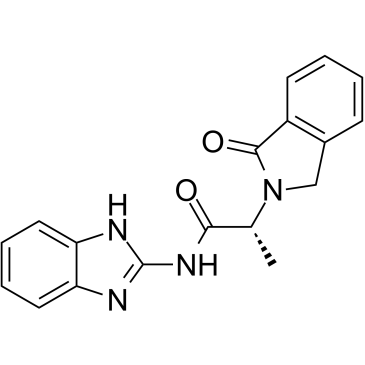
Physicochemical Properties
| Molecular Formula | C18H16N4O2 |
| Molecular Weight | 320.345243453979 |
| Exact Mass | 320.127 |
| CAS # | 2189366-77-4 |
| PubChem CID | 51819448 |
| Appearance | White to off-white solid powder |
| LogP | 2.2 |
| Hydrogen Bond Donor Count | 2 |
| Hydrogen Bond Acceptor Count | 3 |
| Rotatable Bond Count | 3 |
| Heavy Atom Count | 24 |
| Complexity | 511 |
| Defined Atom Stereocenter Count | 1 |
| SMILES | O=C1C2C=CC=CC=2CN1[C@H](C(NC1=NC2C=CC=CC=2N1)=O)C |
| InChi Key | PWSSISUOJZBZFT-LLVKDONJSA-N |
| InChi Code | InChI=1S/C18H16N4O2/c1-11(22-10-12-6-2-3-7-13(12)17(22)24)16(23)21-18-19-14-8-4-5-9-15(14)20-18/h2-9,11H,10H2,1H3,(H2,19,20,21,23)/t11-/m1/s1 |
| Chemical Name | (2R)-N-(1H-benzimidazol-2-yl)-2-(3-oxo-1H-isoindol-2-yl)propanamide |
| HS Tariff Code | 2934.99.9001 |
| Storage |
Powder-20°C 3 years 4°C 2 years In solvent -80°C 6 months -20°C 1 month |
| Shipping Condition | Room temperature (This product is stable at ambient temperature for a few days during ordinary shipping and time spent in Customs) |
Biological Activity
| Targets |
LTβR-IN-1 targets lymphotoxin β receptor (LTβR) [1] |
| ln Vitro |
In response to stimulation with Anti-LTβR or TWEAK (20 ng/mL, respectively; 4 h), LTβR-IN-1 (Compound 919278) (1 nM-100 μM; 30 min) suppresses p52 nuclear translocation with IC50 values of 0.167 μM and 0.169 μM, respectively[1]. In TWEAK-stimulated and control U-2 OS cells, LTβR-IN-1 (3 nM-30 μM; 45 min) decreases the binding affinity of CDK12 and its associated protein CCNK, with IC50 values of 50-61 nM and 29-68 nM, respectively[1]. In U-2 OS cells, LTβR-IN-1 decreases the mRNA abundance of MAP3K14 with an IC50 μM of 0.32 μM [1]. LTβR-IN-1 (1–10 μM; 30 min) decreases RNA polymerase (Pol) II's C-terminal domain (CTD) serine 2 (Ser2) phosphorylation [1]. LTβR-IN-1 maintains the canonical NF-kB signaling pathway while selectively inhibiting non-canonical pathways in a ligand-independent manner [1]. LTβR-IN-1 (1 μM–10 μM) dose-dependently inhibited the activation of the noncanonical NF-κB pathway induced by LTβR ligand (LTα1β2) in HeLa cells. At 5 μM, it reduced the nuclear translocation of RelB by 68% and downregulated the protein levels of NF-κB2 (p100/p52) by 57% compared to the ligand-only group [1] LTβR-IN-1 (3 μM–10 μM) suppressed LTβR-mediated transcriptional activation of noncanonical NF-κB target genes: 10 μM dose reduced RelB mRNA by 72%, NF-κB2 mRNA by 65%, and CCL21 mRNA by 61% in RAW264.7 cells after 24 hours of treatment [1] In CDK12-deficient HeLa cells, LTβR-IN-1 (5 μM) had no significant additional inhibitory effect on the noncanonical NF-κB pathway, indicating its dependence on CDK12-mediated transcriptional regulation [1] LTβR-IN-1 (up to 10 μM) did not affect the canonical NF-κB pathway (TNFα-induced p65 nuclear translocation and IL-6 production), demonstrating selectivity for the noncanonical NF-κB pathway [1] |
| Cell Assay |
Western Blot Analysis[1] Cell Types: U-2 OS cells Tested Concentrations: 1 μM, 3 μM, and 10 μM Incubation Duration: 30 min Experimental Results: decreased the phosphorylating of Ser2 in cells stimulated by 20 ng/mL TWEAK for 4 hr. Note: CDK12 activated RNA Pol II–mediated transcription by phosphorylating Ser2 within the 52 heptad (Y1S2P3T4S5P6S7) repeats in the C-terminal domain (CTD) of RNA Pol II. Ser2 phosphorylation aids in the release of paused RNA Pol II from promoters, resulting in transcriptional elongation, which is particularly important for the transcription of some long, complex genes. Noncanonical NF-κB pathway inhibition assay: HeLa or RAW264.7 cells were seeded in 6-well plates (2 × 10⁵ cells/well) and serum-starved for 12 hours. Cells were pretreated with LTβR-IN-1 (1 μM–10 μM) for 1 hour, then stimulated with LTα1β2 (100 ng/mL) for 6 hours (protein detection) or 24 hours (mRNA detection). Nuclear and cytoplasmic fractions were prepared for Western blot to detect RelB and NF-κB2 (p100/p52) levels; total RNA was extracted for qPCR to quantify target gene mRNA expression [1] Canonical NF-κB pathway selectivity assay: HeLa cells were pretreated with LTβR-IN-1 (5 μM–10 μM) for 1 hour, then stimulated with TNFα (10 ng/mL) for 1 hour. Nuclear p65 levels were detected by Western blot, and IL-6 protein in the supernatant was quantified by ELISA [1] CDK12 dependence assay: CDK12-deficient HeLa cells (generated by siRNA knockdown) and control HeLa cells were treated with LTβR-IN-1 (5 μM) and stimulated with LTα1β2 (100 ng/mL) for 6 hours. RelB nuclear translocation was analyzed by immunofluorescence and Western blot [1] |
| References |
[1]. CDK12-mediated transcriptional regulation of noncanonical NF-κB components is essential for signaling. Sci Signal. 2018 Jul 31;11(541). |
| Additional Infomation |
LTβR-IN-1 is a small-molecule inhibitor of the lymphotoxin β receptor (LTβR) signaling pathway [1] Its mechanism of action involves blocking LTβR-mediated activation of the noncanonical NF-κB pathway by interfering with CDK12-dependent transcriptional regulation of noncanonical NF-κB components (RelB, NF-κB2) [1] The compound exhibits selectivity for the noncanonical NF-κB pathway without affecting the canonical NF-κB pathway, suggesting potential application in diseases driven by dysregulated noncanonical NF-κB signaling (e.g., autoimmune diseases, lymphoproliferative disorders) [1] LTβR-IN-1 relies on CDK12 to exert its inhibitory effect, as CDK12 deficiency abrogates its ability to suppress the noncanonical NF-κB pathway [1] |
Solubility Data
| Solubility (In Vitro) | DMSO : ~125 mg/mL (~390.20 mM) |
| Solubility (In Vivo) |
Solubility in Formulation 1: ≥ 2.08 mg/mL (6.49 mM) (saturation unknown) in 10% DMSO + 40% PEG300 + 5% Tween80 + 45% Saline (add these co-solvents sequentially from left to right, and one by one), clear solution. For example, if 1 mL of working solution is to be prepared, you can add 100 μL of 20.8 mg/mL clear DMSO stock solution to 400 μL PEG300 and mix evenly; then add 50 μL Tween-80 to the above solution and mix evenly; then add 450 μL normal saline to adjust the volume to 1 mL. Preparation of saline: Dissolve 0.9 g of sodium chloride in 100 mL ddH₂ O to obtain a clear solution. Solubility in Formulation 2: ≥ 2.08 mg/mL (6.49 mM) (saturation unknown) in 10% DMSO + 90% (20% SBE-β-CD in Saline) (add these co-solvents sequentially from left to right, and one by one), clear solution. For example, if 1 mL of working solution is to be prepared, you can add 100 μL of 20.8 mg/mL clear DMSO stock solution to 900 μL of 20% SBE-β-CD physiological saline solution and mix evenly. Preparation of 20% SBE-β-CD in Saline (4°C,1 week): Dissolve 2 g SBE-β-CD in 10 mL saline to obtain a clear solution. (Please use freshly prepared in vivo formulations for optimal results.) |
| Preparing Stock Solutions | 1 mg | 5 mg | 10 mg | |
| 1 mM | 3.1216 mL | 15.6079 mL | 31.2159 mL | |
| 5 mM | 0.6243 mL | 3.1216 mL | 6.2432 mL | |
| 10 mM | 0.3122 mL | 1.5608 mL | 3.1216 mL |