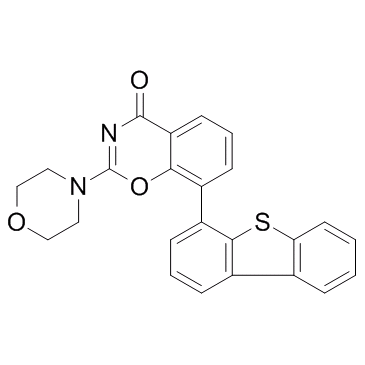
Physicochemical Properties
| Molecular Formula | C24H18N2O3S |
| Molecular Weight | 414.4763 |
| Exact Mass | 414.103 |
| Elemental Analysis | C, 69.55; H, 4.38; N, 6.76; O, 11.58; S, 7.74 |
| CAS # | 1879887-96-3 |
| Related CAS # | 1879887-96-3 |
| PubChem CID | 122705987 |
| Appearance | White to off-white solid powder |
| Density | 1.4±0.1 g/cm3 |
| Boiling Point | 657.8±65.0 °C at 760 mmHg |
| Flash Point | 351.6±34.3 °C |
| Vapour Pressure | 0.0±2.0 mmHg at 25°C |
| Index of Refraction | 1.742 |
| LogP | 3.97 |
| Hydrogen Bond Donor Count | 0 |
| Hydrogen Bond Acceptor Count | 4 |
| Rotatable Bond Count | 2 |
| Heavy Atom Count | 30 |
| Complexity | 694 |
| Defined Atom Stereocenter Count | 0 |
| SMILES | S1C2=C([H])C([H])=C([H])C([H])=C2C2C([H])=C([H])C([H])=C(C1=2)C1=C([H])C([H])=C([H])C2C(N=C(N3C([H])([H])C([H])([H])OC([H])([H])C3([H])[H])OC1=2)=O |
| InChi Key | SMMSWOMXOZLOPI-UHFFFAOYSA-N |
| InChi Code | InChI=1S/C24H18N2O3S/c27-23-19-9-3-6-16(21(19)29-24(25-23)26-11-13-28-14-12-26)18-8-4-7-17-15-5-1-2-10-20(15)30-22(17)18/h1-10H,11-14H2 |
| Chemical Name | 8-dibenzothiophen-4-yl-2-morpholin-4-yl-1,3-benzoxazin-4-one |
| Synonyms | LTURM34; LTURM-34; LTURM 34 |
| HS Tariff Code | 2934.99.9001 |
| Storage |
Powder-20°C 3 years 4°C 2 years In solvent -80°C 6 months -20°C 1 month |
| Shipping Condition | Room temperature (This product is stable at ambient temperature for a few days during ordinary shipping and time spent in Customs) |
Biological Activity
| Targets | DNA-PK (IC50 = 34 nM); PI3Kβ (IC50 = 5.8 μM); PI4Kδ (IC50 = 8.5 μM) |
| ln Vitro | LTURM34 exhibits strong DNA-PK inhibition and superb selectivity over Class I PI3K isoforms. For PI3K β and δ, the IC50s are 5.8 and 8.5 μM, respectively. LTURM34 is more frequently active against the chosen cell lines (11 of 16), but it only inhibits the HOP-92 non-small cell lung cancer cell line by a maximum of 54%[1]. |
| Enzyme Assay | LTURM34 is dissolved at a concentration of 10 mM in DMSO and kept at -20 °C until use. In 50 L of 20 mM HEPES pH 7.5, 5 mM MgCl2, 180 M PI, and 10 μM ATP, the activity of the PI3K enzyme is assessed. The reaction is stopped by adding 50 μl of Kinase-Glo and then incubating for an additional 15 minutes at room temperature following a 60-minute incubation. Then, using a Luostar plate reader, the luminescence is read. The indicated concentrations of LTURM34 are diluted in 20% (v/v) DMSO to produce a concentration versus inhibition of enzyme activity curve, which is then analyzed in GraphPad Prism version 5.00 for Windows to determine the IC50[1]. |
| Cell Assay | Cell lines (MDA-MB-361, MDA-MB-231, MDA-MB-468, BT549, LNCap, A549, H1975, H157, H460, U87MG, A498, 786-O, HCT116, MG63, Rat1, HEK293, and HeLa) are obtained from the American Type Culture Collection. Cell growth assays and IC50 determination are described as follows. For tumor cell growth assays, cells are plated in 96-well culture plates at 1000 to 3000 cells per well for 24 hours, treated with DMSO or various doses of WYE-125132. Viable cell densities are determined three days later by MTS assay employing an assay kit following the kit assay protocol. The effect of each treatment is calculated as percent of control growth relative to the DMSO-treated cells grown in the same culture plate. Inhibitor dose response curves are plotted for determination of IC50 values.WYE-125132 potently and ATP-competitively inhibits recombinant mTOR kinase with IC50 of 0.19 nM and also shows the high selectivity over various PI3Ks and a panel of 230 protein kinases. In vitro, WYE-125132 exhibits a significant anti-proliferative activity against a panel of tumor cell lines with IC50 ranging from 2 nM (LNCap) to 380 nM (HTC116). Besides, WYE-125132 also causes cell cycle progression, induction of apoptosis, and inhibition of protein synthesis and cell size. WYE-125132 results in a significant reduction in the synthesis of pre-tRNALeuby 72%, 80%, and 53% in actively proliferating cells of MG63, MDA361, and HEK293, respectively by inhibiting mTORC1. Moreover, WYE-125132 is also found to induce the dephosphorylation of Maf1 (negative regulator of Pol III transcription) and its accumulation in the nucleus. |
| References |
[1]. Synthesis, structure elucidation, DNA-PK and PI3K and anti-cancer activity of 8- and 6-aryl-substituted-1-3-benzoxazines. Eur J Med Chem. 2016 Mar 3;110:326-39. |
Solubility Data
| Solubility (In Vitro) |
DMSO: 65~82 mg/mL (156.8~197.8 mM) Ethanol: ~4 mg/mL (~9.7 mM) |
| Solubility (In Vivo) |
Solubility in Formulation 1: ≥ 3.25 mg/mL (7.84 mM) (saturation unknown) in 10% DMSO + 90% Corn Oil (add these co-solvents sequentially from left to right, and one by one), clear solution. For example, if 1 mL of working solution is to be prepared, you can add 100 μL of 32.5 mg/mL clear DMSO stock solution to 900 μL of corn oil and mix evenly. (Please use freshly prepared in vivo formulations for optimal results.) |
| Preparing Stock Solutions | 1 mg | 5 mg | 10 mg | |
| 1 mM | 2.4127 mL | 12.0633 mL | 24.1266 mL | |
| 5 mM | 0.4825 mL | 2.4127 mL | 4.8253 mL | |
| 10 mM | 0.2413 mL | 1.2063 mL | 2.4127 mL |