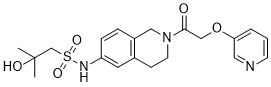
LSN3154567 (LSN-3154567; Nampt-IN-1) is a novel and potent Nicotinamide phosphoribosyltransferase (NAMPT) inhibitor with potential anticancer activity. It inhibits NAMPT with IC50 of 18 nM (NCI-H1155 cell), 49 nM (Calu-6 cell), 333 nM (HCC1937 cell), and 389 nM (MCF-7 cell), respectively.
Physicochemical Properties
| Molecular Formula | C20H25N3O5S |
| Molecular Weight | 419.496 |
| Exact Mass | 419.151 |
| CAS # | 1698878-14-6 |
| PubChem CID | 92044379 |
| Appearance | Off-white to yellow solid powder |
| Density | 1.4±0.1 g/cm3 |
| Boiling Point | 659.9±65.0 °C at 760 mmHg |
| Flash Point | 352.9±34.3 °C |
| Vapour Pressure | 0.0±2.1 mmHg at 25°C |
| Index of Refraction | 1.624 |
| LogP | 0.97 |
| Hydrogen Bond Donor Count | 2 |
| Hydrogen Bond Acceptor Count | 7 |
| Rotatable Bond Count | 7 |
| Heavy Atom Count | 29 |
| Complexity | 664 |
| Defined Atom Stereocenter Count | 0 |
| InChi Key | QHHSCLARESIWBH-UHFFFAOYSA-N |
| InChi Code | InChI=1S/C20H25N3O5S/c1-20(2,25)14-29(26,27)22-17-6-5-16-12-23(9-7-15(16)10-17)19(24)13-28-18-4-3-8-21-11-18/h3-6,8,10-11,22,25H,7,9,12-14H2,1-2H3 |
| Chemical Name | 2-hydroxy-2-methyl-N-[2-(2-pyridin-3-yloxyacetyl)-3,4-dihydro-1H-isoquinolin-6-yl]propane-1-sulfonamide |
| Synonyms | Nampt-IN1 Nampt-IN 1 Nampt-IN-1LSN3154567 LSN-3154567 |
| HS Tariff Code | 2934.99.9001 |
| Storage |
Powder-20°C 3 years 4°C 2 years In solvent -80°C 6 months -20°C 1 month |
| Shipping Condition | Room temperature (This product is stable at ambient temperature for a few days during ordinary shipping and time spent in Customs) |
Biological Activity
| Targets |
|
|
| ln Vitro | LSN3154567 was evaluated in a range of biochemical and cellular assays to assess its selectivity, specificity, and impact on cellular NAD+ levels. Purified NAMPT is inhibited by LSN3154567 at an IC50 of 3.1 nM. It eliminated CSF1R (IC50≈0.84 μM) when evaluated against a panel of human kinases (>100; CEREP Kinase Panel). Broad-spectrum anticancer action is exhibited by LSN3154567. LSN3154567 was tested against a variety of cancer cell lines that were either cultivated with or without nicotinic acid (NA) (10 μM) in order to assess its anticancer potential. LSN3154567 has strong antiproliferative action against a variety of cell lines when NA is not present [1]. | |
| ln Vivo | Nampt-IN-1 (LSN3154567) is an oral medication with good physicochemical characteristics. Its plasma exposure was 195 nM*h with a peak concentration of 57 nM (at 0.25 h) and an oral bioavailability of 39% when given orally to mice at a dose of 2 mg/kg. The liver clearance was 158.73 mL/min/kg and the volume of distribution was 7.1 L/kg when the intravenous dose of 2 mg/kg was given. It is calculated that the terminal elimination half-life is 2.76 hours. LSN3154567 has an estimated TED50 value of 2.0 mg/kg and inhibits NAD+ production in a dose-dependent manner. Rats were given LSN3154567 at doses of 20, 40, and 80 mg/kg for four days in order to determine whether the drug induces retinopathy. There was no discernible retinopathy found. Be mindful of hematological toxicity. Plasma doses of 8,974, 18,061 and 38,327 M*h were measured at 20, 40 and 80 mg/kg of LSN3154567, respectively. As a result, LSN3154567's exposure folds were 3, 7, and 14 times, respectively, greater than the exposure (2,701 M*h) needed to attain high efficacy (≈103%) without simultaneous NA delivery. Dogs received LSN3154567 at doses of 1 and 2.5 mg/kg. It was shown that these dosage levels caused retinal toxicity. All four animals had outer nuclear layer degeneration, albeit it was less severe in those given 1 mg/kg. At dose levels of 1 and 2.5 mg/kg, the plasma exposure was found to be 1,483 and 2,468 nM*h, respectively [1]. | |
| Cell Assay |
|
|
| References |
[1]. Discovery of a Highly Selective NAMPT Inhibitor That Demonstrates Robust Efficacy and Improved Retinal Toxicity with Nicotinic Acid Coadministration. Mol Cancer Ther. 2017 Dec;16(12):2677-2688. |
Solubility Data
| Solubility (In Vitro) | DMSO : ~250 mg/mL (~595.96 mM) |
| Solubility (In Vivo) |
Solubility in Formulation 1: ≥ 2.08 mg/mL (4.96 mM) (saturation unknown) in 10% DMSO + 40% PEG300 + 5% Tween80 + 45% Saline (add these co-solvents sequentially from left to right, and one by one), clear solution. For example, if 1 mL of working solution is to be prepared, you can add 100 μL of 20.8 mg/mL clear DMSO stock solution to 400 μL PEG300 and mix evenly; then add 50 μL Tween-80 to the above solution and mix evenly; then add 450 μL normal saline to adjust the volume to 1 mL. Preparation of saline: Dissolve 0.9 g of sodium chloride in 100 mL ddH₂ O to obtain a clear solution. Solubility in Formulation 2: ≥ 2.08 mg/mL (4.96 mM) (saturation unknown) in 10% DMSO + 90% (20% SBE-β-CD in Saline) (add these co-solvents sequentially from left to right, and one by one), clear solution. For example, if 1 mL of working solution is to be prepared, you can add 100 μL of 20.8 mg/mL clear DMSO stock solution to 900 μL of 20% SBE-β-CD physiological saline solution and mix evenly. Preparation of 20% SBE-β-CD in Saline (4°C,1 week): Dissolve 2 g SBE-β-CD in 10 mL saline to obtain a clear solution. Solubility in Formulation 3: ≥ 2.08 mg/mL (4.96 mM) (saturation unknown) in 10% DMSO + 90% Corn Oil (add these co-solvents sequentially from left to right, and one by one), clear solution. For example, if 1 mL of working solution is to be prepared, you can add 100 μL of 20.8 mg/mL clear DMSO stock solution to 900 μL of corn oil and mix evenly. (Please use freshly prepared in vivo formulations for optimal results.) |
| Preparing Stock Solutions | 1 mg | 5 mg | 10 mg | |
| 1 mM | 2.3838 mL | 11.9190 mL | 23.8379 mL | |
| 5 mM | 0.4768 mL | 2.3838 mL | 4.7676 mL | |
| 10 mM | 0.2384 mL | 1.1919 mL | 2.3838 mL |