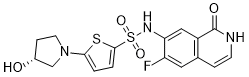
LSN 3213128 is a novel, potent, selective, nonclassical and orally bioavailable antifolate that inhibits Aminoimidazole-4-carboxamide Ribonucleotide Formyltransferase (AICARFT) with IC50 of 16 nM for AICARFT enzyme inhibiton and 19 nM in cells. LSN-3213128 is highly effective in the suppression of tumor growth in a Cancer Xenograft Model. Inhibition of AICARFT with compound LSN-3213128 results in dramatic elevation of 5-aminoimidazole 4-carboxamide ribonucleotide (ZMP) and growth inhibition in NCI-H460 and MDA-MB-231met2 cancer cell lines. Treatment with this inhibitor in a murine based xenograft model of triple negative breast cancer (TNBC) resulted in tumor growth inhibition.
Physicochemical Properties
| Molecular Formula | C17H16FN3O4S2 |
| Molecular Weight | 409.455044746399 |
| Exact Mass | 409.056 |
| CAS # | 1941211-99-9 |
| Related CAS # | 1941211-99-9 (free);1941212-28-7 1941212-29-8 (sodium); |
| PubChem CID | 121378588 |
| Appearance | Off-white to pink solid powder |
| LogP | 1.9 |
| Hydrogen Bond Donor Count | 3 |
| Hydrogen Bond Acceptor Count | 8 |
| Rotatable Bond Count | 4 |
| Heavy Atom Count | 27 |
| Complexity | 714 |
| Defined Atom Stereocenter Count | 1 |
| SMILES | S1C(=CC=C1N1CC[C@H](C1)O)S(NC1=C(C=C2C=CNC(C2=C1)=O)F)(=O)=O |
| InChi Key | N-(6-Fluoro-1-oxo-1,2-dihydroisoquinolin-7-yl)-5-[(3R)-3-hydroxypyrrolidin-1-yl]thiophene-2-sulfonamide |
| InChi Code | DSUZLJDXUJUTGI-LLVKDONJSA-N |
| Chemical Name | LSN-3213128 LSN 3213128 LSN3213128. |
| HS Tariff Code | 2934.99.9001 |
| Storage |
Powder-20°C 3 years 4°C 2 years In solvent -80°C 6 months -20°C 1 month |
| Shipping Condition | Room temperature (This product is stable at ambient temperature for a few days during ordinary shipping and time spent in Customs) |
Biological Activity
| References |
[1]. Discovery of N-(6-Fluoro-1-oxo-1,2-dihydroisoquinolin-7-yl)-5-[(3R)-3-hydroxypyrrolidin-1-yl]thiophene-2-sulfonamide (LSN 3213128), a Potent and Selective Nonclassical Antifolate Aminoimidazole-4-carboxamide Ribonucleotide Formyltransfera. |
Solubility Data
| Solubility (In Vitro) | DMSO : ~62.5 mg/mL (~152.64 mM) |
| Solubility (In Vivo) |
Solubility in Formulation 1: ≥ 2.08 mg/mL (5.08 mM) (saturation unknown) in 10% DMSO + 40% PEG300 + 5% Tween80 + 45% Saline (add these co-solvents sequentially from left to right, and one by one), clear solution. For example, if 1 mL of working solution is to be prepared, you can add 100 μL of 20.8 mg/mL clear DMSO stock solution to 400 μL PEG300 and mix evenly; then add 50 μL Tween-80 to the above solution and mix evenly; then add 450 μL normal saline to adjust the volume to 1 mL. Preparation of saline: Dissolve 0.9 g of sodium chloride in 100 mL ddH₂ O to obtain a clear solution. Solubility in Formulation 2: ≥ 2.08 mg/mL (5.08 mM) (saturation unknown) in 10% DMSO + 90% (20% SBE-β-CD in Saline) (add these co-solvents sequentially from left to right, and one by one), clear solution. For example, if 1 mL of working solution is to be prepared, you can add 100 μL of 20.8 mg/mL clear DMSO stock solution to 900 μL of 20% SBE-β-CD physiological saline solution and mix evenly. Preparation of 20% SBE-β-CD in Saline (4°C,1 week): Dissolve 2 g SBE-β-CD in 10 mL saline to obtain a clear solution. Solubility in Formulation 3: ≥ 2.08 mg/mL (5.08 mM) (saturation unknown) in 10% DMSO + 90% Corn Oil (add these co-solvents sequentially from left to right, and one by one), clear solution. For example, if 1 mL of working solution is to be prepared, you can add 100 μL of 20.8 mg/mL clear DMSO stock solution to 900 μL of corn oil and mix evenly. (Please use freshly prepared in vivo formulations for optimal results.) |
| Preparing Stock Solutions | 1 mg | 5 mg | 10 mg | |
| 1 mM | 2.4422 mL | 12.2112 mL | 24.4224 mL | |
| 5 mM | 0.4884 mL | 2.4422 mL | 4.8845 mL | |
| 10 mM | 0.2442 mL | 1.2211 mL | 2.4422 mL |