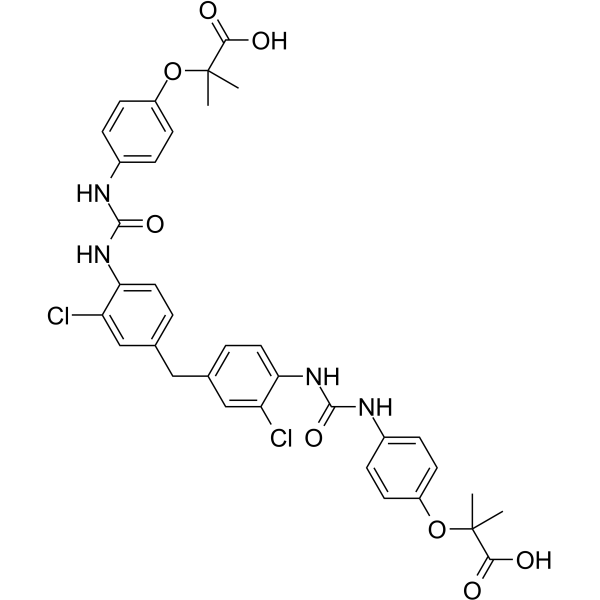
Physicochemical Properties
| Molecular Formula | C35H34CL2N4O8 |
| Molecular Weight | 709.5725 |
| Exact Mass | 708.175 |
| CAS # | 245075-84-7 |
| PubChem CID | 10212249 |
| Appearance | Typically exists as White to off-white solid at room temperature |
| LogP | 8.529 |
| Hydrogen Bond Donor Count | 6 |
| Hydrogen Bond Acceptor Count | 8 |
| Rotatable Bond Count | 12 |
| Heavy Atom Count | 49 |
| Complexity | 1060 |
| Defined Atom Stereocenter Count | 0 |
| SMILES | ClC1=C(C([H])=C([H])C(=C1[H])C([H])([H])C1C([H])=C([H])C(=C(C=1[H])Cl)N([H])C(N([H])C1C([H])=C([H])C(=C([H])C=1[H])OC(C(=O)O[H])(C([H])([H])[H])C([H])([H])[H])=O)N([H])C(N([H])C1C([H])=C([H])C(=C([H])C=1[H])OC(C(=O)O[H])(C([H])([H])[H])C([H])([H])[H])=O |
| InChi Key | WJDMCXSGUCNRPZ-UHFFFAOYSA-N |
| InChi Code | InChI=1S/C35H34Cl2N4O8/c1-34(2,30(42)43)48-24-11-7-22(8-12-24)38-32(46)40-28-15-5-20(18-26(28)36)17-21-6-16-29(27(37)19-21)41-33(47)39-23-9-13-25(14-10-23)49-35(3,4)31(44)45/h5-16,18-19H,17H2,1-4H3,(H,42,43)(H,44,45)(H2,38,40,46)(H2,39,41,47) |
| Chemical Name | 2-[4-[[4-[[4-[[4-(2-carboxypropan-2-yloxy)phenyl]carbamoylamino]-3-chlorophenyl]methyl]-2-chlorophenyl]carbamoylamino]phenoxy]-2-methylpropanoic acid |
| Synonyms | 245075-84-7; LR-90; PJ8V885848; RefChem:154162; 2,2'-(4,4'-(4,4'-methylenebis(2-chloro-4,1-phenylene))bis(azanediyl)bis(oxomethylene)bis(azanediyl)bis(4,1-phenylene))bis(oxy)bis(2-Methylpropanoic acid); lR90; 2,2'-((((((methylenebis(2-chloro-4,1-phenylene))bis(azanediyl))bis(carbonyl))bis(azanediyl))bis(4,1-phenylene))bis(oxy))bis(2-methylpropanoic acid); 2,2'-(Methylenebis((2-chloro-4,1-phenylene)iminocarbonylimino-4,1-phenyleneoxy))bis(2-methylpropanoic acid); |
| HS Tariff Code | 2934.99.9001 |
| Storage |
Powder-20°C 3 years 4°C 2 years In solvent -80°C 6 months -20°C 1 month |
| Shipping Condition | Room temperature (This product is stable at ambient temperature for a few days during ordinary shipping and time spent in Customs) |
Biological Activity
| Targets |
Advanced glycation end product (AGE) formation (IC₅₀ = 275 µM for inhibition of metal ion-catalyzed ascorbate oxidation) [1] |
| ln Vitro |
LR-90 dose-dependently reduced the expression of the genes for RAGE, MCP-1, COX-2, IP-10, and NOX2 after 1 hour of pretreatment. Four hours prior to S100b stimulation [1]. After 24 hours of pretreatment, 1 hour before to S100b stimulation, LR-90 (0, 25, 50, 100, and 200 μM) substantially and dose-dependently inhibited the adherence of THP-1 cells to endothelial cells [1]. THP-1 cell viability was unaffected by LR-90 (0, 25, 50, 100, and 200 μM) for a 24-hour period [1].
- LR-90 pretreatment (1 hour) dose-dependently reduced mRNA expression of RAGE, MCP-1, COX-2, IP-10, and NOX2 in human monocytes stimulated with S100B [1] - Pretreatment with LR-90 (0, 25, 50, 100, 200 µM) for 24 hours, followed by 1 hour of S100B stimulation, dose-dependently inhibited THP-1 cell adhesion to endothelial cells [1] - LR-90 (0–200 µM) did not affect THP-1 cell viability after 24-hour exposure [1] |
| ln Vivo |
LR-90 (50 mg/L, orally administered for 27 weeks) considerably decreases plasma lipids and has a certain influence on hyperglycemia in ZDF rats [2]. LR-90 (50 mg/L) decreases renal AGE, AGER and lipid peroxidation [2].
- Oral administration of LR-90 (50 mg/L in drinking water) for 27 weeks significantly reduced plasma triacylglycerol by ~55% and cholesterol by ~30% in Zucker diabetic fatty (ZDF) rats [2] - LR-90 (50 mg/L) decreased renal AGE accumulation, AGE receptor (AGER) expression, and lipid peroxidation in ZDF rats [2] - Mild improvements in hyperglycemia and blood pressure, and reduced body weight were observed in LR-90-treated ZDF rats [2] |
| Enzyme Assay |
Assay for metal ion-catalyzed ascorbate oxidation inhibition: LR-90 was tested for its ability to scavenge dicarbonyl intermediates and chelate transition metals involved in AGE formation, with an IC₅₀ of 275 µM [1] |
| Cell Assay |
Cell viability assay [1] Cell Types: THP-1 Cell Tested Concentrations: 0, 25, 50, 100 and 200 μM Incubation Duration: 24 hrs (hours) Experimental Results: No cytotoxicity to THP-1 cells. RT-PCR[1] Cell Types: THP-1 Cell Tested Concentrations: 0, 25, 50, 100 and 200 μM Incubation Duration: 1 hour before adding S100b, for 4 hrs (hours) Experimental Results: Dose-dependent inhibition of RAGE, MCP-mRNA expression1 , COX-2, IP-10 and NOX2 were stimulated with S100b. - THP-1 cell adhesion assay: Cells were pretreated with LR-90 (0, 25, 50, 100, 200 µM) for 24 hours, then stimulated with S100B for 1 hour. Adhesion to endothelial cells was quantified [1] - mRNA expression analysis: Human monocytes were pretreated with LR-90 for 1 hour, stimulated with S100B, and gene expression of RAGE, MCP-1, COX-2, IP-10, and NOX2 was measured by PCR [1] |
| Animal Protocol |
Animal/Disease Models: Male ZDF rats (13 to 40 weeks) [2] Doses: 50 mg/L Route of Administration: Oral administration for 27 weeks. Experimental Results: Plasma triacylglycerol and cholesterol were Dramatically diminished by approximately 55% and approximately 30% respectively. Mild effects on hyperglycemia and blood pressure. Lowered body weight. ZDF rats were administered LR-90 at 50 mg/L via drinking water for 27 weeks. Body weight, blood glucose, blood pressure, plasma lipids, and renal parameters were monitored periodically [2] |
| References |
[1]. Anti-inflammatory effects of the advanced glycation end product inhibitor LR-90 in human monocytes. Diabetes. 2007 Mar;56(3):647-55. [2]. LR-90 prevents dyslipidaemia and diabetic nephropathy in the Zucker diabetic fatty rat. Diabetologia. 2008 May;51(5):882-91. |
| Additional Infomation |
- LR-90 is an AGE inhibitor that suppresses S100B- and TNFα-induced NF-κB activation [1] - Protective effects against diabetic nephropathy were associated with reduced collagen accumulation and cross-linking in renal tissues [2] Ligation of advanced glycation end products (AGEs) with their receptor (RAGE) plays an important role in the development of various diabetes complications, including atherosclerosis. Monocyte activation, adhesion, and migration are key events in the pathogenesis of atherosclerosis. Previous studies showed that AGEs and S100b, a specific RAGE ligand, could augment monocyte inflammatory responses via RAGE. In this study, we examined whether LR-90, a compound belonging to a new class of AGE inhibitor, could inhibit inflammatory responses in human monocytes. Human THP-1 cells were pretreated with LR-90 and then stimulated with S100b. LR-90 significantly inhibited S100b-induced expression of RAGE and other proinflammatory genes including monocyte chemoattractant protein-1, interferon-gamma-inducible protein-10, and cyclooxygenase-2 in a dose-dependent manner. These inhibitory effects may be exerted via inhibition of nuclear factor-kappaB (NF-kappaB) activation, as LR-90 suppressed both S100b-and tumor necrosis factor-alpha-induced IkappaB-alpha degradation as well as NF-kappaB promoter transcriptional activity. LR-90 also prevented oxidative stress in activated monocytes, as demonstrated by its inhibitory effects on S100b-induced expression of NADPH oxidase and intracellular superoxide production. In addition, LR-90 blocked S100b-induced monocyte adhesion to human umbilical vein endothelial cell. These new data show that, in addition to its AGE inhibitory effects, LR-90 has novel anti-inflammatory properties and might therefore have additional protective effects against diabetic vascular complications.[1] Aims/hypothesis: Previous studies have shown that LR-90, a new inhibitor of AGE formation, prevented the development of experimental type 1 diabetic nephropathy. In this study, we examined the effects of LR-90 in the Zucker diabetic fatty (ZDF) rat, a model of type 2 diabetes and metabolic syndrome, and investigated the mechanisms by which it may protect against renal injury. Methods: Male ZDF rats were treated without or with LR-90 from age 13 to 40 weeks. Metabolic and kidney functions and renal histology were evaluated. AGE accumulation and the production of the receptor for AGE (AGER) were measured. Profibrotic growth factors, extracellular matrix proteins and intracellular signalling pathways associated with glomerular and tubular damage were also analysed. Results: LR-90 dramatically reduced plasma lipids in ZDF rats, with only modest effects on hyperglycaemia. Renal AGE, AGER and lipid peroxidation were all attenuated by LR-90. LR-90 significantly retarded the increase in albuminuria and proteinuria. This was associated with reduction in glomerulosclerosis and tubulointerstitial fibrosis, concomitant with marked inhibition of renal overproduction of TGF-beta1, connective tissue growth factor, fibronectin and collagen IV. Additionally, LR-90 downregulated the activation of key mitogen-activated protein kinases (MAPKs) and nuclear factor kappa B (NF-kappaB) in the renal cortex. Conclusions/interpretation: These results support our earlier studies on the renoprotective effects of LR-90 on type 1 diabetic nephropathy and provide further evidence that LR-90, an AGE inhibitor with pleiotrophic effects, may also be beneficial for the prevention of type 2 diabetic nephropathy, where multiple risk factors, such as hyperglycaemia, dyslipidaemia, obesity, insulin resistance and hypertension, contribute to renal injury.[2] |
Solubility Data
| Solubility (In Vitro) | DMSO : ≥ 100 mg/mL (~140.93 mM) |
| Solubility (In Vivo) |
Solubility in Formulation 1: ≥ 2.5 mg/mL (3.52 mM) (saturation unknown) in 10% DMSO + 40% PEG300 + 5% Tween80 + 45% Saline (add these co-solvents sequentially from left to right, and one by one), clear solution. For example, if 1 mL of working solution is to be prepared, you can add 100 μL of 25.0 mg/mL clear DMSO stock solution to 400 μL PEG300 and mix evenly; then add 50 μL Tween-80 to the above solution and mix evenly; then add 450 μL normal saline to adjust the volume to 1 mL. Preparation of saline: Dissolve 0.9 g of sodium chloride in 100 mL ddH₂ O to obtain a clear solution. Solubility in Formulation 2: ≥ 2.5 mg/mL (3.52 mM) (saturation unknown) in 10% DMSO + 90% Corn Oil (add these co-solvents sequentially from left to right, and one by one), clear solution. For example, if 1 mL of working solution is to be prepared, you can add 100 μL of 25.0 mg/mL clear DMSO stock solution to 900 μL of corn oil and mix evenly. (Please use freshly prepared in vivo formulations for optimal results.) |
| Preparing Stock Solutions | 1 mg | 5 mg | 10 mg | |
| 1 mM | 1.4093 mL | 7.0465 mL | 14.0930 mL | |
| 5 mM | 0.2819 mL | 1.4093 mL | 2.8186 mL | |
| 10 mM | 0.1409 mL | 0.7047 mL | 1.4093 mL |