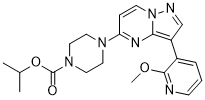
LP-935509 (LP935509) is a novel and potent inhibitor of the Adapter protein-2 Associated Kinase 1 (AAK1) with the potential to Treat Neuropathic Pain. It inhibits AAK1 with IC50 of 3.3 nM.
Physicochemical Properties
| Molecular Formula | C20H24N6O3 |
| Molecular Weight | 396.442963600159 |
| Exact Mass | 396.191 |
| Elemental Analysis | C, 60.59; H, 6.10; N, 21.20; O, 12.11 |
| CAS # | 1454555-29-3 |
| Related CAS # | 1454555-29-3; |
| PubChem CID | 86697436 |
| Appearance | Light yellow to yellow solid powder |
| LogP | 2.1 |
| Hydrogen Bond Donor Count | 0 |
| Hydrogen Bond Acceptor Count | 7 |
| Rotatable Bond Count | 5 |
| Heavy Atom Count | 29 |
| Complexity | 556 |
| Defined Atom Stereocenter Count | 0 |
| InChi Key | GOOYSJIWTIHOGW-UHFFFAOYSA-N |
| InChi Code | InChI=1S/C20H24N6O3/c1-14(2)29-20(27)25-11-9-24(10-12-25)17-6-8-26-18(23-17)16(13-22-26)15-5-4-7-21-19(15)28-3/h4-8,13-14H,9-12H2,1-3H3 |
| Chemical Name | propan-2-yl 4-[3-(2-methoxypyridin-3-yl)pyrazolo[1,5-a]pyrimidin-5-yl]piperazine-1-carboxylate |
| Synonyms | LP-935509 LP 935509 LP935509 |
| HS Tariff Code | 2934.99.9001 |
| Storage |
Powder-20°C 3 years 4°C 2 years In solvent -80°C 6 months -20°C 1 month |
| Shipping Condition | Room temperature (This product is stable at ambient temperature for a few days during ordinary shipping and time spent in Customs) |
Biological Activity
| ln Vitro | LP-935509 has an IC50 value of 2.8 ± 0.4 nM for μ2 phosphorylation inhibition and an IC50 value of 3.3 ± 0.7 nM for phosphorylation of peptides generated from μ2 protein[1]. The reduction of SARS-CoV-2 S-RBD internalization into host cells is demonstrated by LP-935509 in a dose-dependent manner [2]. |
| ln Vivo | The oral single-dose medication LP-935509 (0–60 mg/kg) dramatically lowers pain behaviors [1]. ?In a CCI model, oral LP-935509 (0.1–30 mg/kg; single dosage) reverses thermal hyperalgesia in a dose-dependent manner [1]. ?LP-935509 (intravenous 1 mg/kg or oral 10 mg/kg once) has a 3.6-hour plasma half-life and 100% oral bioavailability [1]. |
| Animal Protocol |
Animal/Disease Models: Male C57BL/6J mice (with SNL (spinal nerve ligation) injury, n=8-10 male mice per group) [1] Doses: 0, 10, 30 and 60mg/kg (10ml/kg) Route of Administration: PO, Single Outcome: Produced a dose-dependent reduction in stage II paw withdrawal that was Dramatically lower than in vehicle-treated animals; demonstrated a dose-dependent reversal of mechanical allodynia; resulted in a substantial reduction in pain behaviors. Animal/Disease Models: Male SD (SD (Sprague-Dawley)) rat (CCI (chronic constriction injury) operated rat) [1] Doses: 0, 0.1, 0.3, 1, 3, 10 or 30 mg/kg Route of Administration: po (po (oral gavage)) daily Two, 5 consecutive day Experimental Results: Produced dose-dependent reversal of thermal hyperalgesia, cold hyperalgesia, mechanical hyperalgesia, and mechanical hyperalgesia in CCI animals. Reversal of behavioral deficits, ED50 values range from 2 mg/kg to 10 mg/kg. Animal/Disease Models: Male SD (SD (Sprague-Dawley)) rat[1] Doses: 1 mg/kg (IV), 10 mg/kg (PO) Route of Administration: IV, PO; once (pharmacokinetic/PK/PK analysis) Experimental Results: Oral bioavailability The conc |
| References |
[1]. Inhibition of AAK1 Kinase as a Novel Therapeutic Approach to Treat Neuropathic Pain. J Pharmacol Exp Ther. 2016 Sep;358(3):371-86. [2]. Role Of Endocytic Machinery Regulators in EGFR Traffic and Viral Entry (2021). Theses & Dissertations. 532. |
Solubility Data
| Solubility (In Vitro) | DMSO : ~50 mg/mL (~126.12 mM) |
| Solubility (In Vivo) |
Solubility in Formulation 1: ≥ 2.08 mg/mL (5.25 mM) (saturation unknown) in 10% DMSO + 40% PEG300 + 5% Tween80 + 45% Saline (add these co-solvents sequentially from left to right, and one by one), clear solution. For example, if 1 mL of working solution is to be prepared, you can add 100 μL of 20.8 mg/mL clear DMSO stock solution to 400 μL PEG300 and mix evenly; then add 50 μL Tween-80 to the above solution and mix evenly; then add 450 μL normal saline to adjust the volume to 1 mL. Preparation of saline: Dissolve 0.9 g of sodium chloride in 100 mL ddH₂ O to obtain a clear solution. Solubility in Formulation 2: ≥ 2.08 mg/mL (5.25 mM) (saturation unknown) in 10% DMSO + 90% (20% SBE-β-CD in Saline) (add these co-solvents sequentially from left to right, and one by one), clear solution. For example, if 1 mL of working solution is to be prepared, you can add 100 μL of 20.8 mg/mL clear DMSO stock solution to 900 μL of 20% SBE-β-CD physiological saline solution and mix evenly. Preparation of 20% SBE-β-CD in Saline (4°C,1 week): Dissolve 2 g SBE-β-CD in 10 mL saline to obtain a clear solution. Solubility in Formulation 3: ≥ 2.08 mg/mL (5.25 mM) (saturation unknown) in 10% DMSO + 90% Corn Oil (add these co-solvents sequentially from left to right, and one by one), clear solution. For example, if 1 mL of working solution is to be prepared, you can add 100 μL of 20.8 mg/mL clear DMSO stock solution to 900 μL of corn oil and mix evenly. (Please use freshly prepared in vivo formulations for optimal results.) |
| Preparing Stock Solutions | 1 mg | 5 mg | 10 mg | |
| 1 mM | 2.5224 mL | 12.6122 mL | 25.2245 mL | |
| 5 mM | 0.5045 mL | 2.5224 mL | 5.0449 mL | |
| 10 mM | 0.2522 mL | 1.2612 mL | 2.5224 mL |