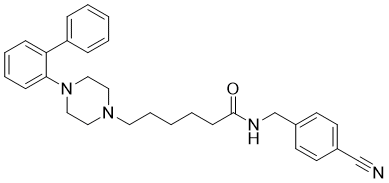
LP-211 is a potent and selective 5-HT7 receptor agonist with a Ki of 0.58 nM at rat cloned 5-HT7 receptors. It exhibits high selectivity against the D2 receptor (Ki=142 nM) and the 5-HT1A receptor (Ki of 188 nM) ((324- and 245-fold, respectively)). LP-211 exhibits agonist characteristics and can cross the blood-brain barrier (EC 50 = 0.60 microM, maximal effect = 82%). LP-211 entered the brain of mice shortly after intraperitoneal injection and quickly made its way into the systemic circulation. Its brain concentration-time profile resembled that of plasma, suggesting that LP-211 diffuses freely and quickly across the blood-brain barrier. N-dealkylation converts LP-211 into the corresponding 1-arylpiperazine metabolite.
Physicochemical Properties
| Molecular Formula | C30H34N4O | |
| Molecular Weight | 466.63 | |
| Exact Mass | 466.273 | |
| Elemental Analysis | C, 77.22; H, 7.34; N, 12.01; O, 3.43 | |
| CAS # | 1052147-86-0 | |
| Related CAS # |
|
|
| PubChem CID | 25107716 | |
| Appearance | Light yellow to yellow solid powder | |
| Density | 1.2±0.1 g/cm3 | |
| Boiling Point | 714.8±60.0 °C at 760 mmHg | |
| Flash Point | 386.1±32.9 °C | |
| Vapour Pressure | 0.0±2.3 mmHg at 25°C | |
| Index of Refraction | 1.632 | |
| LogP | 4.58 | |
| Hydrogen Bond Donor Count | 1 | |
| Hydrogen Bond Acceptor Count | 4 | |
| Rotatable Bond Count | 10 | |
| Heavy Atom Count | 35 | |
| Complexity | 665 | |
| Defined Atom Stereocenter Count | 0 | |
| SMILES | ClC1C=CC=C(C=1C1C(COC2C=CC(=CC=2)C2(CN(C3C=C(C(=O)O)C=CN=3)C2)O)=C(C2CC2)ON=1)Cl |
|
| InChi Key | BQEDZLDNNBDKDS-UHFFFAOYSA-N | |
| InChi Code | InChI=1S/C30H34N4O/c31-23-25-14-16-26(17-15-25)24-32-30(35)13-5-2-8-18-33-19-21-34(22-20-33)29-12-7-6-11-28(29)27-9-3-1-4-10-27/h1,3-4,6-7,9-12,14-17H,2,5,8,13,18-22,24H2,(H,32,35) | |
| Chemical Name | N-[(4-cyanophenyl)methyl]-6-[4-(2-phenylphenyl)piperazin-1-yl]hexanamide | |
| Synonyms |
|
|
| HS Tariff Code | 2934.99.9001 | |
| Storage |
Powder-20°C 3 years 4°C 2 years In solvent -80°C 6 months -20°C 1 month |
|
| Shipping Condition | Room temperature (This product is stable at ambient temperature for a few days during ordinary shipping and time spent in Customs) |
Biological Activity
| Targets | 5-HT7 Receptor ( Ki = 0.58 nM ); 5-HT1A Receptor ( Ki = 188 nM ); D2 Receptor ( Ki = 142 nM ) | |
| ln Vitro |
|
|
| ln Vivo |
|
|
| Enzyme Assay | In the experiment, [3H]-LSD binds to a rat cloned 5-HT7 receptor. 30-gram membranes with 2.5 nM [3H]-LSD and LP-211 (6−9 concentrations) are suspended in 1 milliliter of the incubation buffer (50 milliliters of Tris, 10 milliliters of MgCl2, and 0.5 milliliters of EDTA, pH 7.4). At 37°C, the samples are incubated for 60 minutes. Using GF/A glass fiber filters that have been presoaked in 0.5% polyethylenimine for 30 minutes, the incubation is quickly stopped. An ice-cold buffer (50 mM Tris, pH 7.4) measuring 3 x 53 mL is used to wash the filters. In the presence of 10 μM 5-CT, nonspecific binding is identified. Under these conditions, about 90% of specific binding is determined[1]. | |
| Animal Protocol |
|
|
| References |
[1]. Structural modifications of N-(1,2,3,4-tetrahydronaphthalen-1-yl)-4-aryl-1-piperazinehexanamides: influence on lipophilicity and 5-HT7 receptor activity. Part III. J Med Chem. 2008 Sep 25;51(18):5813-22. [2]. Effect of 5-HT7 receptor agonist, LP-211, on micturition following spinal cord injury in male rats. Am J Transl Res. 2016 Jun 15;8(6):2525-33. eCollection 2016. [3]. LP-211, a selective 5-HT7 receptor agonist, increases novelty-preference and promotes risk-prone behavior in rats. Synapse. 2017 Dec;71(12). |
Solubility Data
| Solubility (In Vitro) |
|
|||
| Solubility (In Vivo) |
Solubility in Formulation 1: ≥ 2.5 mg/mL (5.36 mM) (saturation unknown) in 10% DMSO + 40% PEG300 + 5% Tween80 + 45% Saline (add these co-solvents sequentially from left to right, and one by one), clear solution. For example, if 1 mL of working solution is to be prepared, you can add 100 μL of 25.0 mg/mL clear DMSO stock solution to 400 μL PEG300 and mix evenly; then add 50 μL Tween-80 to the above solution and mix evenly; then add 450 μL normal saline to adjust the volume to 1 mL. Preparation of saline: Dissolve 0.9 g of sodium chloride in 100 mL ddH₂ O to obtain a clear solution. Solubility in Formulation 2: ≥ 2.5 mg/mL (5.36 mM) (saturation unknown) in 10% DMSO + 90% (20% SBE-β-CD in Saline) (add these co-solvents sequentially from left to right, and one by one), clear solution. For example, if 1 mL of working solution is to be prepared, you can add 100 μL of 25.0 mg/mL clear DMSO stock solution to 900 μL of 20% SBE-β-CD physiological saline solution and mix evenly. Preparation of 20% SBE-β-CD in Saline (4°C,1 week): Dissolve 2 g SBE-β-CD in 10 mL saline to obtain a clear solution. Solubility in Formulation 3: ≥ 2.5 mg/mL (5.36 mM) (saturation unknown) in 10% DMSO + 90% Corn Oil (add these co-solvents sequentially from left to right, and one by one), clear solution. For example, if 1 mL of working solution is to be prepared, you can add 100 μL of 25.0 mg/mL clear DMSO stock solution to 900 μL of corn oil and mix evenly. (Please use freshly prepared in vivo formulations for optimal results.) |
| Preparing Stock Solutions | 1 mg | 5 mg | 10 mg | |
| 1 mM | 2.1430 mL | 10.7151 mL | 21.4303 mL | |
| 5 mM | 0.4286 mL | 2.1430 mL | 4.2861 mL | |
| 10 mM | 0.2143 mL | 1.0715 mL | 2.1430 mL |