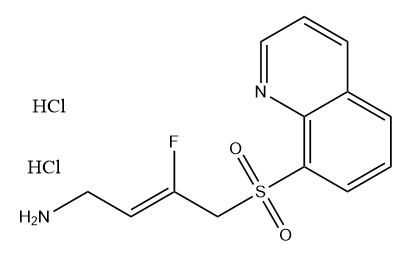
LOX-IN-3 (PXS5505; PXS-5505) dihydrochloride is a novel and oral inhibitor of lysyl oxidase (LOX) with potential usefulness for treatment of a variety of disorders, e.g., fibrosis, cancer and angiogenesis in human subjects as well as in pets and livestock.
Physicochemical Properties
| Molecular Formula | C13H14CLFN2O2S |
| Molecular Weight | 316.778864383698 |
| Exact Mass | 352.021 |
| CAS # | 2409964-23-2 |
| Related CAS # | LOX-IN-3;2409963-83-1;LOX-IN-3 dihydrochloride monohydrate;2414974-55-1 |
| PubChem CID | 146317832 |
| Appearance | Off-white to light yellow solid powder |
| Hydrogen Bond Donor Count | 3 |
| Hydrogen Bond Acceptor Count | 5 |
| Rotatable Bond Count | 4 |
| Heavy Atom Count | 21 |
| Complexity | 430 |
| Defined Atom Stereocenter Count | 0 |
| SMILES | Cl.S(C/C(=C/CN)/F)(C1=CC=CC2=CC=CN=C12)(=O)=O |
| InChi Key | YYYHSAUHJBNINZ-LEOXJOGCSA-N |
| InChi Code | InChI=1S/C13H13FN2O2S.2ClH/c14-11(6-7-15)9-19(17,18)12-5-1-3-10-4-2-8-16-13(10)12;;/h1-6,8H,7,9,15H2;2*1H/b11-6-;; |
| Chemical Name | (Z)-3-fluoro-4-quinolin-8-ylsulfonylbut-2-en-1-amine;dihydrochloride |
| HS Tariff Code | 2934.99.9001 |
| Storage |
Powder-20°C 3 years 4°C 2 years In solvent -80°C 6 months -20°C 1 month Note: Please store this product in a sealed and protected environment, avoid exposure to moisture. |
| Shipping Condition | Room temperature (This product is stable at ambient temperature for a few days during ordinary shipping and time spent in Customs) |
Biological Activity
| ln Vitro | LOX-IN-3 dihydrochloride monohydrate (compound 33) has an IC50 value of less than 10 μM for bovine LOX and less than 1 μM for human LOXL2 activity [1]. LOXL1 and LOXL2 are consistently inhibited by LOX-IN-3 dihydrochloride monohydrate [1]. The monohydrate of LOX-IN-3 dihydrochloride has reduced activity in relation to SSAO/VAP-1 and MAO-B [1]. |
| ln Vivo | LOX-IN-3 dihydrochloride monohydrate (Compound 33) (30 mg/kg; oral; once) suppresses rat lysyl oxidase activity [1]. LOX-IN-3 dihydrochloride monohydrate (10 mg/kg; oral; once daily for 14 days) decreases renal fibrosis in a mouse model of unilateral ureteral obstruction (UUO) [1]. LOX-IN-3 dihydrochloride monohydrate (15 mg/kg; orally; once daily for 21 days) decreases lung fibrosis in rats [1]. |
| Animal Protocol |
Animal/Disease Models: Male Wistar rat[1] Doses: 30 mg/kg Route of Administration: Orally, single dose Experimental Results:Complete elimination of lysyl oxidase activity. Plasma concentrations of the test compound were well below the IC50 after 8 hrs (hrs (hours)), and the recovery half-life was between 2-3 days (ear) and 24 hrs (hrs (hours)) (aorta). Animal/Disease Models: Mouse unilateral ureteral obstruction (UUO) model of acute renal fibrosis [1] Doses: 10 mg/kg Route of Administration: po (oral gavage), one time/day for 14 days Experimental Results: Increased kidney weight and thickness, fiber The area is diminished. Animal/Disease Models: C57Bl/6 mice, bleomycin-induced pulmonary fibrosis model. Doses: 15 mg/kg. Route of Administration: po (oral gavage), one time/day for 21 days. Experimental Results: Dramatically diminished Ashcroft score and lung weight. |
| References |
[1]. Haloallylamine sulfone derivative inhibitors of lysyl oxidases and uses thereof. WO2020024017A1. |
Solubility Data
| Solubility (In Vitro) |
H2O : ≥ 100 mg/mL (~283.09 mM) DMSO : ~33.33 mg/mL (~94.36 mM) |
| Solubility (In Vivo) |
Solubility in Formulation 1: ≥ 2.5 mg/mL (7.08 mM) (saturation unknown) in 10% DMSO + 40% PEG300 + 5% Tween80 + 45% Saline (add these co-solvents sequentially from left to right, and one by one), clear solution. For example, if 1 mL of working solution is to be prepared, you can add 100 μL of 25.0 mg/mL clear DMSO stock solution to 400 μL PEG300 and mix evenly; then add 50 μL Tween-80 to the above solution and mix evenly; then add 450 μL normal saline to adjust the volume to 1 mL. Preparation of saline: Dissolve 0.9 g of sodium chloride in 100 mL ddH₂ O to obtain a clear solution. Solubility in Formulation 2: ≥ 2.5 mg/mL (7.08 mM) (saturation unknown) in 10% DMSO + 90% (20% SBE-β-CD in Saline) (add these co-solvents sequentially from left to right, and one by one), clear solution. For example, if 1 mL of working solution is to be prepared, you can add 100 μL of 25.0 mg/mL clear DMSO stock solution to 900 μL of 20% SBE-β-CD physiological saline solution and mix evenly. Preparation of 20% SBE-β-CD in Saline (4°C,1 week): Dissolve 2 g SBE-β-CD in 10 mL saline to obtain a clear solution. (Please use freshly prepared in vivo formulations for optimal results.) |
| Preparing Stock Solutions | 1 mg | 5 mg | 10 mg | |
| 1 mM | 3.1568 mL | 15.7838 mL | 31.5676 mL | |
| 5 mM | 0.6314 mL | 3.1568 mL | 6.3135 mL | |
| 10 mM | 0.3157 mL | 1.5784 mL | 3.1568 mL |