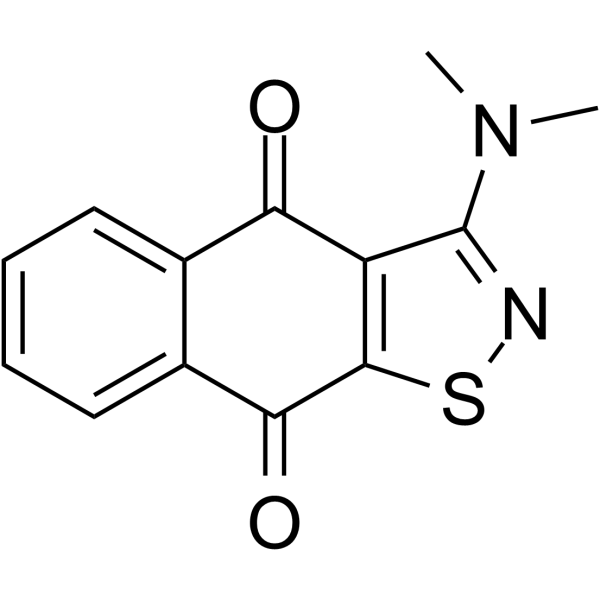
Physicochemical Properties
| Molecular Formula | C13H10N2O2S |
| Molecular Weight | 258.295701503754 |
| Exact Mass | 258.046 |
| CAS # | 2173232-79-4 |
| Related CAS # | 77202-28-9 |
| PubChem CID | 134821683 |
| Appearance | Pink to red solid powder |
| LogP | 2.7 |
| Hydrogen Bond Donor Count | 0 |
| Hydrogen Bond Acceptor Count | 5 |
| Rotatable Bond Count | 1 |
| Heavy Atom Count | 18 |
| Complexity | 385 |
| Defined Atom Stereocenter Count | 0 |
| SMILES | S1C2C(C3C=CC=CC=3C(C=2C(=N1)N(C)C)=O)=O |
| InChi Key | LMNFZYAIQJKFFX-UHFFFAOYSA-N |
| InChi Code | InChI=1S/C13H10N2O2S/c1-15(2)13-9-10(16)7-5-3-4-6-8(7)11(17)12(9)18-14-13/h3-6H,1-2H3 |
| Chemical Name | 3-(dimethylamino)benzo[f][1,2]benzothiazole-4,9-dione |
| Synonyms | LOM612; LOM-612; 2173232-79-4; LO M612; 3-(Dimethylamino)benzo[f][1,2]benzothiazole-4,9-dione; CHEMBL4205434; CID 134821683; . |
| HS Tariff Code | 2934.99.9001 |
| Storage |
Powder-20°C 3 years 4°C 2 years In solvent -80°C 6 months -20°C 1 month Note: Please store this product in a sealed and protected environment (e.g. under nitrogen), avoid exposure to moisture. |
| Shipping Condition | Room temperature (This product is stable at ambient temperature for a few days during ordinary shipping and time spent in Customs) |
Biological Activity
| Targets | Activator of FOXO nuclear-cytoplasmic shuttling (EC50 = 1.5 μM in U2OS-FOXO1a-GFP reporter assay)[1] |
| ln Vitro |
Regardless of CRM-1, LOM612 has a strong effect of activating the nuclear translocation of FOXO, with an EC50 value of 1.5 μM. The FOXO target genes p27 and FasL are expressed more frequently when LOM612 successfully causes endogenous FOXO3a and FOXO1 translocation. On the nuclear export of the endogenous NFKB2 transcription factor in U2OS cells, LOM612 had no effect. With an IC50 of 0.64 μM, LOM612 is cytotoxic to HepG2 cells but does not sensitize non-cancerous THLE2 cells (IC50, 2.76 μM) [1].
LOM612 (10 μM) induced nuclear translocation of FOXO1a in U2OS cells within 1 hour, confirmed by fluorescence microscopy using GFP-tagged FOXO1a. Treatment with LOM612 (10 μM) for 24 hours upregulated FOXO target genes (BIM, p27Kip1, GADD45) in U2OS cells, validated by RT-qPCR analysis. LOM612 (10 μM) reduced viability of androgen receptor-negative prostate cancer PC3 cells by 50% after 72 hours, measured via MTT assay. Minimal effects were observed in normal human fibroblasts at this concentration.[1] |
| Cell Assay |
LOM612 (10 μM) induced nuclear translocation of FOXO1a in U2OS cells within 1 hour, confirmed by fluorescence microscopy using GFP-tagged FOXO1a. Treatment with LOM612 (10 μM) for 24 hours upregulated FOXO target genes (BIM, p27Kip1, GADD45) in U2OS cells, validated by RT-qPCR analysis. LOM612 (10 μM) reduced viability of androgen receptor-negative prostate cancer PC3 cells by 50% after 72 hours, measured via MTT assay. Minimal effects were observed in normal human fibroblasts at this concentration.[1] |
| References |
[1]. Discovery of a Novel, Isothiazolonaphthoquinone-Based Small Molecule Activator of FOXO Nuclear-Cytoplasmic Shuttling. PLoS One. 2016 Dec 9;11(12):e0167491. |
| Additional Infomation |
LOM612 is a novel isothiazolonaphthoquinone compound identified through high-content screening for FOXO1a nuclear translocation activators. It promotes FOXO nuclear accumulation by inhibiting nuclear export machinery without modulating AKT or ERK pathways.[1] Mechanistically, LOM612 induces cell cycle arrest and apoptosis in cancer cells by activating FOXO-dependent transcription of pro-apoptotic (BIM) and cell cycle inhibitory (p27Kip1) genes.[1] It exhibits selective cytotoxicity against androgen receptor-negative prostate cancer cells (PC3) over normal fibroblasts, suggesting therapeutic potential for castration-resistant prostate cancer.[1] |
Solubility Data
| Solubility (In Vitro) | DMSO : ~6 mg/mL (~23.23 mM) |
| Solubility (In Vivo) |
Note: Listed below are some common formulations that may be used to formulate products with low water solubility (e.g. < 1 mg/mL), you may test these formulations using a minute amount of products to avoid loss of samples. Injection Formulations (e.g. IP/IV/IM/SC) Injection Formulation 1: DMSO : Tween 80: Saline = 10 : 5 : 85 (i.e. 100 μL DMSO stock solution → 50 μL Tween 80 → 850 μL Saline) *Preparation of saline: Dissolve 0.9 g of sodium chloride in 100 mL ddH ₂ O to obtain a clear solution. Injection Formulation 2: DMSO : PEG300 :Tween 80 : Saline = 10 : 40 : 5 : 45 (i.e. 100 μL DMSO → 400 μLPEG300 → 50 μL Tween 80 → 450 μL Saline) Injection Formulation 3: DMSO : Corn oil = 10 : 90 (i.e. 100 μL DMSO → 900 μL Corn oil) Example: Take the Injection Formulation 3 (DMSO : Corn oil = 10 : 90) as an example, if 1 mL of 2.5 mg/mL working solution is to be prepared, you can take 100 μL 25 mg/mL DMSO stock solution and add to 900 μL corn oil, mix well to obtain a clear or suspension solution (2.5 mg/mL, ready for use in animals). Injection Formulation 4: DMSO : 20% SBE-β-CD in saline = 10 : 90 [i.e. 100 μL DMSO → 900 μL (20% SBE-β-CD in saline)] *Preparation of 20% SBE-β-CD in Saline (4°C,1 week): Dissolve 2 g SBE-β-CD in 10 mL saline to obtain a clear solution. Injection Formulation 5: 2-Hydroxypropyl-β-cyclodextrin : Saline = 50 : 50 (i.e. 500 μL 2-Hydroxypropyl-β-cyclodextrin → 500 μL Saline) Injection Formulation 6: DMSO : PEG300 : castor oil : Saline = 5 : 10 : 20 : 65 (i.e. 50 μL DMSO → 100 μLPEG300 → 200 μL castor oil → 650 μL Saline) Injection Formulation 7: Ethanol : Cremophor : Saline = 10: 10 : 80 (i.e. 100 μL Ethanol → 100 μL Cremophor → 800 μL Saline) Injection Formulation 8: Dissolve in Cremophor/Ethanol (50 : 50), then diluted by Saline Injection Formulation 9: EtOH : Corn oil = 10 : 90 (i.e. 100 μL EtOH → 900 μL Corn oil) Injection Formulation 10: EtOH : PEG300:Tween 80 : Saline = 10 : 40 : 5 : 45 (i.e. 100 μL EtOH → 400 μLPEG300 → 50 μL Tween 80 → 450 μL Saline) Oral Formulations Oral Formulation 1: Suspend in 0.5% CMC Na (carboxymethylcellulose sodium) Oral Formulation 2: Suspend in 0.5% Carboxymethyl cellulose Example: Take the Oral Formulation 1 (Suspend in 0.5% CMC Na) as an example, if 100 mL of 2.5 mg/mL working solution is to be prepared, you can first prepare 0.5% CMC Na solution by measuring 0.5 g CMC Na and dissolve it in 100 mL ddH2O to obtain a clear solution; then add 250 mg of the product to 100 mL 0.5% CMC Na solution, to make the suspension solution (2.5 mg/mL, ready for use in animals). Oral Formulation 3: Dissolved in PEG400 Oral Formulation 4: Suspend in 0.2% Carboxymethyl cellulose Oral Formulation 5: Dissolve in 0.25% Tween 80 and 0.5% Carboxymethyl cellulose Oral Formulation 6: Mixing with food powders Note: Please be aware that the above formulations are for reference only. InvivoChem strongly recommends customers to read literature methods/protocols carefully before determining which formulation you should use for in vivo studies, as different compounds have different solubility properties and have to be formulated differently. (Please use freshly prepared in vivo formulations for optimal results.) |
| Preparing Stock Solutions | 1 mg | 5 mg | 10 mg | |
| 1 mM | 3.8715 mL | 19.3573 mL | 38.7147 mL | |
| 5 mM | 0.7743 mL | 3.8715 mL | 7.7429 mL | |
| 10 mM | 0.3871 mL | 1.9357 mL | 3.8715 mL |