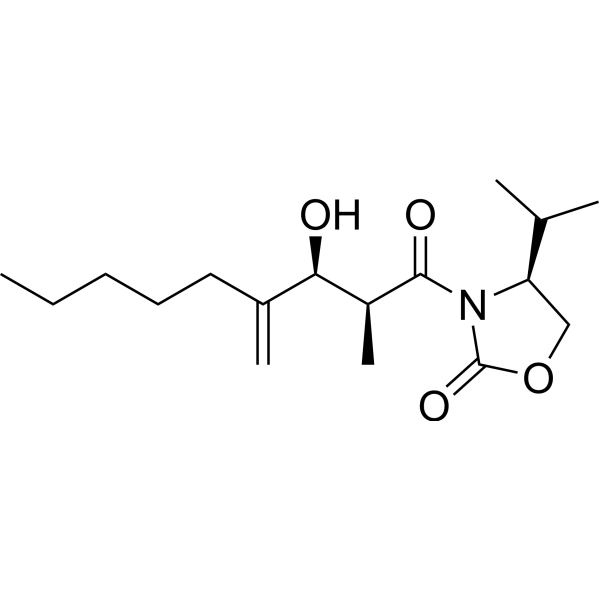
LMT-28 is a novel and potent IL-6 blocker, acting by inhibiting IL-6Rβ (gp130) with IC50 of 5.9 uM (IL-6–induced luciferase activity), selectively inhibiting IL-6–induced phosphorylation of STAT3, JAK2, and gp130.
Physicochemical Properties
| Molecular Formula | C17H29NO4 |
| Molecular Weight | 311.42 |
| Exact Mass | 311.209 |
| CAS # | 1239600-18-0 |
| PubChem CID | 49846977 |
| Appearance | Colorless to light yellow viscous liquid |
| Density | 1.1±0.1 g/cm3 |
| Boiling Point | 452.9±38.0 °C at 760 mmHg |
| Flash Point | 227.7±26.8 °C |
| Vapour Pressure | 0.0±2.5 mmHg at 25°C |
| Index of Refraction | 1.493 |
| LogP | 3.05 |
| Hydrogen Bond Donor Count | 1 |
| Hydrogen Bond Acceptor Count | 4 |
| Rotatable Bond Count | 8 |
| Heavy Atom Count | 22 |
| Complexity | 419 |
| Defined Atom Stereocenter Count | 3 |
| SMILES | O1C(N(C([C@@H](C)[C@@H](C(=C)CCCCC)O)=O)[C@H](C1)C(C)C)=O |
| InChi Key | UDXWSYOXIRPYFK-RRFJBIMHSA-N |
| InChi Code | InChI=1S/C17H29NO4/c1-6-7-8-9-12(4)15(19)13(5)16(20)18-14(11(2)3)10-22-17(18)21/h11,13-15,19H,4,6-10H2,1-3,5H3/t13-,14+,15+/m0/s1 |
| Chemical Name | (4S)-3-[(2S,3S)-3-hydroxy-2-methyl-4-methylidenenonanoyl]-4-propan-2-yl-1,3-oxazolidin-2-one |
| Synonyms | LMT28 LMT 28 LMT-28 |
| HS Tariff Code | 2934.99.9001 |
| Storage |
Powder-20°C 3 years 4°C 2 years In solvent -80°C 6 months -20°C 1 month |
| Shipping Condition | Room temperature (This product is stable at ambient temperature for a few days during ordinary shipping and time spent in Customs) |
Biological Activity
| ln Vitro | At 50 μM, LMT-28 has an IC50 value of 5.9 μM and can inhibit IL-6-induced luciferase activity by almost 90%. LMT-28 (1–100 μM; 1 hour) specifically inhibits IL-6-induced STAT3, JAK2, and gp130 [1]. Cell erythroid cell line TF-1 phosphorylation is inhibited by LMT-28 (1–100 μM; 72 hours) in relation to IL-6-induced phosphorylation of human tissue. |
| ln Vivo | CIA is attenuated by LMT-28 (0-0.5 mg/kg; applied topically once daily for 15 days)[1]. LMT-28 simulates the development of face inflammation (0.25 or 1 mg/kg; po). By directly binding to gp130, the -28 bridge inhibits gp130's reaction to the IL-6/IL-6Rα combination [1]. |
| Cell Assay |
Cell proliferation analysis [1] Cell erythroid cell line TF-1 phosphorylation [1]. Cell Types: TF-1 cells (1 ng/mL IL-6 induced) Tested Concentrations: 1, 10, 100, 1000, 10000 nM Incubation Duration: 72 hrs (hours) Experimental Results: Dramatically inhibited IL-6-induced TF-1 proliferation, IC50 The value is 7.5 μM. Western Blot Analysis[1] Cell Types: HepG2 cells (treated with 10 ng/mL IL-6) Tested Concentrations: 1, 3, 10, 30 and 100 μM Incubation Duration: 1 hour Experimental Results: Inhibition of IL-6-induced phosphorylated STAT3 , JAK2 and gp130. |
| Animal Protocol |
Animal/Disease Models: Sixweeks old male DBA/1J mice (collagen-induced arthritis mice, CIA) [1] Doses: 0-0.5 mg/kg Route of Administration: Oral; one time/day for 15 days Experimental Results: Serum cartilage Oligomeric matrix protein (COMP) levels were Dramatically diminished by 50%, serum amyloid P (SAP) levels were Dramatically diminished by 55%, and anti-CII IgG levels were Dramatically diminished by 62%. |
| References |
[1]. A Novel Small-Molecule Inhibitor Targeting the IL-6 Receptor β Subunit, Glycoprotein 130. J Immunol. 2015 Jul 1;195(1):237-45. |
Solubility Data
| Solubility (In Vitro) | DMSO : ~100 mg/mL (~321.11 mM) |
| Solubility (In Vivo) |
Solubility in Formulation 1: 2.5 mg/mL (8.03 mM) in 10% DMSO + 40% PEG300 + 5% Tween80 + 45% Saline (add these co-solvents sequentially from left to right, and one by one), suspension solution; with sonication. For example, if 1 mL of working solution is to be prepared, you can add 100 μL of 25.0 mg/mL clear DMSO stock solution to 400 μL PEG300 and mix evenly; then add 50 μL Tween-80 to the above solution and mix evenly; then add 450 μL normal saline to adjust the volume to 1 mL. Preparation of saline: Dissolve 0.9 g of sodium chloride in 100 mL ddH₂ O to obtain a clear solution. Solubility in Formulation 2: 2.5 mg/mL (8.03 mM) in 10% DMSO + 90% (20% SBE-β-CD in Saline) (add these co-solvents sequentially from left to right, and one by one), suspension solution; with ultrasonication. For example, if 1 mL of working solution is to be prepared, you can add 100 μL of 25.0 mg/mL clear DMSO stock solution to 900 μL of 20% SBE-β-CD physiological saline solution and mix evenly. Preparation of 20% SBE-β-CD in Saline (4°C,1 week): Dissolve 2 g SBE-β-CD in 10 mL saline to obtain a clear solution. Solubility in Formulation 3: ≥ 2.5 mg/mL (8.03 mM) (saturation unknown) in 10% DMSO + 90% Corn Oil (add these co-solvents sequentially from left to right, and one by one), clear solution. For example, if 1 mL of working solution is to be prepared, you can add 100 μL of 25.0 mg/mL clear DMSO stock solution to 900 μL of corn oil and mix evenly. (Please use freshly prepared in vivo formulations for optimal results.) |
| Preparing Stock Solutions | 1 mg | 5 mg | 10 mg | |
| 1 mM | 3.2111 mL | 16.0555 mL | 32.1110 mL | |
| 5 mM | 0.6422 mL | 3.2111 mL | 6.4222 mL | |
| 10 mM | 0.3211 mL | 1.6055 mL | 3.2111 mL |