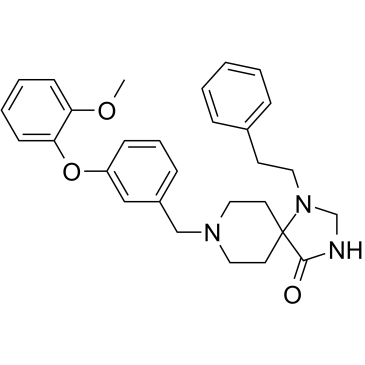
LMD-009 (LMD009) is a novel and potent nonpeptide CCR8 agonist with anti-inflammatory activity. LMD-009 selectively stimulated CCR8 among the 20 identified human chemokine receptors. It mediated chemotaxis, inositol phosphate accumulation, and calcium release with high potencies (EC50 from 11 to 87 nM) and with efficacies similar to that of the endogenous agonist CCL1, and it competed for 125I-CCL1 binding with an affinity of 66 nM.
Physicochemical Properties
| Molecular Formula | C29H33N3O3 |
| Molecular Weight | 471.59062743187 |
| Exact Mass | 471.252 |
| CAS # | 950195-51-4 |
| PubChem CID | 91032188 |
| Appearance | White to off-white solid powder |
| LogP | 4.8 |
| Hydrogen Bond Donor Count | 1 |
| Hydrogen Bond Acceptor Count | 5 |
| Rotatable Bond Count | 8 |
| Heavy Atom Count | 35 |
| Complexity | 674 |
| Defined Atom Stereocenter Count | 0 |
| SMILES | O=C1C2(CCN(CC3C=C(OC4C(OC)=CC=CC=4)C=CC=3)CC2)N(CCC2C=CC=CC=2)CN1 |
| InChi Key | MRXASGVUQJVWMP-UHFFFAOYSA-N |
| InChi Code | InChI=1S/C29H33N3O3/c1-34-26-12-5-6-13-27(26)35-25-11-7-10-24(20-25)21-31-18-15-29(16-19-31)28(33)30-22-32(29)17-14-23-8-3-2-4-9-23/h2-13,20H,14-19,21-22H2,1H3,(H,30,33) |
| Chemical Name | 8-[[3-(2-methoxyphenoxy)phenyl]methyl]-1-(2-phenylethyl)-1,3,8-triazaspiro[4.5]decan-4-one |
| HS Tariff Code | 2934.99.9001 |
| Storage |
Powder-20°C 3 years 4°C 2 years In solvent -80°C 6 months -20°C 1 month |
| Shipping Condition | Room temperature (This product is stable at ambient temperature for a few days during ordinary shipping and time spent in Customs) |
Biological Activity
| ln Vitro | In harvested COS-7 cells expressing human CCR8, LMD-009 (0 -20 nM; 90 min) increases the formation of phosphoinositides [1]. LMD-009 (0-100 nM; 90 min) 1 h) mediates LMD-009 (0.1 nM-100 μM; 40 min)-induced migration of L1.2 cells [1]. LMD-009 (0–10 μM; 90 min) releases calcium from COS-Chinese hamster ovarian cells [1]. Other human chemokine receptors are not antagonistically active to LMD-009 (0-10 nM; 90 min) [1]. Molecular reactions in 7 cells deviate from CCR8 mutations [1]. |
| Cell Assay |
Cell Viability Assay[1] Cell Types: COS-7 cells Tested Concentrations: 0-20 nM Incubation Duration: 90 minutes Experimental Results: Stimulates the accumulation of phosphoinositide in COS-7 cells expressing human CCR8 receptor with an EC50 value of 11 nM. Does not inhibit any receptors of other human chemokine receptors. Cell viability assay [1] Cell Types: Chinese hamster ovary cells Tested Concentrations: 0-100 nM Incubation Duration: 1 hour Experimental Results: Calcium release from Chinese hamster ovary cells is regulated, EC50 value is 87 nM. Cell migration assay [1] Cell Types: Lymphocyte L1.2 cells. Tested Concentrations: 0.1 nM- 100 μM Incubation Duration: 40 minutes Experimental Results: The Ki value of L1.2 cells is 66 nM, and it specifically binds 125I-CCL1. |
| References |
[1]. Molecular interaction of a potent nonpeptide agonist with the chemokine receptor CCR8. Mol Pharmacol. 2007 Aug;72(2):327-40. |
Solubility Data
| Solubility (In Vitro) | DMSO : ~250 mg/mL (~530.12 mM) |
| Solubility (In Vivo) |
Solubility in Formulation 1: ≥ 2.08 mg/mL (4.41 mM) (saturation unknown) in 10% DMSO + 40% PEG300 + 5% Tween80 + 45% Saline (add these co-solvents sequentially from left to right, and one by one), clear solution. For example, if 1 mL of working solution is to be prepared, you can add 100 μL of 20.8 mg/mL clear DMSO stock solution to 400 μL PEG300 and mix evenly; then add 50 μL Tween-80 to the above solution and mix evenly; then add 450 μL normal saline to adjust the volume to 1 mL. Preparation of saline: Dissolve 0.9 g of sodium chloride in 100 mL ddH₂ O to obtain a clear solution. Solubility in Formulation 2: ≥ 2.08 mg/mL (4.41 mM) (saturation unknown) in 10% DMSO + 90% (20% SBE-β-CD in Saline) (add these co-solvents sequentially from left to right, and one by one), clear solution. For example, if 1 mL of working solution is to be prepared, you can add 100 μL of 20.8 mg/mL clear DMSO stock solution to 900 μL of 20% SBE-β-CD physiological saline solution and mix evenly. Preparation of 20% SBE-β-CD in Saline (4°C,1 week): Dissolve 2 g SBE-β-CD in 10 mL saline to obtain a clear solution. Solubility in Formulation 3: ≥ 2.08 mg/mL (4.41 mM) (saturation unknown) in 10% DMSO + 90% Corn Oil (add these co-solvents sequentially from left to right, and one by one), clear solution. For example, if 1 mL of working solution is to be prepared, you can add 100 μL of 20.8 mg/mL clear DMSO stock solution to 900 μL of corn oil and mix evenly. (Please use freshly prepared in vivo formulations for optimal results.) |
| Preparing Stock Solutions | 1 mg | 5 mg | 10 mg | |
| 1 mM | 2.1205 mL | 10.6024 mL | 21.2049 mL | |
| 5 mM | 0.4241 mL | 2.1205 mL | 4.2410 mL | |
| 10 mM | 0.2120 mL | 1.0602 mL | 2.1205 mL |