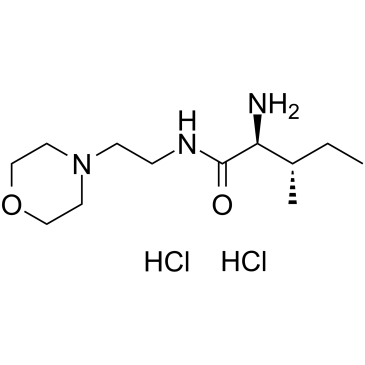
LM11A-31 HCl,a non-peptide p75NTR (neurotrophin receptor p75) modulator, is an orally active and potent proNGF (nerve growth factor) antagonist,in preventing diabetes-induced BRB breakdown. Treating macular oedema, a leading cause of blindness in people with diabetes, may be made easier, safer, and less invasive by targeting p75NTR signalling with the oral bioavailable receptor modulator LM11A-31. A derivative of amino acid that has a high blood-brain barrier permeability and inhibits p75-mediated cell death is LM11A-31 dihydrochloride. M11A-31 dihydrochloride reverses cholinergic neurite dystrophy in mouse models of Alzheimer's disease that progress from a mid- to a late stage.
Physicochemical Properties
| Molecular Formula | C12H25N3O2 |
| Molecular Weight | 316.267 |
| Exact Mass | 243.195 |
| Elemental Analysis | C, 45.57; H, 8.61; Cl, 22.42; N, 13.29; O, 10.12 |
| CAS # | 1243259-19-9 |
| Related CAS # | (Rac)-LM11A-31 dihydrochloride; 1214672-15-7 |
| PubChem CID | 18604758 |
| Appearance | White to off-white solid powder |
| LogP | 1.286 |
| Hydrogen Bond Donor Count | 2 |
| Hydrogen Bond Acceptor Count | 4 |
| Rotatable Bond Count | 6 |
| Heavy Atom Count | 17 |
| Complexity | 230 |
| Defined Atom Stereocenter Count | 2 |
| SMILES | CCC(C)C(C(=O)NCCN1CCOCC1)N.Cl.Cl |
| InChi Key | LLIHJRRZJDEKLB-ULEGLUPFSA-N |
| InChi Code | InChI=1S/C12H25N3O2.2ClH/c1-3-10(2)11(13)12(16)14-4-5-15-6-8-17-9-7-15;;/h10-11H,3-9,13H2,1-2H3,(H,14,16);2*1H/t10-,11-;;/m0../s1 |
| Chemical Name | (2S,3S)-2-amino-3-methyl-N-(2-morpholin-4-ylethyl)pentanamide;dihydrochloride |
| Synonyms | LM11A-31 HCl; LM11A-31 hydrochloride; LM11A-31; LM11A 31; LM11A31; LM 11A-31; LM 11A31; LM-11A-31; |
| HS Tariff Code | 2934.99.9001 |
| Storage |
Powder-20°C 3 years 4°C 2 years In solvent -80°C 6 months -20°C 1 month Note: Please store this product in a sealed and protected environment (e.g. under nitrogen), avoid exposure to moisture. |
| Shipping Condition | Room temperature (This product is stable at ambient temperature for a few days during ordinary shipping and time spent in Customs) |
Biological Activity
| Targets | proNGF |
| ln Vivo |
LM11A-31 (oral gavage; 50 mg kg/day for 4 weeks) significantly reduces the build-up of proNGF and maintains the integrity of BRB[1]. LM11A-31 (orally; 50 or 75 mg/kg) given for three months beginning at 6–8 months of age prevents and/or reverses atrophy of basal forebrain cholinergic neurites and cortical dystrophic neurites in mid-stage male APPL/S mice[2]. |
| Animal Protocol |
Male C57BL/6 J mice 50 mg kg/day Oral gavage; for 4 weeks |
| References |
[1]. Modulation of the p75 neurotrophin receptor using LM11A-31 prevents diabetes-induced retinalvascular permeability in mice via inhibition of inflammation and the RhoA kinase pathway. Diabetologia. 2019 Aug;62(8):1488-1500. [2]. A small molecule p75NTR ligand, LM11A-31, reverses cholinergic neurite dystrophy in Alzheimer's disease mouse models with mid- to late-stage disease progression. PLoS One. 2014 Aug 25;9(8):e102136. |
Solubility Data
| Solubility (In Vitro) | H2O: ~100 mg/mL (~316.2 mM) |
| Solubility (In Vivo) |
Solubility in Formulation 1: 100 mg/mL (316.19 mM) in PBS (add these co-solvents sequentially from left to right, and one by one), clear solution; with sonication. (Please use freshly prepared in vivo formulations for optimal results.) |
| Preparing Stock Solutions | 1 mg | 5 mg | 10 mg | |
| 1 mM | 3.1619 mL | 15.8093 mL | 31.6186 mL | |
| 5 mM | 0.6324 mL | 3.1619 mL | 6.3237 mL | |
| 10 mM | 0.3162 mL | 1.5809 mL | 3.1619 mL |