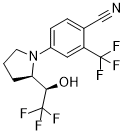
LGD-4033 (also known as VK-5211 and Ligandrol) is a novel, potent and selective androgen receptor modulator (SARM) and is being investigated by Ligand Pharmaceuticals for treatment of conditions such as muscle wasting and osteoporosis. LGD-4033 was safe, had favorable pharmacokinetic profile.
Physicochemical Properties
| Molecular Formula | C14H12F6N2O | |
| Molecular Weight | 338.25 | |
| Exact Mass | 338.085 | |
| Elemental Analysis | C, 49.71; H, 3.58; F, 33.70; N, 8.28; O, 4.73 | |
| CAS # | 1165910-22-4 | |
| Related CAS # |
|
|
| PubChem CID | 44137686 | |
| Appearance | White to off-white solid powder | |
| Density | 1.5±0.1 g/cm3 | |
| Boiling Point | 439.9±45.0 °C at 760 mmHg | |
| Flash Point | 219.8±28.7 °C | |
| Vapour Pressure | 0.0±1.1 mmHg at 25°C | |
| Index of Refraction | 1.496 | |
| LogP | 4.04 | |
| Hydrogen Bond Donor Count | 1 | |
| Hydrogen Bond Acceptor Count | 9 | |
| Rotatable Bond Count | 2 | |
| Heavy Atom Count | 23 | |
| Complexity | 468 | |
| Defined Atom Stereocenter Count | 2 | |
| SMILES | C1C[C@@H](N(C1)C2=CC(=C(C=C2)C#N)C(F)(F)F)[C@H](C(F)(F)F)O |
|
| InChi Key | OPSIVAKKLQRWKC-VXGBXAGGSA-N | |
| InChi Code | InChI=1S/C14H12F6N2O/c15-13(16,17)10-6-9(4-3-8(10)7-21)22-5-1-2-11(22)12(23)14(18,19)20/h3-4,6,11-12,23H,1-2,5H2/t11-,12-/m1/s1 | |
| Chemical Name |
|
|
| Synonyms |
|
|
| HS Tariff Code | 2934.99.9001 | |
| Storage |
Powder-20°C 3 years 4°C 2 years In solvent -80°C 6 months -20°C 1 month |
|
| Shipping Condition | Room temperature (This product is stable at ambient temperature for a few days during ordinary shipping and time spent in Customs) |
Biological Activity
| Targets | AR/androgen receptor (Ki = 1 nM) |
| ln Vitro | The use of selective androgen receptor modulators (SARM) in sports is prohibited by the World Anti-Doping Agency (WADA) due to their potential as performance-enhancing drugs, offering an unfair advantage. LGD-4033 is a SARM known for its similarities to anabolic steroids and can be easily purchased online, leading to increased availability and misuse. Adverse analytical findings have revealed the presence of SARMs in dietary supplements. Although LGD-4033 misuse has been reported in human sports over the years, concerns also arise regarding its illicit use in animal sports, including camel racing. Although various studies have investigated the metabolism of LGD-4033 in humans, horse, and other species, there is limited research specifically dedicated to racing camels. The findings indicated the presence of 12 phase I metabolites and 1 phase II metabolite. Hydroxylation was responsible for the formation of the main phase I metabolites that were identified. A glucuronic acid conjugate of the parent drug was observed in this study, but no sulfonic acid conjugate was found. The possible chemical structures of these metabolites, along with their fragmentation patterns, were identified using MS. Conclusions: These findings provide valuable insights into the metabolism of LGD-4033 in camels and aid in the development of effective doping control methods for the detection of SARMs in camel racing[2]. |
| ln Vivo | In the 3-mg ligandrol group, bone structural properties were improved (trabecular number: 38 ± 8 vs. 35 ± 7 (femur), 26 ± 7 vs. 22 ± 6 (L), 12 ± 5 vs. 6 ± 3 (tibia) and serum phosphorus levels (1.81 ± 0.17 vs.1.41 ± 0.17 mmol/l), uterus (0.43 ± 0.04 vs. 0.11 ± 0.02 g), and heart (1.13 ± 0.11 vs. 1.01 ± 0.08 g) weights were increased compared to the OVX group. Biomechanical parameters were not changed. Low and medium doses did not affect bone tissue and had fewer side effects. Body weight and food intake were not affected by ligandrol; OVX led to an increase in these parameters and worsened all bone parameters. Conclusion: Ligandrol at high dose showed a subtle anabolic effect on structural properties without any improvement in biomechanical properties of osteoporotic bones. Considering side effects of ligandrol at this dose, its further investigation for the therapy of postmenopausal osteoporosis should be reevaluated[1]. |
| Enzyme Assay | This study focuses on the in vitro metabolism of LGD-4033 in homogenized camel liver using liquid chromatography–high-resolution mass spectrometry (LC-HRMS) to identify and characterize the metabolites[2]. |
| Animal Protocol | Three-month-old Sprague Dawley rats were either ovariectomized (OVX, n = 60) or left intact (NON-OVX, n = 15). After 9 weeks, OVX rats were divided into four groups: untreated OVX (n = 15) group and three OVX groups (each of 15 rats) treated with ligandrol orally at doses of 0.03, 0.3, or 3 mg/kg body weight. After five weeks, lumbar vertebral bodies (L), tibiae, and femora were examined using micro-computed tomographical, biomechanical, ashing, and gene expression analyses[1]. |
| References |
[1]. Effects of ligandrol as a selective androgen receptor modulator in a rat model for osteoporosis. J Bone Miner Metab. 2023 Nov;41(6):741-751. [2]. Investigation of in vitro generated metabolites of LGD-4033, a selective androgen receptor modulator, in homogenized camel liver for anti-doping applications. Rapid Commun Mass Spectrom. 2023 Nov 30;37(22):e9633. |
| Additional Infomation | Ligandrol is an investigational selective androgen receptor modulator (SARM) for treatment of conditions such as muscle wasting and osteoporosis. |
Solubility Data
| Solubility (In Vitro) |
|
|||
| Solubility (In Vivo) |
Note: Listed below are some common formulations that may be used to formulate products with low water solubility (e.g. < 1 mg/mL), you may test these formulations using a minute amount of products to avoid loss of samples. Injection Formulations (e.g. IP/IV/IM/SC) Injection Formulation 1: DMSO : Tween 80: Saline = 10 : 5 : 85 (i.e. 100 μL DMSO stock solution → 50 μL Tween 80 → 850 μL Saline) *Preparation of saline: Dissolve 0.9 g of sodium chloride in 100 mL ddH ₂ O to obtain a clear solution. Injection Formulation 2: DMSO : PEG300 :Tween 80 : Saline = 10 : 40 : 5 : 45 (i.e. 100 μL DMSO → 400 μLPEG300 → 50 μL Tween 80 → 450 μL Saline) Injection Formulation 3: DMSO : Corn oil = 10 : 90 (i.e. 100 μL DMSO → 900 μL Corn oil) Example: Take the Injection Formulation 3 (DMSO : Corn oil = 10 : 90) as an example, if 1 mL of 2.5 mg/mL working solution is to be prepared, you can take 100 μL 25 mg/mL DMSO stock solution and add to 900 μL corn oil, mix well to obtain a clear or suspension solution (2.5 mg/mL, ready for use in animals). Injection Formulation 4: DMSO : 20% SBE-β-CD in saline = 10 : 90 [i.e. 100 μL DMSO → 900 μL (20% SBE-β-CD in saline)] *Preparation of 20% SBE-β-CD in Saline (4°C,1 week): Dissolve 2 g SBE-β-CD in 10 mL saline to obtain a clear solution. Injection Formulation 5: 2-Hydroxypropyl-β-cyclodextrin : Saline = 50 : 50 (i.e. 500 μL 2-Hydroxypropyl-β-cyclodextrin → 500 μL Saline) Injection Formulation 6: DMSO : PEG300 : castor oil : Saline = 5 : 10 : 20 : 65 (i.e. 50 μL DMSO → 100 μLPEG300 → 200 μL castor oil → 650 μL Saline) Injection Formulation 7: Ethanol : Cremophor : Saline = 10: 10 : 80 (i.e. 100 μL Ethanol → 100 μL Cremophor → 800 μL Saline) Injection Formulation 8: Dissolve in Cremophor/Ethanol (50 : 50), then diluted by Saline Injection Formulation 9: EtOH : Corn oil = 10 : 90 (i.e. 100 μL EtOH → 900 μL Corn oil) Injection Formulation 10: EtOH : PEG300:Tween 80 : Saline = 10 : 40 : 5 : 45 (i.e. 100 μL EtOH → 400 μLPEG300 → 50 μL Tween 80 → 450 μL Saline) Oral Formulations Oral Formulation 1: Suspend in 0.5% CMC Na (carboxymethylcellulose sodium) Oral Formulation 2: Suspend in 0.5% Carboxymethyl cellulose Example: Take the Oral Formulation 1 (Suspend in 0.5% CMC Na) as an example, if 100 mL of 2.5 mg/mL working solution is to be prepared, you can first prepare 0.5% CMC Na solution by measuring 0.5 g CMC Na and dissolve it in 100 mL ddH2O to obtain a clear solution; then add 250 mg of the product to 100 mL 0.5% CMC Na solution, to make the suspension solution (2.5 mg/mL, ready for use in animals). Oral Formulation 3: Dissolved in PEG400 Oral Formulation 4: Suspend in 0.2% Carboxymethyl cellulose Oral Formulation 5: Dissolve in 0.25% Tween 80 and 0.5% Carboxymethyl cellulose Oral Formulation 6: Mixing with food powders Note: Please be aware that the above formulations are for reference only. InvivoChem strongly recommends customers to read literature methods/protocols carefully before determining which formulation you should use for in vivo studies, as different compounds have different solubility properties and have to be formulated differently. (Please use freshly prepared in vivo formulations for optimal results.) |
| Preparing Stock Solutions | 1 mg | 5 mg | 10 mg | |
| 1 mM | 2.9564 mL | 14.7820 mL | 29.5639 mL | |
| 5 mM | 0.5913 mL | 2.9564 mL | 5.9128 mL | |
| 10 mM | 0.2956 mL | 1.4782 mL | 2.9564 mL |