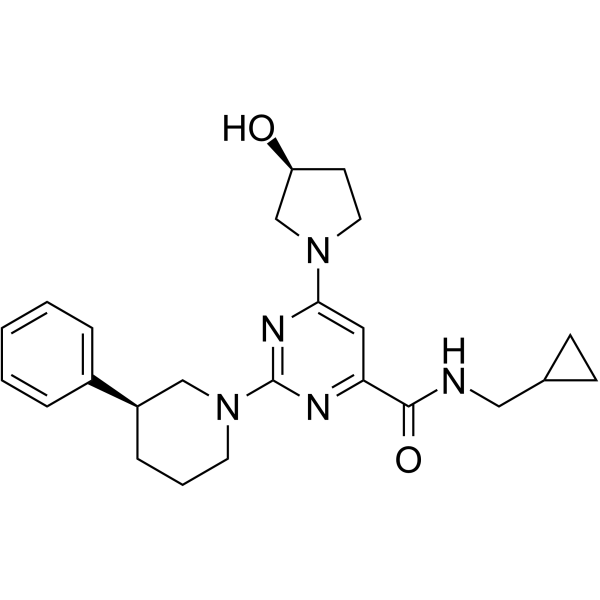
Physicochemical Properties
| Molecular Formula | C20H15BRN4O |
| Molecular Weight | 407.263303041458 |
| Exact Mass | 421.247 |
| CAS # | 2393840-15-6 |
| PubChem CID | 145998143 |
| Appearance | White to off-white solid powder |
| LogP | 3.2 |
| Hydrogen Bond Donor Count | 2 |
| Hydrogen Bond Acceptor Count | 6 |
| Rotatable Bond Count | 6 |
| Heavy Atom Count | 31 |
| Complexity | 609 |
| Defined Atom Stereocenter Count | 2 |
| SMILES | BrC1C=CC=CC=1N1C(C)=C(C(NC2C=CC3C=CC=CC=3N=2)=O)C=N1 |
| InChi Key | GFHJYPQZBBHOCC-UXHICEINSA-N |
| InChi Code | InChI=1S/C24H31N5O2/c30-20-10-12-28(16-20)22-13-21(23(31)25-14-17-8-9-17)26-24(27-22)29-11-4-7-19(15-29)18-5-2-1-3-6-18/h1-3,5-6,13,17,19-20,30H,4,7-12,14-16H2,(H,25,31)/t19-,20+/m1/s1 |
| Chemical Name | N-(cyclopropylmethyl)-6-[(3S)-3-hydroxypyrrolidin-1-yl]-2-[(3S)-3-phenylpiperidin-1-yl]pyrimidine-4-carboxamide |
| HS Tariff Code | 2934.99.9001 |
| Storage |
Powder-20°C 3 years 4°C 2 years In solvent -80°C 6 months -20°C 1 month |
| Shipping Condition | Room temperature (This product is stable at ambient temperature for a few days during ordinary shipping and time spent in Customs) |
Biological Activity
| ln Vitro | In neural cells, LEI-401 decreases a variety of NAEs, including anandamide, in a way that is dependent on NAPE-PLD. With an IC50 of 0.86 μM, LEI-401 (0.04 – 20 μM; 30 min) dose-dependently decreased NAPE-PLD staining in hNAPE-transfected HEK293T cells. In Neuro-2a cells, LEI-401 lowers NAE levels, but not in NAPE-PLD KO cells [1]. |
| ln Vivo | In mice, LEI-401 (30 mg/kg; i.p.) decreases fear extinction[1]. Moreover, HPA axis signaling is activated by LEI-401[1]. t1/2, Cmax, tmax, AUClast, and F values of 2.5 hours, 1370 ng/mL, 2 hours, 6760 h*ng/mL, and 25%, respectively, were observed with LEI-401 (10 mg/kg; po) treatment[1]. Cmax, tmax, AUClast, and F values for LEI-401 (30 mg/kg; ip) dosing were 10,300 ng/mL, 1 hour, 38,600 h*ng/mL, and 48%, respectively[1]. |
| Animal Protocol |
Animal/Disease Models: Male 7–12weeks old C57BL/6J mice[1] Doses: 30 mg/kg Route of Administration: Ip Experimental Results: Produced a significant increase in freezing as compared to vehicle. Animal/Disease Models: C57BL/6J mice[1] Doses: 10 mg/kg Route of Administration: Po (pharmacokinetic/PK Analysis) Experimental Results: The t1/2, Cmax, tmax, AUClast, and F values were 2.5 hrs (hours), 1370 ng/mL, 2 hrs (hours), 6760 h*ng/mL, and 25 %, respectively. |
| References |
[1]. Discovery of a NAPE-PLD inhibitor that modulates emotional behavior in mice. Nat Chem Biol. 2020;16(6):667-675. |
Solubility Data
| Solubility (In Vitro) | DMSO: 100 mg/mL (237.23 mM) |
| Solubility (In Vivo) |
Solubility in Formulation 1: ≥ 2.5 mg/mL (5.93 mM) (saturation unknown) in 10% DMSO + 90% Corn Oil (add these co-solvents sequentially from left to right, and one by one), clear solution. For example, if 1 mL of working solution is to be prepared, you can add 100 μL of 25.0 mg/mL clear DMSO stock solution to 900 μL of corn oil and mix evenly. (Please use freshly prepared in vivo formulations for optimal results.) |
| Preparing Stock Solutions | 1 mg | 5 mg | 10 mg | |
| 1 mM | 2.4554 mL | 12.2772 mL | 24.5543 mL | |
| 5 mM | 0.4911 mL | 2.4554 mL | 4.9109 mL | |
| 10 mM | 0.2455 mL | 1.2277 mL | 2.4554 mL |