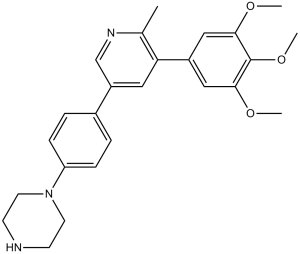
LDN-214117 (LDN 214117; LDN214117) is a novel, potent and selective ALK2 (BMP type I receptor kinase) inhibitor with potential anticancer activity. It inhibits ALK2 with an IC50 of 24 nM.
Physicochemical Properties
| Molecular Formula | C25H29N3O3 | |
| Molecular Weight | 419.52 | |
| Exact Mass | 419.22 | |
| CAS # | 1627503-67-6 | |
| Related CAS # |
|
|
| PubChem CID | 91754554 | |
| Appearance | Light yellow to yellow solid powder | |
| Density | 1.1±0.1 g/cm3 | |
| Boiling Point | 567.9±50.0 °C at 760 mmHg | |
| Flash Point | 297.3±30.1 °C | |
| Vapour Pressure | 0.0±1.6 mmHg at 25°C | |
| Index of Refraction | 1.573 | |
| LogP | 3.27 | |
| Hydrogen Bond Donor Count | 1 | |
| Hydrogen Bond Acceptor Count | 6 | |
| Rotatable Bond Count | 6 | |
| Heavy Atom Count | 31 | |
| Complexity | 522 | |
| Defined Atom Stereocenter Count | 0 | |
| InChi Key | BHUXVRVMMYAXKN-UHFFFAOYSA-N | |
| InChi Code | InChI=1S/C25H29N3O3/c1-17-22(19-14-23(29-2)25(31-4)24(15-19)30-3)13-20(16-27-17)18-5-7-21(8-6-18)28-11-9-26-10-12-28/h5-8,13-16,26H,9-12H2,1-4H3 | |
| Chemical Name | 1-(4-(6-methyl-5-(3,4,5-trimethoxyphenyl)pyridin-3-yl)phenyl)piperazine | |
| Synonyms |
|
|
| HS Tariff Code | 2934.99.9001 | |
| Storage |
Powder-20°C 3 years 4°C 2 years In solvent -80°C 6 months -20°C 1 month |
|
| Shipping Condition | Room temperature (This product is stable at ambient temperature for a few days during ordinary shipping and time spent in Customs) |
Biological Activity
| Targets |
LDN-214117 specifically targets bone morphogenetic protein (BMP) type I receptor ALK2 (wild-type ALK2 IC50 = 1.8 nM) [1] LDN-214117 maintains unaltered binding affinity for fibrodysplasia ossificans progressiva (FOP)-causing ALK2 mutants (ALK2 R206H IC50 = 2.1 nM; ALK2 G328R IC50 = 1.9 nM) [1] |
| ln Vitro |
At an IC50 of 24 nM, LDN-214117 exhibits good selectivity and inhibition of ALK2 kinase proteins[1]. LDN-214117 has kinase activity against ALK1, ALK3, and ALK5, with corresponding IC50 values of 27 nM, 1,171 nM, and 3,000 nM[1]. Using IC50 values of 100 nM, 1,022 nM, and 960 nM, respectively, LDN-214117 shows comparatively specific inhibition for BMP6, BMP2, and BMP4[1]. LDN-214117 exhibits an IC50 value of 16,000 nM for the suppression of TGF-β1-induced transcriptional activity[1]. ID1 targeting is caused by a BMP signaling route other than SMAD-dependent one, and LDN-214117 (5 μM, 30 min, 3 h, and 24 h) exhibits time-dependent effect activity on gene regulation level[2]. LDN-214117 (5 μM, 24-120 h) inhibits lung cancer cells LCLC-103H's viability, growth, and induces apoptosis[2]. The chemotactic potential and wound healing of LCLC-103H cells are suppressed by LDN-214117 (5 μM, 0-48 h)[2]. Multicellular LCLC-103H spheroids grow less quickly when exposed to LDN-214117 (5 μM, 48 h)[2]. In recombinant wild-type and mutant ALK2 kinase assays, LDN-214117 dose-dependently inhibits kinase activity, blocking BMP-induced Smad1/5/8 phosphorylation. At 10 nM, it inhibits wild-type ALK2 activity by 89%, ALK2 R206H by 87%, and ALK2 G328R by 88% [1] - In non-small cell lung carcinoma (NSCLC) cells (A549, H1299) with activated BMP signaling, LDN-214117 (5 μM) inhibits cell proliferation by 63-68% after 72 hours (MTT assay). It reduces cell migration by 70% (wound-healing assay) and invasion by 65% (Transwell assay) after 48 hours, and downregulates BMP target genes (ID1, ID2) by 60-65% at mRNA level [2] - In ACVR1 (ALK2) mutant diffuse intrinsic pontine glioma (DIPG) cells (SU-DIPG13, SU-DIPG17), LDN-214117 (2 μM) inhibits cell viability by 55-60% after 72 hours (CCK-8 assay). It induces apoptosis (Annexin V-positive cells increased from 7% to 35% in SU-DIPG13) and downregulates p-Smad1/5/8 (75% reduction) and BMP-responsive genes (RUNX2, OPN) by 62-68% [3] - In normal human bronchial epithelial cells (HBECs) and astrocytes, LDN-214117 shows low toxicity at concentrations up to 20 μM (cell viability > 85% vs. control) [2][3] |
| ln Vivo |
Mice have responded favorably to LDN-214117 (po, 25 mg/kg, daily, for 14 days)[3]. In nude mice bearing orthotopic SU-DIPG13 xenografts (intracranial implantation), oral administration of LDN-214117 (50 mg/kg/day for 28 days) significantly inhibits tumor growth. Tumor volume was reduced by 62% compared to vehicle controls, and median survival was prolonged from 24 days to 41 days. Tumor tissues show downregulated p-Smad1/5/8 (70% reduction) and Ki-67 (55% reduction) [3] |
| Enzyme Assay |
Wild-type/mutant ALK2 kinase activity assay: Purified recombinant human wild-type ALK2, ALK2 R206H, or ALK2 G328R was incubated with Smad1-derived substrate peptide and LDN-214117 (0.1 nM-100 nM) in assay buffer (50 mM Tris-HCl, pH 7.5, 10 mM MgCl₂, 1 mM DTT, 0.1 mM ATP) at 30°C for 60 minutes. Phosphorylated substrate was detected by radiolabeled ATP counting, and IC50 values were calculated from dose-response curves [1] - Surface Plasmon Resonance (SPR) binding assay: LDN-214117 (0.01-10 μM) was injected over sensor chips immobilized with wild-type ALK2 or ALK2 mutants (R206H, G328R) in running buffer. Binding affinity (KD) was determined by measuring resonance signals, confirming unaltered binding to mutants compared to wild-type [1] |
| Cell Assay |
Cell Viability Assay[2] Cell Types: LCLC-103H cells Tested Concentrations: 5 μM Incubation Duration: 24 h, 48 h, 72 h and 96 h Experimental Results: diminished markedly with time, counting approximately 60% of the vehicle control level at the 96-h measurement point. Western Blot Analysis[2] Cell Types: LCLC -103H cells Tested Concentrations: 5 μM Incubation Duration: 30 min, 3 h and 24 h Experimental Results: Diminished the increase of ID1 protein. Apoptosis Analysis[2] Cell Types: LCLC-103H cells Tested Concentrations: 5 μM Incubation Duration: 24 h, 48 h, 72 h and 96 h Experimental Results: Induced considerable death of LCLC-103H cells. RT-PCR[2] Cell Types: LCLC-103H cells Tested Concentrations: 5 μM Incubation Duration: 24 h, 48 h and 72 h Experimental Results: Induced distinct gene expression patterns for the two EMTTFs. Cell Migration Assay [2] Cell Types: LCLC-103H cells Tested Concentrations: 5 μM Incubation Duration: 0 h, 24 h and 48 h Experimental Results: Dramatically hindered the migration of LCLC-103H cells into the wound area by Inhibiting of BMP signaling. NSCLC cell proliferation/migration assay: A549 and H1299 cells were seeded in 96-well plates (proliferation) or 6-well plates (migration/invasion) at 3×10³ cells/well or 2×10⁵ cells/well respectively. Cells were treated with LDN-214117 (0.5-10 μM) for 48-72 hours. MTT assay assessed proliferation; wound-healing and Transwell assays evaluated migration/invasion; qPCR analyzed ID1/ID2 mRNA levels [2] - DIPG cell viability/apoptosis assay: SU-DIPG13 and SU-DIPG17 cells were seeded in 96-well plates (viability) or 6-well plates (apoptosis) at 3×10³ cells/well or 2×10⁵ cells/well respectively. Cells were treated with LDN-214117 (0.1-5 μM) for 72 hours. CCK-8 assay measured viability; Annexin V-FITC/PI staining quantified apoptosis; Western blot detected p-Smad1/5/8 and total Smad1; qPCR analyzed RUNX2/OPN mRNA levels [3] - BMP signaling assay: A549 cells were pretreated with LDN-214117 (1-5 μM) for 1 hour, then stimulated with BMP4 (10 ng/mL) for 24 hours. Western blot detected p-Smad1/5/8 and total Smad1 [2] |
| Animal Protocol |
Animal/Disease Models: NOD.SCID (severe combined immunodeficient) mouse[3] Doses: 25 mg/kg Route of Administration: po, daily, for 14 days Experimental Results: demonstrated good-tolerated in mice. Nude mouse orthotopic DIPG model: 6-8 weeks old nude mice were anesthetized, and SU-DIPG13 cells (1×10⁵ cells/5 μL) were implanted into the pontine region of the brain. Seven days post-implantation, LDN-214117 was suspended in 0.5% carboxymethylcellulose sodium and administered orally at 50 mg/kg/day for 28 days. Vehicle group received carboxymethylcellulose sodium. Tumor volume was measured by MRI at 28 days; median survival was recorded. Mice were euthanized, and brain tissues were collected for immunohistochemistry (Ki-67) and Western blot (p-Smad1/5/8) [3] |
| Toxicity/Toxicokinetics |
In vitro, LDN-214117 shows low toxicity to normal human cells (HBECs IC50 > 20 μM; human astrocytes IC50 > 25 μM) [2][3] - In in vivo studies, oral administration of LDN-214117 (50 mg/kg/day for 28 days) causes no significant body weight loss (<5% vs. baseline) or overt lethality in nude mice [3] - No significant changes in liver function (ALT, AST) or renal function (creatinine, BUN) were observed in LDN-214117-treated mice compared to vehicle controls [3] |
| References |
[1]. Structure-activity relationship of 3,5-diaryl-2-aminopyridine ALK2 inhibitors reveals unaltered binding affinity for fibrodysplasia ossificans progressiva causing mutants. J Med Chem. 2014 Oct 9;57(19):7900-15. [2]. Inhibition of bone morphogenetic protein signaling reduces viability, growth and migratory potential of non-small cell lung carcinoma cells. J Cancer Res Clin Oncol. 2019 Nov;145(11):2675-2687. [3]. ALK2 inhibitors display beneficial effects in preclinical models of ACVR1 mutant diffuse intrinsic pontine glioma. Commun Biol. 2019 May 9;2:156. |
| Additional Infomation |
LDN-214117 is a potent, selective small-molecule inhibitor of ALK2 (wild-type and FOP-causing mutants) [1] - Its mechanism of action involves competitive binding to the ATP-binding pocket of ALK2, inhibiting its kinase activity and blocking downstream BMP/Smad1/5/8 signaling pathway activation [1][2][3] - LDN-214117 exhibits in vitro anti-proliferative, anti-migratory activities in NSCLC cells, and anti-tumor, pro-apoptotic activities in ALK2-mutant DIPG cells [2][3] - In vivo, it inhibits intracranial DIPG tumor growth and prolongs survival in nude mice, supporting its potential for treating ALK2-driven tumors [3] - It is widely used as a tool compound to study ALK2/BMP signaling in FOP, lung cancer, and brain tumors [1][2][3] |
Solubility Data
| Solubility (In Vitro) |
|
|||
| Solubility (In Vivo) |
Solubility in Formulation 1: ≥ 2 mg/mL (4.77 mM) (saturation unknown) in 10% DMSO + 40% PEG300 + 5% Tween80 + 45% Saline (add these co-solvents sequentially from left to right, and one by one), clear solution. For example, if 1 mL of working solution is to be prepared, you can add 100 μL of 20.0 mg/mL clear DMSO stock solution to 400 μL PEG300 and mix evenly; then add 50 μL Tween-80 to the above solution and mix evenly; then add 450 μL normal saline to adjust the volume to 1 mL. Preparation of saline: Dissolve 0.9 g of sodium chloride in 100 mL ddH₂ O to obtain a clear solution. Solubility in Formulation 2: ≥ 2 mg/mL (4.77 mM) (saturation unknown) in 10% DMSO + 90% (20% SBE-β-CD in Saline) (add these co-solvents sequentially from left to right, and one by one), clear solution. For example, if 1 mL of working solution is to be prepared, you can add 100 μL of 20.0 mg/mL clear DMSO stock solution to 900 μL of 20% SBE-β-CD physiological saline solution and mix evenly. Preparation of 20% SBE-β-CD in Saline (4°C,1 week): Dissolve 2 g SBE-β-CD in 10 mL saline to obtain a clear solution. Solubility in Formulation 3: ≥ 2 mg/mL (4.77 mM) (saturation unknown) in 10% DMSO + 90% Corn Oil (add these co-solvents sequentially from left to right, and one by one), clear solution. For example, if 1 mL of working solution is to be prepared, you can add 100 μL of 20.0 mg/mL clear DMSO stock solution to 900 μL of corn oil and mix evenly. (Please use freshly prepared in vivo formulations for optimal results.) |
| Preparing Stock Solutions | 1 mg | 5 mg | 10 mg | |
| 1 mM | 2.3837 mL | 11.9184 mL | 23.8368 mL | |
| 5 mM | 0.4767 mL | 2.3837 mL | 4.7674 mL | |
| 10 mM | 0.2384 mL | 1.1918 mL | 2.3837 mL |