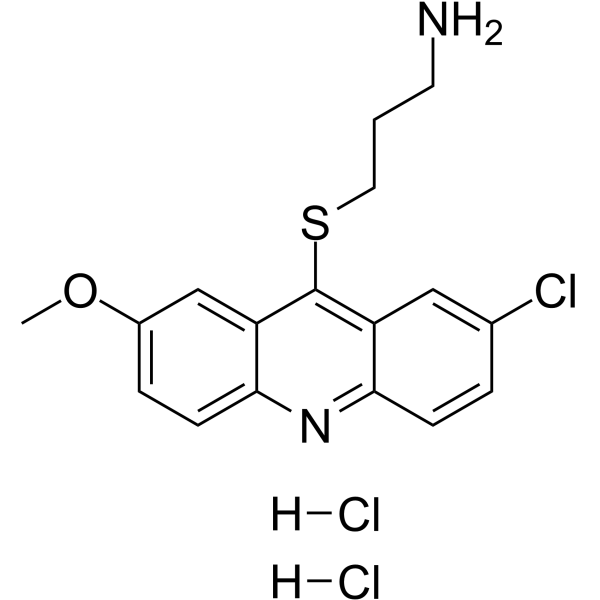
Physicochemical Properties
| Molecular Formula | C17H19CL3N2OS |
| Molecular Weight | 405.769560098648 |
| Exact Mass | 404.028 |
| CAS # | 1784281-97-5 |
| PubChem CID | 90488975 |
| Appearance | Yellow to orange solid powder |
| Hydrogen Bond Donor Count | 3 |
| Hydrogen Bond Acceptor Count | 4 |
| Rotatable Bond Count | 5 |
| Heavy Atom Count | 24 |
| Complexity | 360 |
| Defined Atom Stereocenter Count | 0 |
| SMILES | ClC1C=CC2=C(C=1)C(=C1C=C(C=CC1=N2)OC)SCCCN.Cl.Cl |
| InChi Key | WOCCOXNODBCCGK-UHFFFAOYSA-N |
| InChi Code | InChI=1S/C17H17ClN2OS.2ClH/c1-21-12-4-6-16-14(10-12)17(22-8-2-7-19)13-9-11(18)3-5-15(13)20-16;;/h3-6,9-10H,2,7-8,19H2,1H3;2*1H |
| Chemical Name | 3-(2-chloro-7-methoxyacridin-9-yl)sulfanylpropan-1-amine;dihydrochloride |
| HS Tariff Code | 2934.99.9001 |
| Storage |
Powder-20°C 3 years 4°C 2 years In solvent -80°C 6 months -20°C 1 month Note: Please store this product in a sealed and protected environment, avoid exposure to moisture. |
| Shipping Condition | Room temperature (This product is stable at ambient temperature for a few days during ordinary shipping and time spent in Customs) |
Biological Activity
| Targets | IC50: 55 nM (haspin kinase) IC50: 9.9 μM (DYRK2)[1] |
| ln Vitro | Serine/threonine kinase Haspin, also known as Haploid Germ Cell-Specific Nuclear Protein Kinase, is expressed in a number of different tissues, including the testis, bone marrow, thymus, and spleen. Furthermore, haspin is crucial during mitosis, where it phosphorylates histone H3 at Thr-3 (H3T3) in G2/early prophase, reaches its peak in prometaphase/metaphase, and then starts to decline in anaphase[1]. DYRKs are ePKs that are a part of the CMGC family. They are further classified into two classes: class 2 kinases (DYRK2, 3, and 4) and class 1 kinases (DYRK1A and 1B). During synthesis, a critical activation loop tyrosine is autophosphorylated, which is necessary for DYRK activity[1]. |
| References |
[1]. Structure-activity Relationship Study of Acridine Analogs as Haspin and DYRK2 Kinase Inhibitors. Bioorg Med Chem Lett. [2]. Structure, Roles and Inhibitors of a Mitotic Protein Kinase Haspin. Curr Med Chem. 2017;24(21):2276-2293. |
Solubility Data
| Solubility (In Vitro) | DMSO : 33.33 mg/mL (82.14 mM) |
| Solubility (In Vivo) |
Solubility in Formulation 1: ≥ 2.5 mg/mL (6.16 mM) (saturation unknown) in 10% DMSO + 40% PEG300 +5% Tween-80 + 45% Saline (add these co-solvents sequentially from left to right, and one by one), clear solution. For example, if 1 mL of working solution is to be prepared, you can add 100 μL of 25.0 mg/mL clear DMSO stock solution to 400 μL PEG300 and mix evenly; then add 50 μL Tween-80 + to the above solution and mix evenly; then add 450 μL normal saline to adjust the volume to 1 mL. Preparation of saline: Dissolve 0.9 g of sodium chloride in 100 mL ddH₂ O to obtain a clear solution. (Please use freshly prepared in vivo formulations for optimal results.) |
| Preparing Stock Solutions | 1 mg | 5 mg | 10 mg | |
| 1 mM | 2.4645 mL | 12.3223 mL | 24.6445 mL | |
| 5 mM | 0.4929 mL | 2.4645 mL | 4.9289 mL | |
| 10 mM | 0.2464 mL | 1.2322 mL | 2.4645 mL |