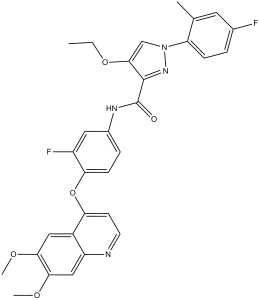
LDC1267 (LDC-1267) is a novel, highly potent and selective TAM (Tyro3, Axl and Mer) kinase inhibitor with potential antitumor activity. It has lower effects on other kinases like Met, Aurora B, Lck, Src, and CDK8, and inhibits Mer, Tyro3, and Axl with IC50s of<5 nM, 8 nM, and 29 nM, respectively. In the mouse B16F10 metastatic melanoma model, it exhibits outstanding in vivo antitumor efficacy.
Physicochemical Properties
| Molecular Formula | C30H26F2N4O5 | |
| Molecular Weight | 560.55 | |
| Exact Mass | 560.187 | |
| Elemental Analysis | C, 64.28; H, 4.68; F, 6.78; N, 10.00; O, 14.27 | |
| CAS # | 1361030-48-9 | |
| Related CAS # |
|
|
| PubChem CID | 56847486 | |
| Appearance | White to off-white solid powder | |
| Density | 1.3±0.1 g/cm3 | |
| Boiling Point | 628.4±55.0 °C at 760 mmHg | |
| Flash Point | 333.8±31.5 °C | |
| Vapour Pressure | 0.0±1.8 mmHg at 25°C | |
| Index of Refraction | 1.610 | |
| LogP | 6.48 | |
| Hydrogen Bond Donor Count | 1 | |
| Hydrogen Bond Acceptor Count | 9 | |
| Rotatable Bond Count | 9 | |
| Heavy Atom Count | 41 | |
| Complexity | 860 | |
| Defined Atom Stereocenter Count | 0 | |
| SMILES | FC1C([H])=C([H])C(=C(C([H])([H])[H])C=1[H])N1C([H])=C(C(C(N([H])C2C([H])=C([H])C(=C(C=2[H])F)OC2C([H])=C([H])N=C3C([H])=C(C(=C([H])C3=2)OC([H])([H])[H])OC([H])([H])[H])=O)=N1)OC([H])([H])C([H])([H])[H] |
|
| InChi Key | ISPBCAXOSOLFME-UHFFFAOYSA-N | |
| InChi Code | InChI=1S/C30H26F2N4O5/c1-5-40-28-16-36(23-8-6-18(31)12-17(23)2)35-29(28)30(37)34-19-7-9-25(21(32)13-19)41-24-10-11-33-22-15-27(39-4)26(38-3)14-20(22)24/h6-16H,5H2,1-4H3,(H,34,37) | |
| Chemical Name | N-[4-(6,7-dimethoxyquinolin-4-yl)oxy-3-fluorophenyl]-4-ethoxy-1-(4-fluoro-2-methylphenyl)pyrazole-3-carboxamide | |
| Synonyms |
|
|
| HS Tariff Code | 2934.99.9001 | |
| Storage |
Powder-20°C 3 years 4°C 2 years In solvent -80°C 6 months -20°C 1 month |
|
| Shipping Condition | Room temperature (This product is stable at ambient temperature for a few days during ordinary shipping and time spent in Customs) |
Biological Activity
| Targets |
Mer (IC50 <5 nM); Tyro3 (IC50 = 8 nM); Axl (IC50 = 29 nM) TAM family tyrosine kinases (Mer, Axl, Tyro3) [1] |
| ln Vitro |
LDC1267 has an IC50 of >5μM and reasonably inhibits the growth of 11 out of 95 distinct cell lines. Gas6 stimulation's inhibitory effects are eliminated by LDC1267 in NKG2D-activated NK cells.[1] Enhanced natural killer (NK) cell cytotoxicity: LDC1267 (concentration not specified) increased the killing activity of mouse primary NK cells against YAC-1 lymphoma target cells [1] - Inhibited TAM receptor signaling: LDC1267 reduced the phosphorylation level of Mer and Axl in mouse NK cells activated by apoptotic cells [1] |
| ln Vivo |
LDC1267 (20 mg/kg, i.p.) effectively increases anti-metastatic NK cell activity in B16F10 melanoma-bearing mice and rejects tumor metastases without causing significant cytotoxicity.[1] Suppressed cancer metastasis: C57BL/6 mice were inoculated with B16F10 melanoma cells (intravenous injection), followed by LDC1267 treatment. The number of lung metastatic nodules was reduced compared with vehicle control [1] - Restored NK cell function in tumor-bearing mice: LDC1267 treatment increased the production of IFN-γ by NK cells in mouse peripheral blood[1] |
| Enzyme Assay | Kinase tracer 236 and the HTRF method have established an Axl binding assay for the purpose of optimizing Axl/TAM receptor inhibitors. The basis of this assay is the binding and displacement of each glutathione S-transferase (GST)-tagged kinase utilized in the binding assay by the Alexa Fluor 647-labelled Kinase tracer 236, as demonstrated by this method. Utilizing anti-GST antibodies labeled with europium (Eu), the tracer's binding to the kinase was distinguished. A fluorescence resonance energy transfer (FRET) signal is produced when the fluorescent tracer and the Eu-labeled antibodies bind to the GST-tagged kinase simultaneously. The FRET signal is lost when the inhibitor binds to the kinase and competes with the tracer for binding. The chemical is diluted in 20 mM HEPES, pH 8.0, 1 mM DTT, 10 mM MgCl2, and 0.01% Brij35 for the assay. Next, the compound dilutions ranging from 5 nM to 10 μM are combined with the kinase of interest (5 nM final concentration), fluorescent tracer (15 nM final concentration), and LanthaScreen Eu-anti-GST antibody (2 nM final concentration) and incubated for a duration of 1 hour. An EnVision Multilabellreader 2104 is used to quantify the FRET signal. |
| Cell Assay |
CellTiterGlow reagent is used to measure the proliferation in comparison to the corresponding DMSO control after the LDC1267 is incubated for 72 hours. NK cell cytotoxicity assay: Mouse primary NK cells were isolated from spleen, pretreated with LDC1267 (concentration not specified) for 2 hours, then co-cultured with YAC-1 target cells at an effector-to-target ratio of 10:1 for 4 hours. Cytotoxicity was detected by lactate dehydrogenase (LDH) release assay [1] - Western blot assay: Mouse NK cells were lysed in RIPA buffer containing protease and phosphatase inhibitors. Equal amounts of protein (loading amount not specified) were separated by SDS-PAGE, probed with antibodies against phosphorylated Mer (p-Mer), phosphorylated Axl (p-Axl), total Mer, total Axl, and β-actin. Signals were visualized by chemiluminescence [1] |
| Animal Protocol |
Mouse B16F10 metastatic melanoma model 20 mg/kg i.p. Melanoma lung metastasis model: 6-8 week-old female C57BL/6 mice were injected intravenously with 2×10⁵ B16F10 melanoma cells. One day after tumor cell inoculation, LDC1267 was administered by oral gavage (dose: 30 mg/kg) once daily for 14 consecutive days. The drug was dissolved in 0.5% methylcellulose . Mice were euthanized on day 15, and lung tissues were collected to count metastatic nodules [1] |
| References |
[1]. The E3 ligase Cbl-b and TAM receptors regulate cancer metastasis via natural killer cells. Nature. 2014 Mar 27;507(7493):508-12. |
| Additional Infomation |
LDC1267 is a small-molecule inhibitor of TAM family tyrosine kinases, which is used as a tool compound to study the role of TAM receptors in regulating NK cell function and cancer metastasis [1] - Its mechanism of action in suppressing metastasis involves inhibiting TAM receptor signaling in NK cells, thereby reversing TAM-mediated NK cell dysfunction and enhancing anti-tumor immune surveillance [1] |
Solubility Data
| Solubility (In Vitro) |
|
|||
| Solubility (In Vivo) |
Solubility in Formulation 1: ≥ 2.5 mg/mL (4.46 mM) (saturation unknown) in 10% DMSO + 40% PEG300 + 5% Tween80 + 45% Saline (add these co-solvents sequentially from left to right, and one by one), clear solution. For example, if 1 mL of working solution is to be prepared, you can add 100 μL of 25.0 mg/mL clear DMSO stock solution to 400 μL PEG300 and mix evenly; then add 50 μL Tween-80 to the above solution and mix evenly; then add 450 μL normal saline to adjust the volume to 1 mL. Preparation of saline: Dissolve 0.9 g of sodium chloride in 100 mL ddH₂ O to obtain a clear solution. Solubility in Formulation 2: 2.5 mg/mL (4.46 mM) in 10% DMSO + 90% (20% SBE-β-CD in Saline) (add these co-solvents sequentially from left to right, and one by one), suspension solution; with ultrasonication. For example, if 1 mL of working solution is to be prepared, you can add 100 μL of 25.0 mg/mL clear DMSO stock solution to 900 μL of 20% SBE-β-CD physiological saline solution and mix evenly. Preparation of 20% SBE-β-CD in Saline (4°C,1 week): Dissolve 2 g SBE-β-CD in 10 mL saline to obtain a clear solution. Solubility in Formulation 3: ≥ 2.5 mg/mL (4.46 mM) (saturation unknown) in 10% DMSO + 90% Corn Oil (add these co-solvents sequentially from left to right, and one by one), clear solution. For example, if 1 mL of working solution is to be prepared, you can add 100 μL of 25.0 mg/mL clear DMSO stock solution to 900 μL of corn oil and mix evenly. Solubility in Formulation 4: 10 mg/mL (17.84 mM) in 50% PEG300 50% Saline (add these co-solvents sequentially from left to right, and one by one), suspension solution; with ultrasonication. Preparation of saline: Dissolve 0.9 g of sodium chloride in 100 mL ddH₂ O to obtain a clear solution. (Please use freshly prepared in vivo formulations for optimal results.) |
| Preparing Stock Solutions | 1 mg | 5 mg | 10 mg | |
| 1 mM | 1.7840 mL | 8.9198 mL | 17.8396 mL | |
| 5 mM | 0.3568 mL | 1.7840 mL | 3.5679 mL | |
| 10 mM | 0.1784 mL | 0.8920 mL | 1.7840 mL |